
Imagine running your hand over your forearm or scalp and feeling something that feels exactly like coarse sandpaper, even though the skin looks mostly normal. For many, this is the first sign of Actinic Keratoses is a precancerous skin condition caused by years of ultraviolet (UV) radiation damage, resulting in rough, scaly patches on sun-exposed areas. While they might seem like simple dry spots, these lesions are a loud warning from your skin that it has reached a tipping point of solar damage.
The real danger isn't the rough patch itself, but what it can become. If left alone, these spots can evolve into Squamous Cell Carcinoma (SCC), a type of skin cancer. In fact, about 90% of cutaneous SCCs start as untreated actinic keratoses (AKs). The good news? When caught early, they are highly treatable, and the right approach can stop cancer before it ever starts.
How to Spot Actinic Keratoses
AKs are often "more felt than seen." You might notice a gritty texture before you see any actual discoloration. These patches typically range from 1 to 2 cm in diameter and can appear in various colors: red, pink, gray, brown, or even a silvery hue. In people with darker skin tones, they often look more like traditional age spots.
Because they love the sun, you'll mostly find them in "high-traffic" UV areas. Data shows that roughly 85% appear on the face and scalp, while 70% are found on the hands and forearms. If you have a spot that is tender, thicker than 0.5 cm, or starting to ulcerate, it's time to stop guessing and see a professional immediately, as these are red flags for active cancer.
Understanding Field Cancerization
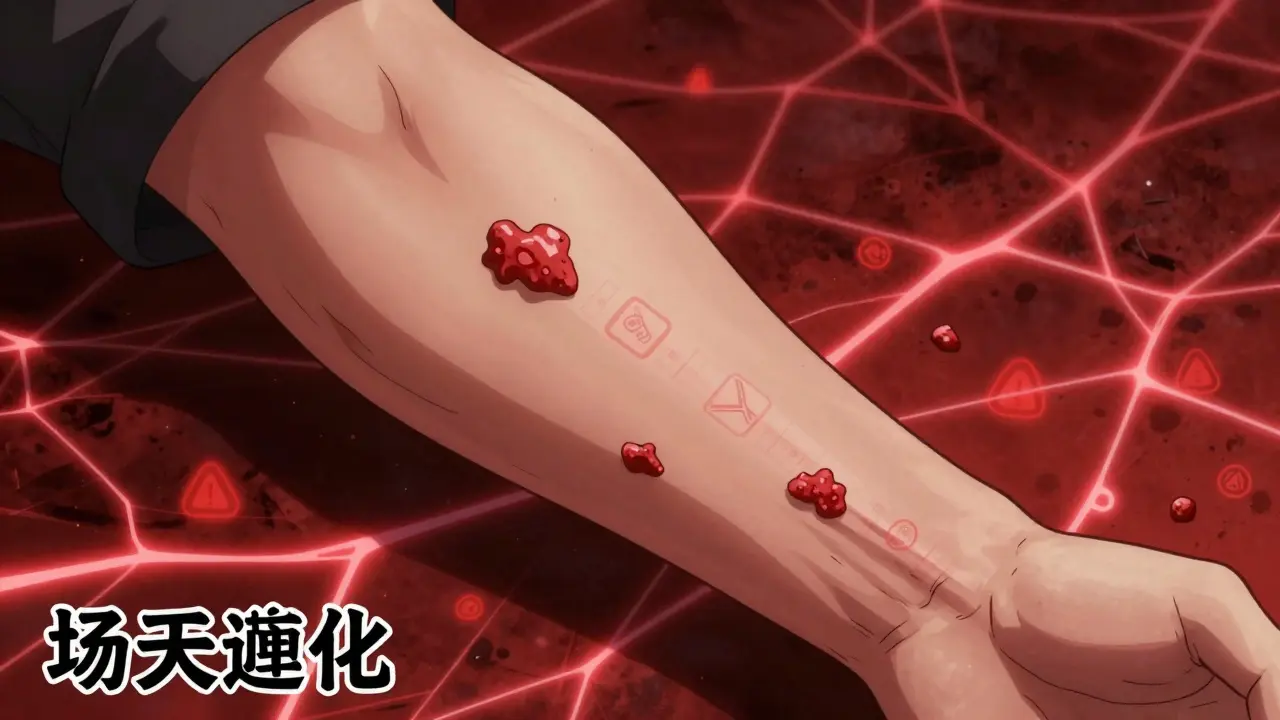
If you have one AK, you likely have more that aren't visible yet. This is a concept called Field Cancerization, where an entire area of skin has been damaged by the sun. Even if your doctor only sees three spots, the surrounding skin is often riddled with subclinical damage-essentially "invisible" precancers waiting to surface.
This is why treating just the visible bumps (spot treatment) often isn't enough. If you only freeze the visible spots, new ones will likely pop up right next to the old ones within months. To truly clear the skin, you need field treatment, which targets the entire damaged area to wipe out both visible and invisible lesions.
Comparing Field Treatment Options
Depending on how many lesions you have and where they are located, your dermatologist will suggest different paths. Some prefer a "slow and steady" approach with creams, while others opt for rapid, clinic-based procedures.
| Treatment Type | Common Agents | Duration | Pros | Cons |
|---|---|---|---|---|
| Topical Creams | Fluorouracil (5-FU), Imiquimod | 2 to 16 weeks | High clearance rates (up to 85%) | Significant redness and inflammation |
| Rapid Topicals | Tirbanibulin (Klisyri) | 5 days | Very fast application | Higher cost than generic creams |
| Light Therapy | Photodynamic Therapy (PDT) | 1 to 2 sessions | Fast clinical result | Requires clinic visit; sun sensitivity |
| Chemical Peels | Trichloroacetic Acid (TCA) | Variable | Deep exfoliation | Can be harsh on sensitive skin |
The Reality of Treatment: What to Expect
If you choose a field treatment like 5-fluorouracil, be prepared: it doesn't feel like putting on a moisturizer. Most patients experience an inflammatory phase. Your skin will likely get red, crusty, and may even feel like it's burning. This is actually a sign that the medication is working-it's selectively killing the abnormal cells.
Many people find this phase daunting. Some have to pause treatment because the redness becomes too intense. However, those who push through often report a "reset" of their skin. It's a trade-off: a few weeks of looking like a bad sunburn in exchange for preventing a future surgery to remove a carcinoma.

Preventing New Lesions
Treating current AKs is only half the battle. Since your skin has already proven it's susceptible to UV damage, prevention is non-negotiable. Simply wearing a hat isn't enough. You need a daily regimen of broad-spectrum sunscreen and protective clothing.
Evidence shows that patients who stick to a structured sun protection plan can reduce the development of new AKs by about 37% over two years. If you have fair skin, a history of severe sunburns, or a suppressed immune system, you are at a much higher risk and should schedule professional skin checks at least once a year.
Summary of Action Steps
- The Sandpaper Test: Gently run your fingers over your face, ears, and hands. If it feels rough but looks clear, see a dermatologist.
- Discuss Field vs. Spot: Ask your doctor if you are a candidate for field therapy to address subclinical damage.
- Manage Expectations: If using topicals, expect some redness. Don't panic; it's part of the healing process.
- Daily Defense: Apply SPF 30+ every morning, regardless of the weather.
Are all actinic keratoses cancerous?
No, they are not cancerous yet, but they are "precancers." This means they have the potential to turn into squamous cell carcinoma. While not every single spot will become cancer, treating them now removes that risk.
How long does it take for field treatments to work?
It depends on the method. Some newer creams like Tirbanibulin work in just 5 days. Traditional creams like Fluorouracil can take 2 to 4 weeks, while Imiquimod might require up to 16 weeks of application to achieve full clearance.
Can I treat actinic keratoses at home?
You should never attempt to treat AKs with over-the-counter acids or "home remedies." Because AKs look so similar to early skin cancer, a professional diagnosis is required to ensure you aren't accidentally treating a malignant tumor that requires surgical excision.
Why does the skin get so red during treatment?
Field treatments like 5-FU target rapidly dividing cells. Since precancerous cells divide faster than healthy ones, the drug attacks them, causing a localized inflammatory response. This redness (erythema) is a normal part of the skin's clearing process.
What is the most effective treatment?
There isn't one "best" for everyone, but 5-fluorouracil has a high complete clearance rate of 75-85%. For those who can't tolerate long cream cycles, Photodynamic Therapy (PDT) provides a fast, effective alternative in a clinical setting.
Mark Zhang
It is so important to talk about the 'invisible' damage part of this. I've known a few people who just froze one spot and then felt totally defeated when three more appeared right next to it a month later. Understanding field cancerization really helps take the frustration out of the process because you realize the skin is just catching up to the damage that was already there. Just hang in there if you're doing the creams; the redness is temporary but the peace of mind is forever.
The Charlotte Moms Blog
The table is... fine... but why leave out the actual cost of Klisyri???!!! Some of us actually care about our insurance deductibles!!!! Absolute oversight!!!!
Hudson Nascimento Santos
There is a certain irony in how we treat the skin. We spend decades ignoring the sun's slow erosion of our biology, only to spend weeks of intense pain trying to 'reset' the clock. It makes one wonder if the inflammation is a physical manifestation of the body finally protesting years of neglect. The trade-off between temporary aesthetic distress and long-term survival is a classic utilitarian calculation.
Rob Newton
Sunscreen is a scam. Just stay inside.
Vicki Marinker
I find it quite tiresome that we are expected to just 'push through' the burning sensation of 5-FU as if it were some sort of rite of passage. The description of it as a 'reset' is a rather optimistic euphemism for looking like a raw piece of meat for three weeks. I personally cannot imagine the mental toll of maintaining a professional appearance while one's face is actively peeling off in sheets. It is an exhausting prospect that the guide glosses over with a simple 'don't panic'.
Lawrence Rimmer
Exactly. The whole 'no pain no gain' mentality in dermatology is just a way to make us feel better about the fact that the medicine is essentially caustic. We've romanticized the struggle of the 'inflammatory phase' to justify the lack of better-feeling alternatives. It's a basic lack of innovation in drug delivery.
sophia alex
Ugh, typical! Only the most elite clinics in the US even do the high-end PDT properly 🙄. If you're getting the budget version, don't even bother. Just get the best or don't even try! 💅✨
HARSH GUSANI
My doctor in India said the same thing about the sunscreen! 🇮🇳 Best advice ever! Just follow the rules and you are safe! 💪🔥
Sakshi Mahant
It is wonderful to see these options laid out so clearly for everyone. Many of us in warmer climates deal with this constantly, and having a guide that emphasizes professional diagnosis over home remedies is truly helpful for the community. Peace and health to all who are navigating this journey.
Hope Azzaratta-Rubyhawk
YOU ABSOLUTELY MUST FOLLOW THE SPF GUIDELINES! There is zero excuse for skipping sunscreen in this day and age! If you don't take your skin seriously now, you are just inviting a medical crisis later! Be aggressive with your prevention or suffer the consequences!
Dipankar Das
I STRONGLY URGE ALL READERS TO ADHERE TO THE ANNUAL SKIN CHECK SCHEDULE! It is an absolute imperative that you do not neglect your health for the sake of convenience! YOU MUST BE PROACTIVE AND RIGOROUS IN YOUR APPROACH TO SURVEILLANCE TO ENSURE TOTAL CLEARANCE!