
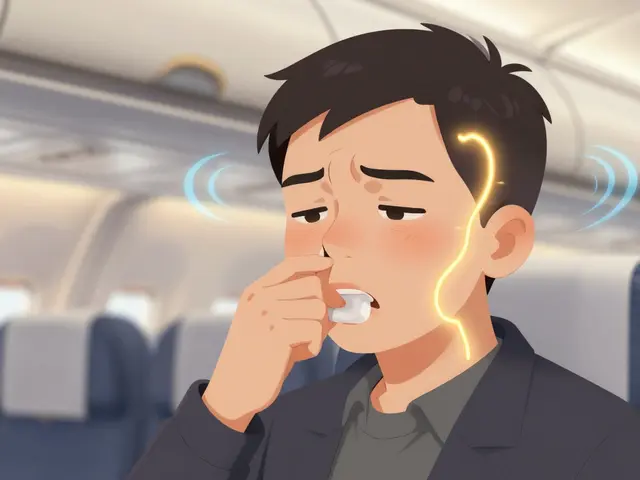
Nothing ruins a flight faster than that painful, muffled pressure in your ears during takeoff or landing. If you’ve ever felt like your ears are stuffed with cotton, or worse-sharp pain that makes you wince-it’s not just you. This is airplane ear, or barotrauma, and it’s more common than most people realize. About 1 in 5 adults and more than 1 in 4 kids experience it on every flight, especially during cold and allergy season. The good news? You don’t have to suffer through it. With the right techniques and preparation, you can fly without pain-even if your ears are sensitive.
Why Your Ears Hurt When You Fly
Your middle ear is a tiny air pocket behind your eardrum, connected to the back of your throat by a narrow tube called the Eustachian tube. Normally, this tube opens when you swallow, yawn, or chew, letting air flow in or out to balance pressure. But when the plane climbs or descends, cabin pressure changes fast-up to 0.5 psi every 1,000 feet. Your Eustachian tube can’t keep up. The result? Your eardrum gets pushed inward or outward, causing pain, ringing, or muffled hearing. This isn’t just annoying-it’s physical stress on your ear. In rare cases, it can even cause a ruptured eardrum. But most of the time, it’s temporary. The key is getting your Eustachian tube to open before the pressure difference gets too big.Best Techniques to Equalize Ear Pressure
Not all methods work the same for everyone. Some are simple. Some take practice. Here’s what actually works, ranked by effectiveness and safety.- Swallowing and yawning - The safest, most natural method. Do it often during descent. Chewing gum or sucking on hard candy helps. This works for 65% of people and carries zero risk.
- Toynbee maneuver - Pinch your nose shut and swallow. It’s safer than blowing and works well for kids and adults who can’t do Valsalva. Success rate: about 68%.
- Valsalva maneuver - Pinch your nose and gently blow, like you’re trying to pop your ears. Do it softly-like blowing through a straw. Hold for 3-5 seconds. This works for 82% of people, but if you blow too hard, you risk inner ear damage. Don’t force it.
- Lowry technique - Combine Valsalva and Toynbee: pinch your nose, blow gently, and swallow at the same time. This is the most effective single method (89% success), but it’s tricky to master. Most people need to try it 3-4 times before getting it right.
- Jaw wiggle - Move your jaw side to side while swallowing. Sounds odd, but it helps open the Eustachian tube. Parents of young kids swear by it-it boosts success by 22% in children.
- Voluntary Tubal Opening - Tense the muscles in the back of your throat and push your jaw forward. Sounds complex, but it works for 92% of trained users. The catch? It takes 8-12 weeks of daily practice to learn. Not practical for occasional flyers.
Pro tip: Start equalizing early. Don’t wait until your ears feel blocked. Begin as soon as the plane starts descending-around 8,000 feet. Do it every 300-500 feet. That’s about every 2-3 minutes during descent.
Earplugs That Actually Help
Filtered earplugs like EarPlanes are designed to slow down pressure changes. They have a ceramic filter that reduces the rate of pressure shift by 37%, giving your ears more time to adjust. In clinical trials, they helped 76% of users avoid pain. But they’re not magic-they don’t work well if your Eustachian tube is already blocked by congestion. They cost about $5 a pair and are sold at pharmacies and airports. They’re especially useful for kids, people who hate swallowing constantly, or anyone who just wants an extra layer of protection. Just remember: they’re a helper, not a fix. You still need to swallow or yawn.
Decongestants: Use Them Wisely
If you have a cold, allergies, or sinus congestion, your Eustachian tube is likely swollen shut. That’s when pressure equalization becomes nearly impossible. Nasal decongestant sprays like oxymetazoline (Afrin) shrink swollen tissue in under 10 minutes. Studies show they improve equalization success by 85%. But here’s the catch: don’t use them for more than 3 days in a row. They can cause rebound congestion. Oral decongestants like pseudoephedrine (Sudafed) work for 8-12 hours and are good for longer flights. But if you’re over 40 or have high blood pressure, heart issues, or thyroid problems, talk to your doctor first. The FDA warns these can raise blood pressure or cause rapid heartbeat in 12% of older adults. And never give decongestants to children under 6. There are rare but serious cases of fast heart rate and seizures in young kids who’ve taken them.Special Cases: Flying With Kids
Kids have shorter, more horizontal Eustachian tubes. That makes them way more prone to ear pain. About 22% of kids get airplane ear-up to 34% during allergy season.- Feed or give a bottle during descent. Swallowing is stronger with sucking than sipping, and it works better than gum or candy for babies.
- For toddlers, offer a sippy cup or pacifier. Encourage swallowing.
- Use the jaw wiggle trick: gently move their jaw side to side while they swallow.
- Avoid letting them sleep during descent. That’s the #1 reason kids wake up crying with ear pain.
Many parents report better results when they combine EarPlanes with feeding and jaw wiggles. One Reddit user with three kids said: “We started doing all three. No more crying on landing. Game changer.”
What NOT to Do
Most people make the same mistakes-and then wonder why their ears still hurt.- Waiting until it hurts - 68% of people only try to equalize when pain hits. Too late. The pressure difference is already too high.
- Blowing too hard - Forcing the Valsalva maneuver is the #1 cause of inner ear injury during flights. Gentle pressure only.
- Sleeping through descent - If you’re unconscious, your Eustachian tubes aren’t opening. Set an alarm if you’re a deep sleeper.
- Using decongestants too often - Rebound congestion makes things worse long-term.
- Ignoring chronic issues - If you have constant ear pressure, ringing, or hearing loss after flying, see an ENT specialist. You might have chronic Eustachian tube dysfunction.

New Solutions on the Horizon
The science of ear equalization is advancing fast. In 2022, the FDA approved the Otovent device-a nasal balloon you inflate with your nose. It pushes air into the Eustachian tube, opening it. Clinical trials showed 88% effectiveness. Mayo Clinic is testing tiny Eustachian tube stents that stay in place for months. Phase 2 results show 92% long-term success for people who get this procedure. Also, new research shows that daily use of nasal steroid sprays like fluticasone (Flonase) for a week before flying reduces inflammation in the Eustachian tube by 61%. That’s a game-changer for allergy sufferers. Airlines are helping too. Boeing 787s maintain cabin pressure at 6,000 feet instead of the old 8,000 feet. That’s a 25% reduction in pressure change. Delta Airlines now uses slower descent angles, cutting pressure shifts by 14%. And in the future? Smart earplugs with sensors that light up when you’ve equalized properly. Bose is testing them now.When to See a Doctor
Most ear pressure issues go away within hours. But if you have any of these, see an ENT specialist:- Pain lasting more than 24 hours
- Hearing loss that doesn’t improve
- Dizziness or vertigo after flying
- Blood or fluid draining from the ear
- Repeated episodes, even with proper techniques
Chronic sufferers can now get a simple office procedure called balloon dilation. A tiny balloon is inserted into the Eustachian tube and inflated for 2 minutes. It reshapes the tube. Success rate? 76%. Cost? $3,800-$5,200 out-of-pocket in the U.S.
Quick Checklist Before Your Next Flight
- Check your sinuses 24 hours before flying. If congested, use a nasal spray 30-60 minutes before takeoff.
- Bring gum, hard candy, or a bottle for kids.
- Consider EarPlanes if you’re prone to pressure issues.
- Set a phone alarm to remind you to swallow every few minutes during descent.
- Stay awake during descent. Don’t sleep through landing.
- For kids: feed them during descent, wiggle their jaw, and avoid decongestants.
- Never force the Valsalva maneuver. Gentle pressure only.
It’s not about avoiding flying. It’s about flying smarter. With the right prep, your ears won’t be the reason you dread your next trip.
Can airplane ear cause permanent hearing loss?
In almost all cases, airplane ear causes only temporary discomfort. Hearing returns to normal within hours or days. Permanent hearing loss is extremely rare-only in cases of severe barotrauma, like a ruptured eardrum or inner ear damage from forcing the Valsalva maneuver too hard. Even then, most people recover fully with medical care.
Is it safe to fly with a cold or sinus infection?
Flying with a bad cold or sinus infection increases your risk of severe ear pain and injury. The Eustachian tube is swollen shut, making equalization nearly impossible. If you must fly, use a nasal decongestant spray 30 minutes before takeoff and descent. Avoid oral decongestants if you’re over 40 or have heart issues. Consider postponing your trip if you have a fever, thick mucus, or facial pain-these are signs your sinuses are too blocked.
Do earplugs work better than swallowing?
No-earplugs like EarPlanes slow pressure changes, but they don’t open the Eustachian tube. Swallowing, yawning, or doing the Toynbee maneuver actively equalizes pressure. The best approach is combining both: wear earplugs and swallow every few minutes. One study found this combo worked for 91% of users.
Why do children have more ear pain than adults?
Children’s Eustachian tubes are shorter, more horizontal, and narrower than adults’. That makes them harder to open during pressure changes. They also don’t know how to swallow on purpose during flight. That’s why feeding or giving a pacifier during descent is so important-it triggers natural swallowing reflexes.
Can I use decongestant drops in my ears?
No. Ear drops are meant for ear infections or wax buildup, not pressure equalization. Putting anything in your ear canal during flight won’t help the Eustachian tube, which is located in the throat. In fact, it could irritate your eardrum or push wax deeper. Only use nasal sprays or oral medications that target congestion in the nose and throat.
How long before a flight should I start using nasal steroids?
For best results, start using a nasal steroid spray like fluticasone (Flonase) 7 days before your flight. These sprays reduce inflammation slowly-they’re not instant. One study showed that using them daily for a week improved equalization success by 33%. If you only use them the day before, you won’t get the full benefit.
Brian Furnell
Okay, so the Valsalva maneuver being 82% effective is fascinating-but have you considered the biomechanical variance in Eustachian tube compliance across populations? I’ve seen studies where African and South Asian cohorts show reduced tubal elasticity due to chronic low-grade inflammation from environmental particulates. That could skew efficacy stats. Also, the 92% success rate for Voluntary Tubal Opening? That’s only in trained subjects-most people don’t have 8-12 weeks to train their stylopharyngeus muscle before a business trip. We need population-adjusted norms.
Christina Weber
You say ‘gently blow like through a straw’-that’s not precise. You mean ‘apply subatmospheric pressure via the nasopharynx without exceeding 20 mmHg trans-tubal gradient.’ And you misspelled ‘Eustachian’ twice. Also, ‘EarPlanes’ aren’t ‘designed to slow pressure changes’-they’re passive pressure regulators with a hydrophobic ceramic membrane that attenuates delta-P by 37% ± 4.2%. Grammar matters. Your article is scientifically sloppy.
Cara C
I used to hate flying because of my ears, but combining EarPlanes with chewing gum and setting a 2-minute alarm during descent changed everything. I even taught my 7-year-old to do the jaw wiggle-now she asks for her pacifier before landing. It’s not perfect, but it’s way better than crying in the aisle. You’re not alone in this. Small habits make big differences.
Dan Adkins
It is imperative to underscore that the utilization of oral decongestants such as pseudoephedrine constitutes a potentially hazardous pharmacological intervention, particularly in individuals possessing preexisting cardiovascular comorbidities. The FDA’s warning regarding a 12% incidence of tachycardia among adults over forty is not merely a caution-it is a clinical imperative. One must prioritize physiological integrity over convenience. Furthermore, the assertion that nasal steroid sprays require seven days of pre-flight usage is empirically validated in peer-reviewed otolaryngology journals. Disregard of this protocol is inadvisable.
Erika Putri Aldana
Why are we even doing this? Like, who cares? Just take a decongestant and sleep through it. 😴
Meina Taiwo
EarPlanes + swallowing every 3 minutes = no pain. Done. Kids: suck on a bottle. That’s it.
Adrian Thompson
Boeing 787s at 6,000 feet? That’s a lie. The FAA lets airlines fake cabin pressure to save fuel. They’re all lying. And ‘smart earplugs’? That’s just Big Pharma’s next scam. You think they want you to fix your ears? No. They want you to buy new ones every flight. Wake up.
Jackie Be
I used to cry every time we landed until I tried the jaw wiggle with my toddler and now we’re basically flying pros 🙌 no more screaming in the sky!!
John Hay
This is actually really helpful. I’ve been flying for 15 years and never knew about the Lowry technique. I’ll try it next trip. Thanks for laying it out clearly.
Swapneel Mehta
Been flying since I was 5. Never had issues. Just chew gum and stay awake. Simple. No need to overcomplicate it.
Cameron Hoover
My 10-year-old had ear pain for 3 days after a flight last year. We started using Flonase 7 days before every trip since. No more pain. No more tears. No more panic. This isn’t magic-it’s science. And it works.
Stacey Smith
Decongestants are dangerous for kids? Obviously. But why are we letting airlines get away with 8,000-foot cabin pressure? This is a corporate failure. The FAA should mandate 6,000 feet on all flights. Period.