
Azithromycin Liver Risk Assessor
Assessment Result:
Symptoms to Watch For (1-3 weeks post-treatment):
- Jaundice: Yellowing of skin/eyes (87% of cases)
- Fatigue: Unexplained tiredness (79% of cases)
- Pruritus: Intense itching without rash (63% of cases)
- Abdominal Pain: Upper right quadrant discomfort (52% of cases)
Note: 89% of cases develop symptoms after the antibiotic course is completed.
Imagine finishing a five-day course of azithromycin for a stubborn sinus infection. You feel better, the fever is gone, and you go back to your normal routine. Then, two weeks later, your eyes turn yellow. Your skin itches uncontrollably. You’re exhausted. This isn’t just a lingering bug; it’s a warning sign that your liver might be struggling with the medication you just took.
Azithromycin is one of the most prescribed antibiotics in the world. It’s convenient, effective, and generally safe. But behind its reputation as a 'gentle' antibiotic lies a serious risk: hepatotoxicity, or liver damage. While rare, this side effect can be severe, sometimes leading to permanent liver injury or even requiring a transplant. If you’ve been prescribed this drug, especially if you have existing liver issues, understanding these risks is crucial.
The Hidden Risk of a Common Antibiotic
Azithromycin is a semisynthetic macrolide antibiotic widely used for respiratory, skin, and sexually transmitted infections. Developed by Pliva (now part of TEVA Pharmaceuticals) and approved by the FDA in 1991, it became a household name because it works well and requires only a short treatment course-often just three to five days. In the United States alone, it accounts for roughly 12.7 million outpatient prescriptions annually.
Because it is so commonly used, even a small percentage of adverse events adds up to a significant number of cases. According to data from the National Institute of Diabetes and Digestive and Kidney Diseases (NIDDK), azithromycin has risen to become one of the top ten causes of drug-induced liver injury (DILI) in large case series. The FDA itself updated the drug’s label in 2015 and again in 2018 to strengthen warnings about this potential liver damage. So, while the drug remains a first-line treatment for many conditions, the medical community is increasingly aware that it carries a heavier toll on the liver than previously thought.
How Does Azithromycin Damage the Liver?
Unlike some medications that cause predictable dose-dependent damage, azithromycin-induced liver injury is often idiosyncratic. This means it happens unpredictably in certain individuals, likely due to a hypersensitivity reaction rather than direct toxicity. Dr. Jayant A. Talwalkar from the Mayo Clinic notes that the rapid onset of symptoms suggests an immune-mediated response.
However, science is still uncovering the exact mechanisms. A controversial 2024 study published in *Immunopharmacology and Immunotoxicology* proposed a different angle: azithromycin might suppress Nrf2 activation, a key cellular defense against oxidative stress. This suppression could lead to increased reactive oxygen species (ROS) production, directly damaging liver cells. Whether it’s an allergic-type reaction or direct cellular toxicity, the result is the same: inflammation and injury to the liver tissue.
| Antibiotic | Liver Injury Incidence | Primary Injury Pattern | Key Differentiator |
|---|---|---|---|
| Azithromycin | 1 in 2,500 to 1 in 65,000 | Cholestatic (78%) or Mixed | Widely used; low cardiac risk |
| Erythromycin | ~1 in 1,000 | Cholestatic | Higher incidence; QT prolongation risk |
| Clarithromycin | ~1 in 10,000 | Cholestatic | Lower incidence than erythromycin |
Compared to other macrolides like erythromycin, azithromycin has a lower individual risk of causing liver injury. However, because it is prescribed far more frequently, it appears more often in DILI statistics. Erythromycin, for instance, has a higher incidence rate but is less commonly prescribed due to its interaction with heart rhythms (QT interval prolongation). Clarithromycin sits somewhere in the middle but also carries significant drug-interaction risks.
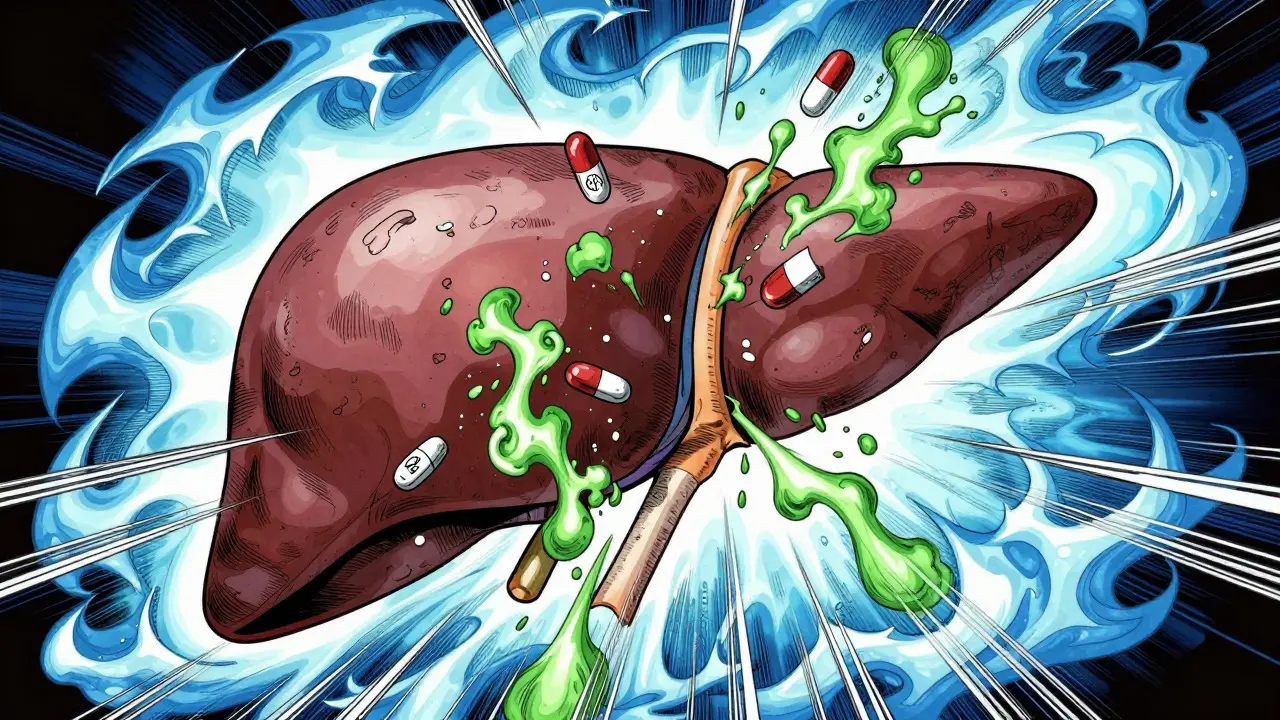
Symptoms and Timeline: What to Watch For
The tricky part about azithromycin-induced liver injury is the timing. Symptoms rarely appear while you are taking the pills. In fact, 89% of cases develop after the antibiotic course is completed. The typical latency period is one to three weeks after starting treatment, with many patients noticing symptoms about nine days after their last dose.
You should watch for these specific signs:
- Jaundice: Yellowing of the skin and whites of the eyes (seen in 87% of cases).
- Fatigue: Unexplained, profound tiredness (79% of cases).
- Pruritus: Intense itching without a rash (63% of cases).
- Abdominal Pain: Discomfort in the upper right quadrant where the liver is located (52% of cases).
If you experience any of these symptoms within a month of finishing azithromycin, do not assume it’s a viral illness. Contact your doctor immediately. Early recognition is critical. A study by Chalasani et al. found that delayed diagnosis (more than 14 days after symptom onset) correlated with a much longer recovery time-median 18 weeks compared to just 8 weeks for those diagnosed early.
Who Is at Higher Risk?
While anyone can potentially develop this reaction, certain groups face higher risks. Elderly patients, particularly those over 65, represent 38% of severe cases reported to the FDA. This may be due to age-related changes in liver metabolism or the presence of other medications that interact with azithromycin.
Patient history matters too. If you have pre-existing liver disease, such as hepatitis or cirrhosis, your liver is already compromised. The European Medicines Agency recommends avoiding azithromycin in patients with severe liver impairment. Additionally, combining azithromycin with other hepatotoxic drugs can amplify the risk. For example, a February 2023 FDA safety announcement highlighted a dangerous interaction between azithromycin and atovaquone (used for babesiosis), which can exacerbate liver injury.

Diagnosis and Management
If your doctor suspects azithromycin-induced liver injury, they will order blood tests to check liver enzymes. Specifically, they look for elevated levels of:
- Alkaline Phosphatase (ALP): Often rises significantly (median peak 4.2x upper limit of normal).
- Gamma-Glutamyl Transferase (GGT): Another marker of bile duct stress.
- Bilirubin: High levels cause jaundice (median peak 5.3 mg/dL).
- ALT/AST: Markers of liver cell damage.
The pattern of injury is predominantly cholestatic, meaning it affects the flow of bile rather than just destroying liver cells. However, about 22% of cases present with hepatocellular injury. In severe cases, histological examination may reveal bile duct loss, a condition known as vanishing bile duct syndrome, which can be irreversible.
Management primarily involves stopping the drug immediately. According to American Association for the Study of Liver Diseases (AASLD) guidelines, if serum ALT exceeds 3 times the upper limit of normal (ULN) or total bilirubin exceeds 2x ULN, the drug must be discontinued. Most patients (92%) recover fully within four to eight weeks after stopping the medication. However, in rare instances (0.7% of cases), the injury progresses to chronic liver failure, necessitating a liver transplant.
Alternatives and Prevention
Given these risks, is there a safer alternative? For many common infections, yes. Doxycycline, for instance, has a significantly lower risk of hepatotoxicity and is equally effective for many respiratory and skin infections. Newer antibiotics like tedizolid have shown no significant hepatotoxicity in phase 3 trials. However, azithromycin remains unique in its ability to treat specific pathogens like chlamydia with high efficacy and low resistance rates.
To protect yourself:
- Inform your doctor: Always mention any history of liver disease or previous reactions to antibiotics.
- Ask about alternatives: If you are being prescribed azithromycin for a mild infection, ask if doxycycline or another antibiotic is appropriate.
- Monitor for symptoms: Keep an eye out for jaundice, itching, or unusual fatigue for up to three weeks after finishing the course.
- Avoid alcohol: Alcohol puts additional stress on the liver. Avoid it during and shortly after antibiotic therapy.
The gap between awareness and practice is wide. A Medscape poll found that 78% of primary care physicians rarely consider hepatotoxicity when prescribing azithromycin, despite being aware of the risk. This makes patient advocacy essential. You are your own best health advocate.
How common is liver damage from azithromycin?
It is relatively rare but significant due to the drug's popularity. Clinically apparent liver injury occurs in approximately 1 in 2,500 to 1 in 65,000 prescriptions. Asymptomatic enzyme elevations happen in 1-2% of short-term users and up to 5-7% of those on long-term therapy.
When do symptoms of azithromycin liver injury appear?
Symptoms typically appear 1 to 3 weeks after starting treatment. Crucially, 89% of cases develop symptoms after the antibiotic course is completed, often around 9 days post-treatment.
Is azithromycin worse for the liver than other antibiotics?
It has a lower individual risk than erythromycin but a higher incidence than clarithromycin. Compared to older drugs like isoniazid (which causes liver issues in 10-20% of users), azithromycin is much safer. However, among commonly prescribed outpatient antibiotics, it is now a leading cause of drug-induced liver injury.
Can azithromycin cause permanent liver damage?
In most cases (92%), the liver recovers fully within 4-8 weeks of stopping the drug. However, in rare cases (0.7%), it can progress to chronic liver failure or vanishing bile duct syndrome, which may require a liver transplant.
What should I do if I suspect liver injury after taking azithromycin?
Contact your healthcare provider immediately. Do not wait. Early diagnosis leads to faster recovery. Your doctor will likely order blood tests to check liver enzymes (ALT, AST, ALP, Bilirubin) and may refer you to a hepatologist if levels are significantly elevated.

Write a comment