
Most people think heart disease shows up with chest pain or shortness of breath. But by then, it’s often too late. The truth? Your arteries can be clogged for years before you feel a thing. That’s where a simple coronary calcium score comes in - a quick, non-invasive CT scan that tells you exactly how much plaque is building up in your heart’s arteries. No symptoms needed. No stress test. Just a 10-second scan that might save your life.
What Exactly Is a Coronary Calcium Score?
A coronary calcium score, also called a CAC score, is a measurement of calcified plaque in your coronary arteries. It’s not a guess. It’s not an estimate. It’s a real count of hard, chalky deposits - the kind your body makes when cholesterol and other fats build up over time. These deposits don’t cause symptoms, but they’re a dead giveaway that atherosclerosis is happening. And that’s dangerous.
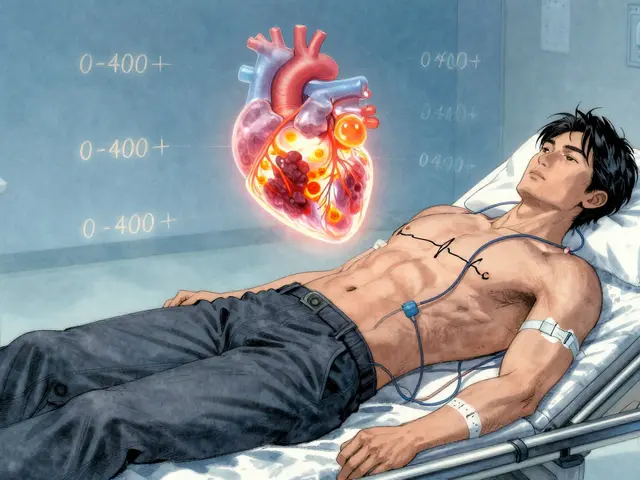
The scan uses a special type of CT machine, usually a multidetector CT (MDCT), to take dozens of images of your heart in less than a minute. You lie on a table, EKG leads are stuck to your chest to sync the scan with your heartbeat, and you hold your breath for 10 to 15 seconds. No needles. No dye. No fasting, except you should skip caffeine and smoking for a few hours beforehand. That’s it.
The result? A number. A single number that tells you how much calcified plaque is in your arteries. The scale starts at zero. Zero means no detectable calcium - a rare and reassuring result. Anything above zero? That’s plaque. And it means your risk for a heart attack is higher than most people think.
How Is the Score Calculated?
The score isn’t just a guess. It’s based on the Agatston Score, developed in 1990 by Dr. Arthur Agatston. The machine doesn’t just count calcium spots - it measures their size and how dense they are. Each spot gets a score between 1 and 4, depending on how bright it looks on the scan (that’s the Hounsfield unit density). Then it multiplies the area of each spot by its density. All those numbers add up.
But here’s the key: your score doesn’t mean much on its own. A score of 150 means something very different for a 45-year-old woman than for a 65-year-old man. That’s why modern reports include a percentile - your score compared to others your age, sex, and ethnicity. This is called the MESA Percentile, from the Multi-Ethnic Study of Atherosclerosis. It’s the real benchmark.
Here’s what the numbers usually mean:
- 0 - No detectable calcium. Low risk.
- 1-10 - Minimal plaque. Still low risk, but not zero.
- 11-100 - Mild plaque. Some narrowing. Risk is higher than average.
- 101-400 - Moderate plaque. More than 75% of people with this score have significant artery blockage. Risk of heart attack jumps.
- 401+ - Extensive plaque. High risk. Often means more than 70% blockage in one or more arteries.
These aren’t just guidelines. The American College of Cardiology and American Heart Association say a score above the 75th percentile for your age group should trigger stronger treatment - like statins - even if your cholesterol looks fine.
Why This Test Beats Traditional Risk Tools
Most doctors use risk calculators like the Pooled Cohort Equations. They ask about your age, blood pressure, cholesterol, smoking, and diabetes. But here’s the problem: they’re wrong about 1 in 3 people.
Imagine someone with normal cholesterol, no diabetes, and a healthy weight. Their calculator says they’re low risk. But they’ve been eating processed food for 20 years. Their arteries are clogged. The calculator misses it. A coronary calcium score doesn’t. It sees the plaque - even if everything else looks good.
Studies show CAC scoring reclassifies risk in 40-50% of people who were labeled as “intermediate risk” by traditional tools. That means people who were told to just “watch their diet” suddenly get a clear signal: you need statins. Or you need to quit smoking. Or you need to move more.
One 2021 study in JAMA Internal Medicine found that CAC scoring led to statin therapy in 35% of patients who would’ve been left untreated otherwise. That’s not a small number. That’s life-changing.

What the Scan Can’t Tell You
Here’s the catch: this scan only sees calcified plaque. It misses the soft, fatty kind - the kind that’s more likely to rupture and cause a heart attack. About 20-30% of total plaque is non-calcified. That’s why a zero score doesn’t mean zero risk. It just means no hard calcium yet.
That’s also why a coronary CT angiography (CCTA) exists - a more detailed scan that uses contrast dye to see both soft and hard plaque. But it’s more expensive, exposes you to more radiation, and isn’t needed for most people. The calcium score is the first step. If it’s high, then CCTA might be next.
Another limitation: people with kidney disease often have heavy calcium deposits from their condition, not from heart disease. Their score can be misleadingly high. That’s why doctors always look at your full picture - not just the number.
Who Should Get Tested?
This isn’t for everyone. It’s not a screening tool for healthy 25-year-olds. It’s for people in the gray zone - those who aren’t clearly high risk, but aren’t clearly low risk either.
The guidelines say this test makes the most sense for:
- Men aged 40-75
- Women aged 50-75
- With at least one risk factor: high LDL, low HDL, smoking, high blood pressure, family history of early heart disease
- Who are classified as intermediate risk (7.5-20% chance of heart disease in 10 years)
Even better: if your LDL cholesterol is 160 mg/dL or higher, the 2023 Society of Cardiovascular CT guidelines say you should get a scan - even if you don’t have other risk factors. That’s a big shift. It means cholesterol alone might be enough to trigger the test.
And if you have a strong family history of early heart disease - a parent who had a heart attack before age 55 - this test is almost essential. Genetics can hide in plain sight. The scan doesn’t.

What Happens After the Scan?
The results come back in 1-2 days. Your doctor will compare your score to your age, sex, and ethnicity. Then they’ll decide what to do next.
If your score is low (below 100, especially below the 25th percentile), you’re likely fine. Keep eating well, stay active, and come back in 5 years.
If your score is 100-300, that’s a red flag. You’re in the moderate range. Doctors now recommend moderate-intensity statins - even if your cholesterol is normal. Lifestyle changes are no longer optional. You need to quit smoking, cut sugar, and move daily.
If your score is over 300? High-intensity statins. Period. And you need to be monitored closely. That’s not just a number - it’s a warning that your arteries are already damaged.
One Reddit user, u/CardioCurious, shared his story: “My score was 142 at age 52 - higher than 78% of men my age. It scared me into finally quitting smoking and starting statins, which my doctor had recommended for years but I ignored.” That’s the power of this test. It turns abstract risk into a concrete number. And numbers change behavior.
Cost, Coverage, and Access
Here’s the frustrating part: insurance doesn’t always cover it. Medicare doesn’t pay for it at all. In the U.S., about 41% of privately insured patients still pay out of pocket - between $100 and $300. That’s steep, but it’s a fraction of the cost of a heart attack.
Some employers and wellness programs now offer it as a preventive benefit. Independent imaging centers often charge less than hospitals. If your doctor recommends it, ask if your local imaging center has a cash rate. Many do.
The technology is becoming more common. In 2022, over 2.1 million scans were done in the U.S. - up 17% from the year before. AI is making the scans faster and safer. New algorithms cut radiation by 40% without losing detail. That’s huge for people who need repeat scans.
Why This Matters Now
Heart disease still kills 1 in 5 people in the U.S. and the U.K. Most of those deaths happen in people who had no warning. The coronary calcium score changes that. It finds the silent disease before it finds you.
It’s not perfect. It’s not for everyone. But for the millions of people stuck in the middle - not sick, not healthy - it’s one of the clearest signals medicine has. A score of zero gives peace of mind. A score of 400 gives a wake-up call.
If you’re between 40 and 75, have high cholesterol, smoke, or have a family history of early heart disease - ask your doctor about the scan. Don’t wait for chest pain. Don’t wait for a stroke. Let the scan do the work before your body does.
Can a coronary calcium score predict a heart attack?
Yes - more accurately than most other tools. A high calcium score is one of the strongest predictors of future heart attack or death from heart disease. Studies show it improves risk prediction by 10-15% compared to traditional methods. A score over 100 doubles your risk. A score over 400 increases it by 5-10 times.
Is the radiation from the scan dangerous?
The radiation dose is low - between 1 and 3 millisieverts (mSv), about the same as a mammogram or a round-trip flight from London to New York. That’s far below the level linked to increased cancer risk. New AI-powered scanners cut this even further. The benefit of catching heart disease early far outweighs the tiny radiation risk.
Do I need to prepare for the scan?
Yes, but it’s simple. Avoid caffeine and smoking for 4 hours before the scan - they can raise your heart rate and blur the images. Wear comfortable clothes without metal zippers or buttons over your chest. No fasting, no injections, no special diet. Just show up, lie still for 10 seconds, and breathe when told.
If my score is zero, am I completely safe from heart disease?
No. A zero score means no calcified plaque - but it doesn’t rule out soft, non-calcified plaque or inflammation. It also doesn’t protect you from future damage. If you smoke, have high cholesterol, or are sedentary, you can still develop plaque later. A zero score is good news, but not a free pass to ignore healthy habits.
Why don’t more doctors offer this test?
Two main reasons: insurance coverage is patchy, and many doctors aren’t trained to interpret or act on the results. Only 15% of eligible patients get the scan, even though guidelines strongly support it. That’s changing. More cardiologists now use it routinely, especially in places with better insurance coverage. If your doctor says it’s not necessary, ask for a second opinion - especially if you have risk factors.
John Watts
Just got my CAC score back last week - 87 at 48. Was told I’m ‘low risk’ because my cholesterol is fine. Turns out, my arteries are screaming. I started statins, cut sugar cold turkey, and started walking 6 miles a day. No more ‘I’ll start Monday.’ This scan didn’t just give me a number - it gave me a second chance.
Stop waiting for chest pain. Your arteries don’t care how fit you look on Instagram.
Camille Hall
I’m a nurse in cardiac rehab, and I’ve seen too many people come in after a heart attack saying, ‘But I felt fine.’ This test is the silent hero of preventive medicine. If you’re over 40 and have any risk factors - even just one - get it done. It’s cheaper than a monthly coffee subscription and way more life-saving.
Ritteka Goyal
in india we dont have this test in most hospitals and its so expensive like 5000 rupees but my uncle got it done in bangalore and his score was 312! he was shocked because he thought he was healthy cause he walks 10k steps daily and eats ghee roti but turns out his arteries are full of calcium like a chalkboard!
now he takes atorvastatin and i told my whole family to get tested. if you dont know your score you are gambling with your heart. my cousin died at 49 from a silent heart attack. dont be him.
Monica Warnick
Okay but… what if you’re one of those people who eats kale, does yoga, and still has a score of 450? Like… is it just bad luck? Or is this whole thing just a scam to sell statins?
I mean, my grandma lived to 98 eating bacon and donuts. Maybe we’re overcomplicating this?
Chelsea Deflyss
So you're telling me I should take a statin because I have a score of 120... but my HDL is 82 and my triglycerides are 70? My doctor said I'm fine. You think I'm lying to myself? Or are you just one of those people who thinks numbers > biology?
Also, why is this even covered in the US but not in Canada? Hypocrisy much?
Tricia O'Sullivan
Thank you for this comprehensive and clinically grounded overview. The distinction between calcified and non-calcified plaque is often overlooked in public discourse, and the reference to the MESA percentile is both accurate and essential. I am particularly encouraged by the growing adoption of AI in reducing radiation exposure - a significant advancement in patient safety. This is precisely the kind of evidence-based preventive care we must champion.
Brandon Osborne
THIS IS A SCAM. The entire cardiovascular industry is built on fear. You think they want you healthy? No. They want you on meds for life. That 10-second scan? They charge $250. The statin? $100 a month. The follow-up echo? $800. It’s a racket.
My uncle had a score of 510. He refused statins. He started taking turmeric, coconut oil, and doing cold plunges. Two years later? He’s hiking in Patagonia. No meds. No doctor visits. Coincidence? I think not.
Stop trusting Big Pharma. Trust your body.
Lyle Whyatt
Just had my scan done last month - 22 at 35. Zero. I was stunned. I’ve been eating McDonald’s twice a week since I was 16, smoked until 30, and never exercised. My dad had a triple bypass at 51. I thought I was doomed.
Turns out, genetics ain’t destiny. Or maybe I just got lucky. Either way, I’m not taking it for granted. I’ve started lifting, cut the soda, and got a home BP monitor. If you’re young and think you’re invincible - this test is your wake-up call. Don’t wait until you’re 50 to care.
Ken Cooper
So, I got my score: 68. Age 50. Male. Family history. I asked my doc, ‘What’s my percentile?’ She said, ‘Oh, we don’t do that here.’ So I went to a private clinic. Turns out I’m at the 63rd percentile - way higher than I thought.
They didn’t even mention the MESA chart. That’s wild. How are people supposed to make informed decisions if docs don’t even know the guidelines? I had to Google it myself. This test should come with a full report - not just a number.
Also, I think ‘no fasting’ is misleading. I had a latte 3 hours before. My heart rate spiked. The tech had to rescan me. So… maybe skip the coffee? Just saying.
Jacob den Hollander
I’ve been a paramedic for 18 years. I’ve seen 17-year-olds with heart attacks because their parents didn’t get them tested. I’ve seen 70-year-olds with zero scores who live to 95 because they listened.
This isn’t about fear. It’s about clarity. A number doesn’t judge you - it tells you where you stand. If you’re in that gray zone - not sick, not healthy - this is your flashlight in the fog.
And if your doctor won’t order it? Find one who will. Your future self will thank you.
Also - please, if you smoke, quit. No matter what your score is. Smoke is the silent killer. The scan just shows you what it’s doing.
Jessica Klaar
I’m 53, female, and my score was 190. I was devastated. I eat clean, run 3x a week, and don’t smoke. I felt like I failed.
But then my cardiologist said, ‘This isn’t about blame. It’s about action.’ I started on a low-dose statin. Added omega-3s. Started meditation. And I’m not obsessing over the number anymore. I’m just doing the work.
It’s not about being perfect. It’s about being aware. And honestly? Knowing is better than wondering.
PAUL MCQUEEN
Why are we even doing this? Why not just focus on blood pressure and cholesterol? This scan is just another way for hospitals to make money. I’ve read studies - the predictive power isn’t that much better than the old tools.
Also, why do we assume everyone needs statins? Maybe lifestyle changes are enough? Just saying.
glenn mendoza
As a retired cardiologist, I have witnessed the evolution of cardiovascular risk assessment over four decades. The coronary calcium score represents one of the most significant advances in preventive cardiology since the advent of lipid-lowering therapy. Its ability to reclassify risk - particularly in individuals with intermediate risk by traditional metrics - is both statistically robust and clinically transformative.
I encourage all eligible patients to pursue this screening with diligence. The data are unequivocal: early detection saves lives.
Patrick Jarillon
EVERYTHING IS A LIE. The CT scan? It’s calibrated to show calcium - but calcium is just a marker. The real issue is inflammation. And who controls the inflammation data? Big Pharma. They don’t want you to know about vitamin K2 or magnesium. They want you on statins.
Also - why do all these studies come from the US? What about global data? In Japan, people live longer with way higher scores. Maybe the system is broken?
And why is the government pushing this? Are they trying to make us dependent? Think deeper.
Kathryn Lenn
Oh wow, so now we’re all supposed to panic because a machine counted some white dots on our hearts? Let me guess - next they’ll scan our souls for ‘spiritual plaque’ and charge us $500 for a prayer supplement.
Meanwhile, I’ve got a 300+ score and I’m still alive. My doctor says I’m ‘low risk’ because I’m 29. So… what’s the point? Maybe I should just eat more bacon and call it a day.