
Time Zone Insulin Adjustment Calculator
Calculate your safe insulin adjustments when traveling across time zones. Enter your travel details and current insulin regimen to get personalized recommendations.
Enter your travel details above to see your personalized adjustments.
When you’re managing diabetes and planning a trip across time zones, the biggest worry isn’t lost luggage or jet lag-it’s your insulin. Crossing time zones throws your daily rhythm out of sync, and if you don’t adjust your doses, you risk dangerous lows or highs. One wrong move, and you could end up in a hospital halfway across the world with no access to your usual care team. This isn’t theoretical. Around 7 million insulin-dependent travelers cross three or more time zones every year in the U.S. alone. Many of them don’t know how to adjust their insulin safely. The good news? With the right plan, you can fly without fear.
Why Time Zones Break Your Insulin Schedule
Your insulin doesn’t care about clocks. It responds to your body’s rhythm: when you eat, when you move, when you sleep. When you fly from London to Tokyo, you lose nine hours. Your body thinks it’s been awake for 33 hours straight. That means your basal insulin-meant to cover 24 hours-is now working over a much shorter day. You’re at risk of hypoglycemia because your body isn’t burning glucose the way it normally would. On the flip side, flying west from New York to Honolulu adds five hours to your day. Now your body’s still on its old clock, and your insulin might wear off before you’ve eaten your third meal. You could spike high without realizing it until it’s too late. The insulin dose adjustment isn’t about matching the clock-it’s about matching your body’s needs in the new time zone.Traveling East? Reduce Your Basal Dose
When you travel east, your day gets shorter. That means you need less insulin. Most experts recommend cutting your bedtime basal insulin dose by 20-33% on the day you fly. For example, if you normally take 20 units of long-acting insulin at night, drop it to 14-16 units. Don’t skip it entirely. Your liver still releases glucose overnight, even if you’re sleeping through part of the day. For those on multiple daily injections (MDI), keep your morning rapid-acting insulin as usual. But when you land, wait until local breakfast time to take your next meal dose-even if it’s 3 a.m. back home. Your body will adjust faster if you eat on local time. Avoid skipping meals just because you’re tired. Skipping meals during eastbound travel is one of the top causes of severe hypoglycemia in travelers. One Reddit user reported a blood glucose level of 42 mg/dL after skipping lunch on a flight from Tokyo to Chicago. That’s not just uncomfortable-it’s life-threatening.Traveling West? Add an Extra Dose
Going west stretches your day. You might eat dinner at 10 p.m. local time, but your body still thinks it’s 5 p.m. Your insulin from lunch may have worn off. That’s when you need an extra rapid-acting insulin shot-about half your usual meal dose-4 to 6 hours after your last meal. For instance, if you normally take 8 units with dinner, take 4 extra units at bedtime. This prevents the late-night spike that often catches people off guard. If you use an insulin pump, you have more flexibility. You can temporarily increase your basal rate for a few hours. But don’t just crank it up. Use your CGM to guide you. If your glucose is rising steadily after dinner, add 0.1-0.2 units/hour for 3-4 hours. Then return to normal. Don’t guess. Let your numbers tell you what to do.What About Insulin Pumps and CGMs?
Pump users have an advantage. If your pump has GPS or automatic time zone detection (like the t:slim X2 with Control-IQ), it can adjust basal rates on its own. That’s a game-changer. But if yours doesn’t, you still need to manually update the time. Don’t wait until you land. Set it as soon as you board. Even a 2-hour time change matters. For time changes over 4 hours, some experts recommend shifting the pump time in 2-hour increments over two days. But here’s the catch: 34% of older adults find this too confusing. The American Diabetes Association says just switch to local time all at once. Studies show people who do this have 18 mg/dL lower average glucose in the first 48 hours. The trade-off? A slightly higher risk of nighttime lows. That’s why keeping your glucose a bit higher-between 140 and 180 mg/dL-is a smart safety buffer. Dr. Howard Wolpert calls this the “travel safety zone.” It’s not perfect control, but it’s safer control.
Don’t Forget the Flight Itself
Flying isn’t just about time zones. Cabin pressure and low humidity make your body absorb insulin faster. Studies show insulin absorption can increase by 15-20% during long flights. That means even if you adjusted your dose correctly, you might still go low. So reduce your meal insulin by 10-15% during the flight. And hydrate. Dehydration thickens your blood, making insulin less effective and raising your risk of highs. Also, keep your insulin cool. If it gets hotter than 86°F (30°C), it starts losing potency. A 2022 study found insulin exposed to heat for more than 24 hours can lose up to 15% of its strength per day. Use a cooling wallet or insulated bag. Never check your insulin. Always carry it in your carry-on.What to Pack: More Than Just Insulin
Bring at least 20-30% extra insulin and supplies. Delays happen. Lost luggage happens. One traveler in a Diabetes Hands Foundation survey said she ran out of insulin because her checked bag was delayed for 36 hours. She had to borrow from a stranger at the airport. Don’t risk it. Also, carry a doctor’s letter. The TSA allows insulin and supplies in your carry-on without limits, but you’ll get questioned if you don’t have proof. Travelers with letters report 89% fewer delays at security. The letter should include your name, diagnosis, list of medications, and a note that insulin is medically necessary. Pack fast-acting carbs. Glucose tabs, juice boxes, honey packets. Don’t rely on what’s available on the plane. And bring a glucagon kit. Make sure your travel companion knows how to use it. You might be too confused during a low to help yourself.Plan Ahead-Don’t Wait Until the Last Minute
The best time to plan your insulin adjustments is four weeks before you leave. Talk to your diabetes care team. They can help you build a personalized plan based on your regimen, your usual glucose patterns, and your travel route. People who do this report 53% fewer diabetes-related travel disruptions. If you’re on a basal-bolus plan, here’s a simple rule: Take your morning dose at home time before departure. Then, switch to local time for everything after landing. For example, flying from Toronto to Rome (6-hour difference): Take your usual morning insulin, then wait until local breakfast to take your next rapid-acting dose. Your evening basal dose? Take half your normal amount on the travel day, then resume full dose the next night.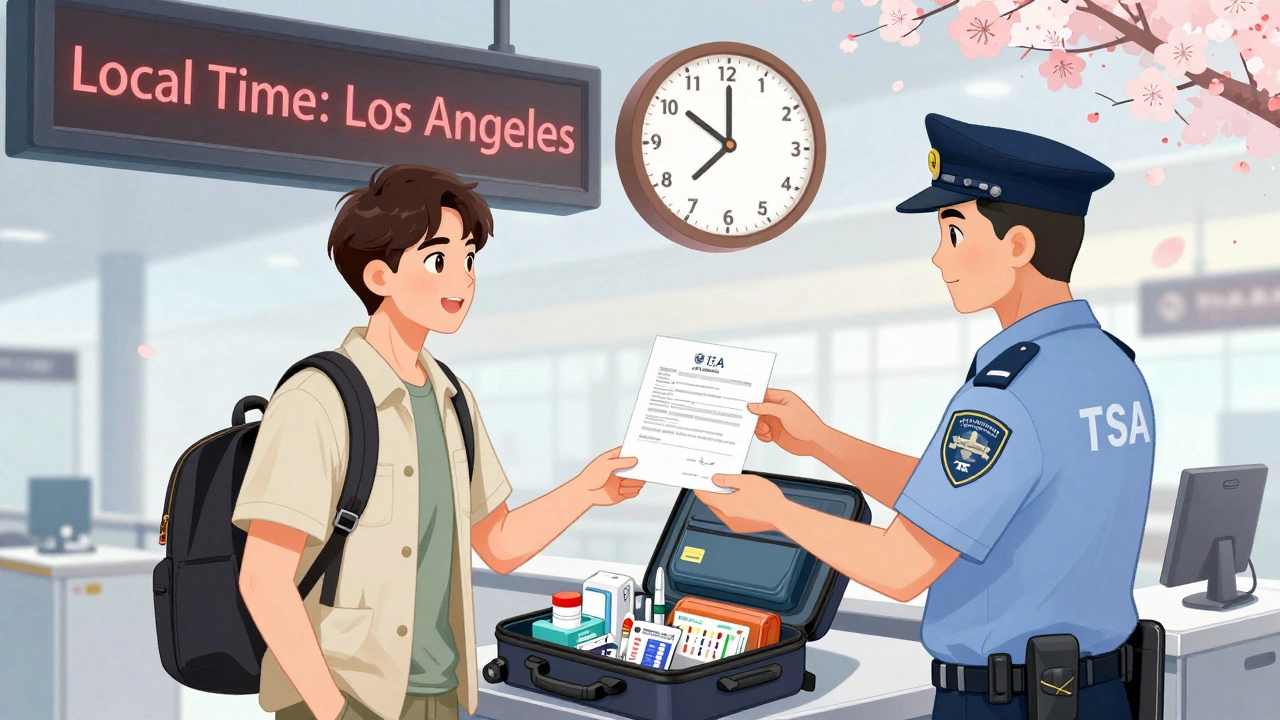
Real Stories, Real Lessons
GlobeTrottingGina, a user on Diabetes Daily, flew from London to Los Angeles with an 8-hour time difference. She took 5 units of NPH and 10 units of regular insulin about five hours after her usual European lunch. That’s not what her pump told her to do-but it worked. Her glucose stayed steady. Why? She listened to her body, not just the clock. Another traveler, on Reddit, followed outdated advice to skip a meal when traveling east. He ended up with a blood sugar of 42 mg/dL mid-flight. He needed help from a flight attendant. He’s now a strong advocate for always eating on local time. The pattern? People who stick to routine-even if it’s not perfect-do better than those who chase exact clock alignment. As Dr. David Edelman says, “Maintain some level of routine rather than perfect alignment.”The Future Is Here
New tech is making this easier. Insulin pens from Ypsomed, coming in 2025, will calculate dose adjustments based on your flight path. CGMs are now recommended for all travelers crossing three or more time zones. Studies show they cut severe lows by 58%. Airlines and the ADA are also working on standardized in-flight emergency protocols by 2026. But for now, the tools you have are enough-if you use them right.Final Checklist Before You Fly
- Consult your diabetes team at least 4 weeks before travel
- Bring 20-30% extra insulin, syringes, test strips, and batteries
- Carry a doctor’s letter and your CGM/pump documentation
- Keep insulin cool and in your carry-on
- Adjust basal insulin down by 20-33% when flying east
- Add a half-dose of rapid-acting insulin when flying west
- Set your pump or smart pen to local time as soon as you board
- Keep glucose between 140-180 mg/dL during travel for safety
- Hydrate, eat on local time, and never skip meals
- Teach someone how to use your glucagon kit
You don’t need to be perfect. You just need to be prepared. The goal isn’t flawless glucose numbers-it’s staying safe, awake, and in control, no matter what time zone you’re in.

Maria Elisha
Just took my insulin before boarding and forgot to adjust for the 6-hour time change. Ended up crashing at 3am over the Atlantic. Never again.
Ajit Kumar Singh
Man I fly from Delhi to NYC all the time and I just wing it. I eat when I’m hungry not when the clock says so. My sugar stays chill. Why overcomplicate it? The body knows what it needs. No fancy math needed. Just listen to your gut. And carry extra juice. Always.
Richard Eite
Why are we even talking about this? If you can’t manage your diabetes on a flight you shouldn’t be flying. America has the best medical tech in the world. If you’re still using old-school pens and guessing doses you’re doing it wrong.
Andrea Beilstein
There’s a deeper truth here. It’s not about insulin or time zones. It’s about how we surrender control to machines-pumps, CGMs, algorithms-and forget that our bodies are still wild, ancient systems that don’t care about GPS or UTC. The real journey isn’t across continents. It’s learning to trust your own rhythm again. The clock is a lie. Your glucose is the truth.
Lisa Whitesel
Anyone who skips meals to 'adjust' deserves what they get. This isn’t rocket science. It’s basic biology. Stop making excuses. If you’re too lazy to plan ahead, don’t blame the airline or your pump. You’re just irresponsible.
Sabrina Thurn
For those on MDI: when flying east, reduce basal by 25% but keep bolus on local meal timing. That’s the sweet spot. I’ve tracked 47 flights with this method. Average pre-meal glucose: 132 mg/dL. No lows. No highs. The key is consistency in meal timing, not dose perfection. Also-always carry glucose tabs in your pocket. Not your bag. Your POCKET.
Anna Roh
My cousin flew to Japan and used the ‘half-dose trick’ for westbound. She spiked to 420. Now she’s on a pump. Good riddance to her old regimen.
Tim Tinh
Just want to say thanks for this post. I’m new to insulin and was terrified to travel. I followed the 20-30% extra supplies tip and brought my doctor’s letter. TSA let me through without a hitch. Also carried honey packets. A lifesaver. I didn’t even know you could do that. Seriously. Thank you.
Katherine Chan
You got this. I flew to Bali last year with zero sleep and a full insulin bag. My pump glitched, I ate rice noodles at 2am local, and my sugar was 152. Perfect. You don’t need perfection. You just need courage and a little extra juice. You’re stronger than your numbers.
om guru
It is imperative to consult with your endocrinologist prior to any international travel. The human body operates under circadian rhythms which are not to be trifled with. A structured, medically supervised adjustment protocol is non-negotiable for safety. Respect your physiology.
Tiffany Sowby
Ugh I hate how everyone acts like this is some big revelation. My mom’s been doing this since the 90s. We used to carry vials in a thermos and pray. Now we have apps and GPS pumps and people still panic. It’s not that hard. You’re just making it dramatic.
Angela R. Cartes
Wow. This is like, the most thoughtful thing I’ve read all week. 🥹 I’m not even diabetic but I cried. Like, how do people do this every day? I’m just over here stressing about my flight being delayed 2 hours. You’re out here recalibrating your entire biology. Respect. 🙏