
It’s not just about what you eat - it’s about when you eat it. If you’re on antibiotics like doxycycline or ciprofloxacin, having a glass of milk, a bowl of yogurt, or even a calcium-fortified orange juice at the same time can seriously mess with how well your medicine works. This isn’t a myth. It’s chemistry. And it’s happening right now in kitchens across the country - including yours.
Why Dairy Stops Antibiotics from Working
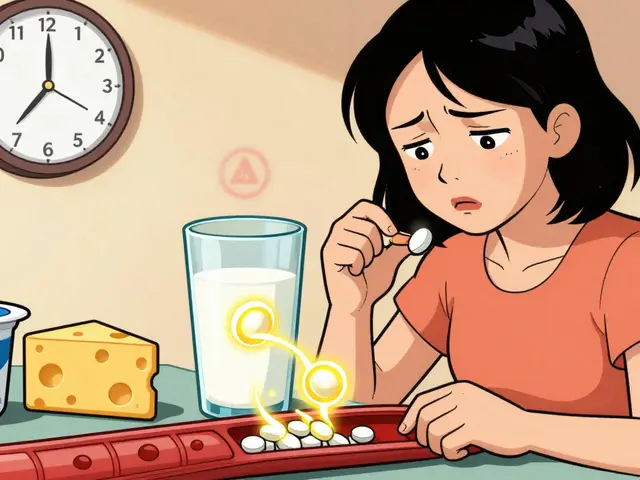
Dairy products are full of calcium, magnesium, and other minerals. These minerals don’t just build bones - they also bind tightly to certain antibiotics in your stomach and intestines. Think of it like glue. When calcium sticks to the antibiotic molecule, it forms a solid clump your body can’t absorb. That means the drug never makes it into your bloodstream where it needs to fight the infection. This isn’t new science. Back in the 1960s, researchers first noticed that people taking tetracycline weren’t getting better - even when they took the right dose. The culprit? Milk. Since then, dozens of studies have confirmed it. One study from the Journal of Rawal Academy of Sciences in 2022 showed that yogurt cut ciprofloxacin absorption by 92%. Milk still dropped it by 70%. That’s not a small drop. That’s the difference between your infection clearing up and it coming back worse.Which Antibiotics Are Affected?
Not all antibiotics react this way. Penicillin? Fine. Amoxicillin? No problem. Azithromycin? Also safe. But two major classes are troublemakers:- Tetracyclines: This group includes tetracycline, doxycycline, and minocycline. They’re commonly used for acne, Lyme disease, and respiratory infections. Tetracycline is the worst offender - absorption can drop by up to 90% with dairy. Doxycycline is a little better, but still needs space.
- Fluoroquinolones: Ciprofloxacin (Cipro), levofloxacin (Levaquin), and moxifloxacin (Avelox) fall here. These are often prescribed for UTIs, sinus infections, and pneumonia. Even a small amount of dairy can slash their effectiveness by 50-90%.
Some people think switching to low-fat milk helps. It doesn’t. The calcium content is nearly the same. Same goes for almond milk, soy milk, or oat milk - if it’s fortified with calcium, it’s just as risky. Even calcium supplements or antacids like Tums can cause the same problem.
How Long Should You Wait?
Timing isn’t just advice - it’s the only thing that works. You can’t just avoid dairy forever. You need to space it out. And the window depends on the antibiotic.For tetracyclines (including doxycycline):
- Take the pill at least 1 hour before eating dairy.
- Or wait 2 hours after you’ve had milk, cheese, yogurt, or calcium-fortified foods.
For fluoroquinolones like ciprofloxacin:
- Take the pill 2 hours before dairy.
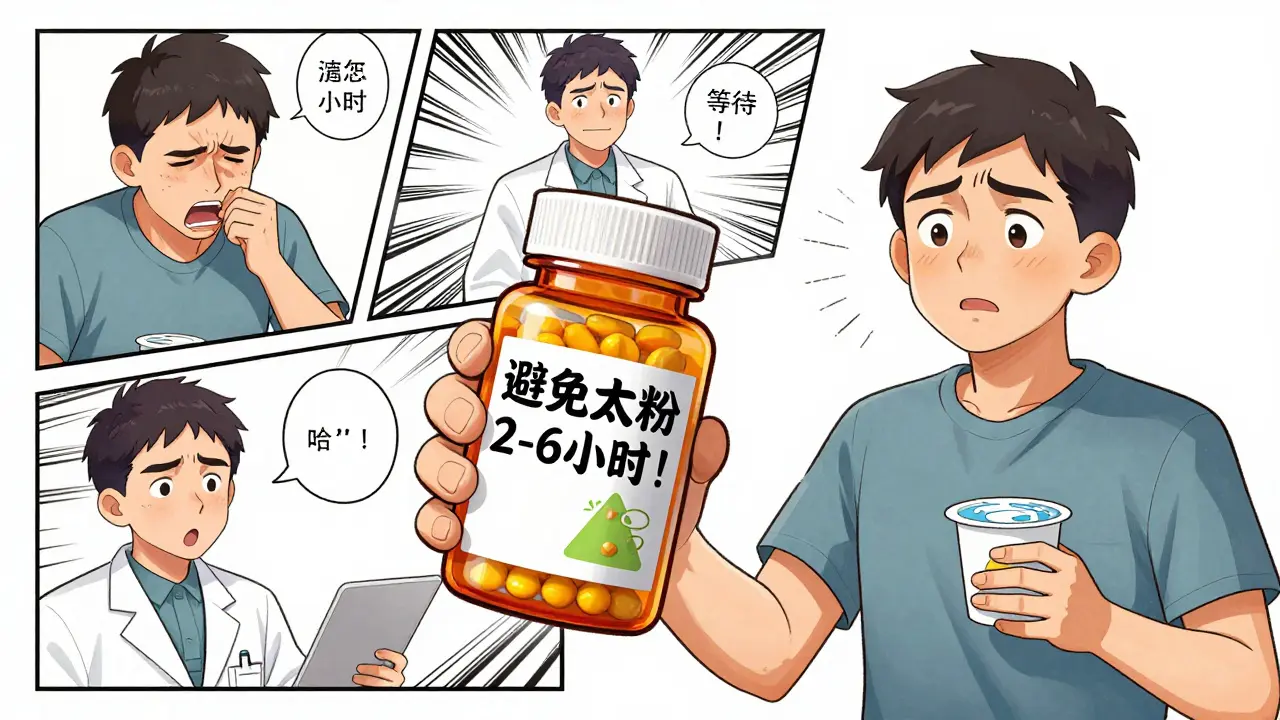
- Wait 4 to 6 hours after eating dairy before taking the next dose.
Why the longer wait for ciprofloxacin? Because it’s more sensitive. A 2023 study in the Journal of Antimicrobial Chemotherapy found that even 2 hours wasn’t enough for some patients - 4 hours was the minimum to avoid treatment failure. If you’re taking it twice a day, plan your meals around it. Take your morning pill before breakfast, and your evening pill after dinner, leaving a 6-hour gap between dairy and dose.
What Happens If You Ignore This?
It’s not just about the medicine not working. It’s about bigger risks.If your antibiotic doesn’t reach effective levels in your blood, the bacteria don’t die. They survive. And they adapt. That’s how antibiotic resistance starts. The WHO estimates that improper timing with dairy contributes to 5-10% of community-based antibiotic resistance cases. That’s not just your problem - it’s everyone’s.
Real-world stories back this up. A nurse on Reddit shared how a patient with Lyme disease kept getting worse - until they realized she was drinking milk with every doxycycline pill. Once she waited two hours, her symptoms cleared in days. Another patient on Drugs.com had recurring UTIs for months. Her doctor kept prescribing ciprofloxacin. She didn’t know about the yogurt. After switching to a 4-hour gap, the infection vanished.
And it’s not rare. A 2022 survey found 43% of patients given tetracyclines or fluoroquinolones got zero instructions about dairy. That’s a system failure. You’re not stupid for not knowing. You just weren’t told.
What About Food and Other Supplements?
Dairy isn’t the only culprit. Calcium-fortified plant milks, breakfast cereals, and even some protein shakes can trigger the same reaction. Same goes for iron pills, antacids, and supplements with magnesium or zinc. Even a multivitamin with minerals can interfere.Here’s a simple rule: If it has calcium, magnesium, aluminum, or iron listed on the label - wait. Don’t take your antibiotic within 2-6 hours of it. And if you’re unsure? Check the label. Or ask your pharmacist. They’ve seen this a hundred times.
What Can You Do Instead?
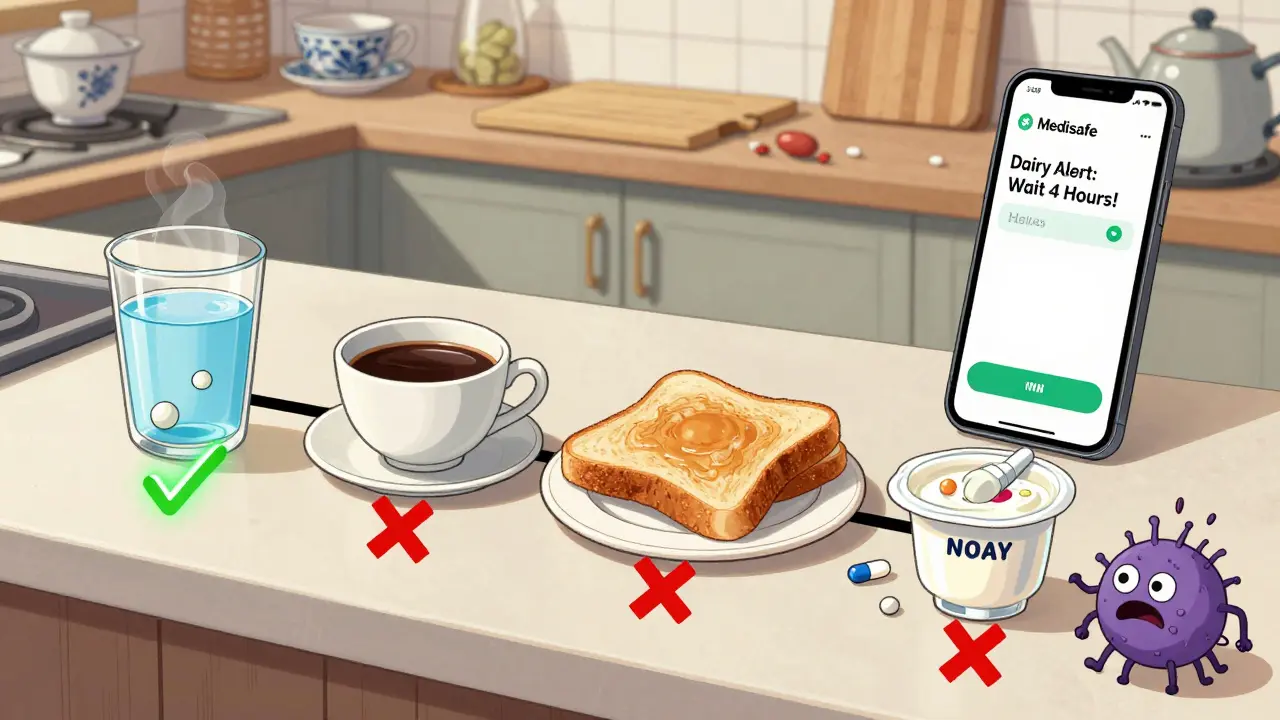
You don’t have to go dairy-free. Just plan ahead.- Take your antibiotic on an empty stomach - first thing in the morning, before coffee or toast.
- Save your yogurt for lunch or dinner, well after your dose.
- If you take it at night, avoid late-night snacks with calcium.
- Use water to swallow your pill. Not milk, not juice, not tea.
- Set phone reminders: “Take pill,” then “Dairy in 2 hours.”
Some pharmacies now offer digital alerts. Apps like Medisafe and MyMeds will pop up a warning if you enter ciprofloxacin or doxycycline and log dairy. If yours doesn’t, ask your pharmacist if they can send you a text reminder.
The Future: Better Pills and Better Warnings
Pharmaceutical companies are trying to fix this. Extended-release versions of ciprofloxacin (Cipro XR) were designed to reduce interaction, but they cost over $200 - ten times more than the generic. Not practical for most.In 2023, the FDA required clearer labeling on all tetracycline and fluoroquinolone packaging. No more vague “take on empty stomach” - now it says “avoid dairy 2-6 hours before and after.” That’s progress.
Researchers are also testing new tetracycline derivatives that don’t bind to calcium. Early trials look promising. But they’re still years away. For now, timing is still your best tool.
Bottom line: This isn’t complicated. It’s not about being perfect. It’s about being smart. One glass of milk at the wrong time can undo days of treatment. But one simple change - waiting two hours - can make all the difference.
Can I drink milk with doxycycline if I wait an hour?
No. While doxycycline is less affected than older tetracyclines, you should still wait at least 2 hours after taking it before consuming dairy. Even a small amount of calcium can reduce absorption by up to 30%. Waiting 2 hours gives your body time to absorb the drug before calcium enters your system.
Does yogurt affect antibiotics more than milk?
Yes. Studies show yogurt can reduce ciprofloxacin absorption by up to 92%, while milk reduces it by about 70%. This may be because yogurt contains higher concentrations of calcium and other ions, or because its thicker consistency slows digestion and prolongs contact time. Either way, treat yogurt the same as milk - avoid it for 2-6 hours around your antibiotic dose.
What if I accidentally take my antibiotic with dairy?
Don’t panic. Skip your next dose if it’s too soon - don’t double up. Take your next scheduled dose as planned, but make sure to avoid dairy for the next 2-6 hours. One mistake won’t ruin your treatment, but repeating it might. If your symptoms don’t improve in a few days, contact your doctor - you may need a different antibiotic or a longer course.
Are there antibiotics that are safe with dairy?
Yes. Penicillins (like amoxicillin), cephalosporins (like cephalexin), macrolides (like azithromycin), and sulfonamides (like Bactrim) don’t interact with dairy. You can take them with food or milk without worry. But if you’re unsure, always check the label or ask your pharmacist - never assume.
Why don’t doctors always tell patients about this?
Many don’t realize how common this mistake is. A 2022 survey found 43% of patients prescribed affected antibiotics received no specific instructions. Doctors are busy. Prescriptions are printed with generic advice like “take on empty stomach.” But that’s not enough. If you’re on doxycycline or ciprofloxacin, ask your doctor or pharmacist: “What foods or drinks should I avoid, and how long should I wait?” Don’t wait for them to bring it up.
Sajith Shams
This is why most people are dying from antibiotic resistance - not because of superbugs, but because they’re chugging yogurt with their cipro like it’s a smoothie. The science is 60 years old. If you don’t know this by now, you’ve been asleep at the wheel. No excuses.
bhushan telavane
Bro in India we just take antibiotics with tea and roti and live to 90. Maybe our gut is tougher? Or maybe the West overthinks everything. My uncle took doxycycline with milk for 3 weeks - healed fine. Maybe it’s just placebo effect from the label?
Mahammad Muradov
Let me be clear: this isn’t about timing. It’s about control. The pharmaceutical industry wants you to believe you need to wait two hours - so you’ll buy more pills. They profit when you fail. They profit when you re-prescribe. They profit when you blame yourself. The calcium-binding theory? Convenient. But who funded the studies? Check the footnotes. I’ve seen this pattern before.
Tim Goodfellow
OMG this is the most important thing I’ve read all year. I’ve been taking my cipro with almond milk lattes like a total idiot. My UTI came back twice. Now I’m drinking water like a monk. I even set a timer. My microbiome is throwing me a parade. THIS IS LIFE-CHANGING. THANK YOU.
mark shortus
So... you're telling me... that my entire life... I've been DOING IT WRONG?!?!?! I took doxycycline with a bowl of cereal and milk for my acne... for YEARS?!?!?! And now I'm... what? Immune? Resistant? A walking biohazard?!?!?! My kids are gonna have superbugs in their blood! I'm gonna die in a hospital with a sign that says 'DIED FROM YOGURT'! I NEED A THERAPIST AND A NEW ANTIBIOTIC!!!
Aboobakar Muhammedali
Man I never knew this. I take my pills with breakfast every day. My wife makes me yogurt every morning. I feel bad now. I’m gonna start taking it before I even get out of bed. Just water. No toast. No coffee. Just me and my pill. Hope it works. Thanks for telling us.
Laura Hamill
THIS IS A GOVERNMENT LIE. They want you to wait 2 hours so you’ll buy more meds. Also, dairy is a corporate tool to control your hormones. The FDA is owned by Big Dairy and Big Pharma. They don’t want you healthy. They want you dependent. I take my cipro with milk and a multivitamin. I feel stronger. Who’s really sick here?
Alana Koerts
92% reduction? Where’s the p-value? Sample size? Control group? You cited a journal called 'Rawal Academy of Sciences' - that’s not a real journal. It’s a vanity press. This whole thing smells like a blog post dressed up as science. I’m not convinced.
Dikshita Mehta
Actually, this is spot-on. I’m a pharmacist and I see this every week. Patients think 'empty stomach' means 'before coffee' - nope, it means NO MINERALS. I tell them to take it with water only, wait 2 hours for dairy, 4 for cipro. Simple. Effective. Saves money too. If you’re on doxycycline - trust the science. Your body will thank you.
Marsha Jentzsch
You know what’s worse than dairy? The fact that your doctor didn’t warn you. I had a friend who got sepsis because she took her antibiotic with calcium-fortified orange juice. She cried for days. She said she thought 'fortified' meant 'good for you'. That’s not ignorance - that’s negligence. And now she’s on disability. Who’s responsible? Not her. Not the milk. The system.
Janelle Moore
They’re hiding the truth. The real reason dairy interferes is because it contains fluoride. Fluoride + calcium = antibiotic neutralizer. That’s why they push fluoridated water and calcium-fortified milk. It’s all connected. The CDC knows. They just don’t tell you. I only drink raw goat milk now. No calcium added. No conspiracy. Just freedom.
Henry Marcus
Wait - so if I take my doxycycline with a glass of water… and then drink almond milk… and then take a TUMS for heartburn… and then eat a protein bar with magnesium… am I basically poisoning myself? Is this why I keep getting headaches? I think I’m being slowly murdered by my own breakfast routine. I need a new life. And a new doctor. And maybe a bunker.
Carolyn Benson
It’s not about calcium. It’s about control. The body is a sacred vessel. The pharmaceutical industry has weaponized our trust in science to turn us into obedient chemical consumers. We’ve forgotten that healing is natural. Why not use probiotics? Or garlic? Or fasting? The real antibiotic is awareness. The dairy? Just a distraction. The system wants you distracted. Don’t be.
Chris porto
I think we’re missing the point. It’s not just about timing. It’s about rhythm. Our ancestors didn’t have pill schedules. They ate when food was available. Maybe the problem isn’t dairy - it’s that we’ve lost touch with natural cycles. Maybe we should be eating in sync with the sun, not with a pharmacy label. The science is useful, but the wisdom? That’s older.