
Daptomycin Muscle Toxicity Risk Calculator
This tool assesses your risk of daptomycin-induced muscle toxicity based on your treatment parameters and medical conditions. It provides recommendations for CK monitoring frequency and action steps.
Daptomycin Treatment Details
Risk Factors Assessment
Symptom Assessment
When you're fighting a serious bacterial infection like MRSA or a deep-seated bloodstream infection, daptomycin can be a lifesaver. But there's a hidden risk most people don't talk about: daptomycin muscle toxicity. It's not rare. It's not theoretical. And if you're on this antibiotic for more than a week, you need to know the signs - and how to catch it before it turns dangerous.
What Is Daptomycin, and Why Does It Hurt Your Muscles?
Daptomycin is a powerful antibiotic used for tough Gram-positive infections - think MRSA, endocarditis, or infected joint replacements. It works by punching holes in bacterial cell membranes. But here's the problem: it doesn't stop at bacteria. In some people, it also damages human skeletal muscle cells.
This isn't a side effect you feel right away. It builds up. Studies show daptomycin causes direct injury to muscle tissue, especially under low-oxygen conditions. That means if you're already sick with sepsis, have heart disease, or poor circulation, your muscles are more vulnerable. A 2020 study using lab-grown muscle cells proved this: under normal oxygen levels, daptomycin caused damage. Under low oxygen? The damage jumped by over 60%.
How Common Is Muscle Toxicity?
The FDA label says muscle problems happen in about 0.2% of patients. But that's not the full story. Clinical trials are clean, controlled, and short. Real life? Not so much.
In actual practice, muscle toxicity shows up in 5% to 10% of patients. Why the gap? Two big reasons:
- Doctors now use higher doses - 8 to 12 mg/kg - for bone and joint infections, even though the official label only goes up to 6 mg/kg. These higher doses raise the risk.
- People stay on daptomycin longer. For a skin infection, maybe 10 days. For an infected hip replacement? Six weeks. Longer exposure = more muscle damage.
One case report described a patient with heart disease who got daptomycin for a fake heart valve infection. His CK level hit 6,250 U/L - over 30 times the normal limit. He needed hospitalization. He wasn't on statins. He wasn't over-dosed. He just had poor blood flow. That’s the hidden trigger.
What Are the Symptoms?
Don’t wait for muscle pain to become unbearable. Early signs are subtle:
- Unexplained muscle soreness - like you ran a marathon but didn’t move all day
- Weakness in your legs or arms, making stairs or lifting things harder
- Tenderness when you press on your thighs or shoulders
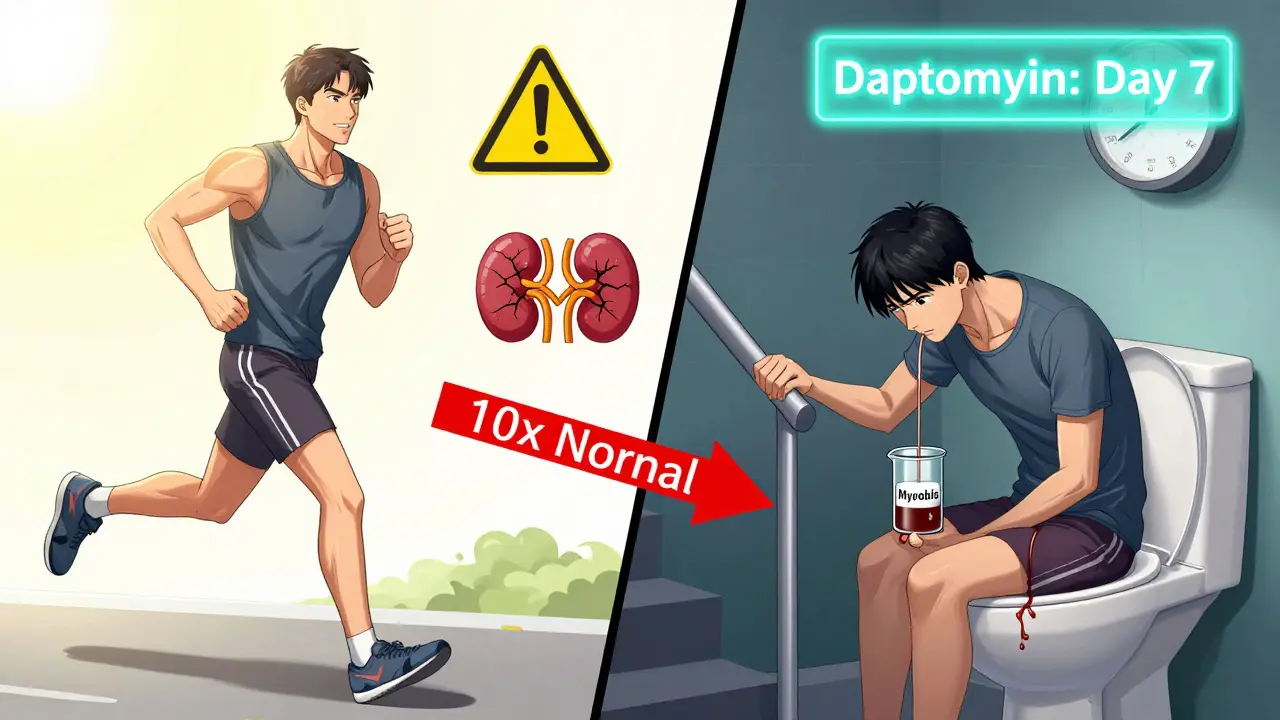
- Dark urine - a sign your muscles are breaking down and dumping proteins into your bloodstream
These symptoms often show up after 5-10 days of treatment. If you're on daptomycin for a bone infection and start feeling this way at day 7? That’s not normal. That’s your body screaming for a CK test.
CK Monitoring: The Only Way to Catch It Early
There’s no other way. You can’t feel muscle damage until it’s advanced. That’s why creatine phosphokinase (CK or CPK) monitoring is non-negotiable.
CK is a protein released when muscle cells break down. Higher levels = more damage. Here’s what the guidelines say:
- Test CK before starting daptomycin - baseline matters
- Test weekly during treatment - no exceptions
- Stop daptomycin if:
- You have muscle symptoms AND CK > 1,000 U/L
- You have no symptoms but CK > 10x the upper limit of normal (usually >1,000-1,500 U/L depending on lab)
Most labs set the normal range at 30-140 U/L. So if your CK hits 1,400, that’s 10x the top end. That’s your stop sign.
Some clinics test every 3-4 days for high-risk patients - like those with heart failure, diabetes, or kidney disease. That’s smart. That’s cautious. That’s what saves people.
What About Statins? Do They Make It Worse?
For years, doctors told patients to stop statins when starting daptomycin. The fear? Double trouble - two drugs damaging muscles.
But recent data says otherwise. A 2014 study of 220 patients found:
- 6.1% of those on statins had muscle pain
- 2.9% of those not on statins had muscle pain
- 10.2% of statin users had CK >1,000 U/L
- 5.3% of non-statin users had CK >1,000 U/L
That sounds scary - until you look at the numbers. The difference wasn’t statistically significant. Meaning? Statins might raise the risk a little, but daptomycin is the main culprit.
Still, many doctors recommend pausing statins during daptomycin treatment. Why? Because muscle damage is reversible - but rhabdomyolysis (severe muscle breakdown) can kill you. Better safe than sorry.
Who’s at Highest Risk?
Not everyone gets this toxicity. But some people are sitting on a ticking clock:
- Patients on high-dose daptomycin (8-12 mg/kg) - common in bone and joint infections
- People with poor circulation - heart disease, diabetes, peripheral artery disease
- Those with low oxygen levels - sepsis, COPD, pneumonia
- Long-term users - more than 14 days of therapy
- Older adults - muscle mass declines with age, making damage more dangerous
If you fit even one of these, your doctor should be testing your CK every 5-7 days - not waiting for symptoms.
What Happens If You Ignore It?
Most cases of daptomycin-induced myopathy are reversible. Stop the drug, rest, hydrate - and CK levels drop in days. Muscle strength returns.
But if you keep going? You risk rhabdomyolysis. That’s when muscle cells explode, flooding your blood with myoglobin. Your kidneys can’t handle it. You can develop kidney failure. You might need dialysis. In rare cases, you die.
One study found 12% of patients with CK levels over 5,000 U/L developed acute kidney injury. That’s not a gamble you want to take.

What About Other Antibiotics?
Vancomycin? It can hurt your kidneys, but not your muscles. Fluoroquinolones? They can cause tendon ruptures. Daptomycin’s damage is different - it’s muscle cell death, not tendon snapping.
And unlike vancomycin, which needs expensive blood tests to check drug levels, daptomycin only needs a simple, cheap CK test - about $7.50 per draw. That’s a small price to pay to avoid hospitalization.
What Should You Do?
If you’re on daptomycin:
- Ask for your baseline CK level before starting
- Make sure you get tested weekly - no skipping
- Watch for muscle pain, weakness, or dark urine - even if it’s mild
- Don’t assume statins are the problem - daptomycin is the trigger
- Speak up if you’re on high doses or have heart/lung disease
It’s not paranoia. It’s prevention.
Is There a Better Way?
Doctors are starting to use something called therapeutic drug monitoring - not just measuring CK, but measuring how much daptomycin is in your blood. A 2023 study showed that keeping the drug exposure between 666 and 939 mg·h/L reduced side effects without losing effectiveness.
This isn’t standard yet. But it’s coming. Until then, CK monitoring is your best tool.
And remember: daptomycin saves lives. But it can also break them - if you don’t watch for the signs.

John Sonnenberg
Daptomycin is the silent killer in plain white pills. No one talks about it because hospitals don't want to admit how often it fries your muscles. I saw a guy on it for 18 days after a knee replacement. CK hit 8,300. He didn't even know his legs were turning to jelly until he couldn't stand up from the toilet. That's not a side effect. That's negligence.
And don't get me started on the 'weekly CK' myth. My brother's doctor skipped it for 10 days because 'he looked fine.' Looked fine? He was peeing cola. By the time they tested, his kidneys were already in panic mode. This isn't rocket science. Test it. Every week. No excuses.
Jessica Klaar
This post is one of the most important things I've read all year. I work in rehab and see patients come in with muscle atrophy after daptomycin, and no one connects the dots. The real tragedy is how many are told it's 'just aging' or 'flu-like symptoms.'
My aunt was on it for a prosthetic joint infection. She had mild leg soreness at day 6. She thought it was from lying in bed too long. By day 12, she couldn't climb stairs. CK was 5,200. They stopped it. She recovered fully. But if she'd been told to monitor, she might've avoided the whole thing. This info needs to be in every discharge packet.
Elan Ricarte
Let me cut through the medical BS. Daptomycin is a muscle-melting nuke wrapped in a lab coat. The FDA says 0.2%? That's like saying 'only 0.2% of planes crash' while ignoring the 20% that crash due to pilot error. They're not testing the real world. They're testing lab rats on treadmills.
High-dose? Long-term? Heart disease? You're not a patient. You're a target. And the statin debate? Please. It's like blaming the spark for the gasoline fire. The fire is daptomycin. The statin? Just the match.
I've seen three people go into renal failure from this. One died. The hospital called it 'unforeseen complication.' Bullshit. It's foreseeable. It's preventable. And someone's getting paid to look the other way.
Camille Hall
I'm a nurse practitioner in a rural clinic, and I can't tell you how many times I've had patients come in scared because their CK was up and no one explained why. This post is a gift. I'm printing it and taping it to my wall.
I always check CK before starting daptomycin now. I tell patients: 'If your legs feel heavy, like you did 100 squats while sleeping, call me. Don't wait. Don't assume it's nothing.' I had a 72-year-old man with COPD last month. He noticed weakness on day 5. We stopped daptomycin. CK dropped by half in 48 hours. He's back to gardening. Prevention isn't paranoia. It's practice.
Ritteka Goyal
oh my god this is so important i live in india and here doctors dont even know about daptomycin muscle toxicity they just give it like amoxicillin. my uncle was on it for 3 weeks for a bone infection and he couldnt walk after 20 days. they said he had arthritis. then i found this post and made them test his ck. it was 6,700. they were shocked. now they are learning. we need more awareness in developing countries. this should be in every medical college. also why is ck so cheap in usa but here it cost 1500 rs? thats like 20 dollars. its not fair. we need global standards. thank you for writing this. i am sharing with every doctor i know. love from india
Jonah Mann
Biggest mistake I ever made? Letting my doc skip the CK test because 'you're young and healthy.' I was on daptomycin for a staph infection after surgery. Day 8: legs felt like lead. I thought I was just sore from rehab. Day 10: urine looked like iced tea. I finally pushed for a test. CK was 4,100. They stopped it. I was fine. But I almost didn't make it because I trusted the system. Don't be like me. Test. Every. Week. Even if you're 25 and lift weights. This drug doesn't care how fit you are.
THANGAVEL PARASAKTHI
very good information i am a doctor from india and i have seen many cases of daptomycin induced myopathy. the problem is we dont have routine ck monitoring in most hospitals. even in tertiary centers. we rely on symptoms. but by then its too late. i now order ck before and after 7 days for all patients on daptomycin. its cheap and simple. why dont we do it? because we dont think about it. this post should be mandatory reading for all interns. thank you for raising awareness. from a fellow clinician
Chelsea Deflyss
Wow. Just wow. I'm a pharmacist and I've seen this happen 3 times. Patients get daptomycin, go home, feel 'off,' and don't say anything because they think it's normal. Then they show up in the ER with kidney failure. And guess what? The doctor blames the statin. Or the dehydration. Or 'age-related muscle loss.'
Here's the truth: if you're on daptomycin longer than 7 days and you're not getting CK checked, you're being gambled with. And the worst part? The hospital doesn't even track this. No one's auditing it. No one's问责. It's a silent epidemic. And we're all complicit.
Tricia O'Sullivan
This is an exceptionally well-researched and clearly articulated piece. The clinical nuance presented here-particularly the distinction between observed incidence and actual prevalence-is both alarming and vital. I work in an ICU and have witnessed the downstream consequences of unchecked myopathy. The fact that CK monitoring remains inconsistent across institutions is a systemic failure. Thank you for elevating this conversation with such precision and gravity. I will be sharing this with our pharmacy and clinical governance committees.
Scott Conner
ck test is 7.50? why dont they just make it automatic? like a blood panel? this is insane