
Renal Dosing Calculator for Elderly Patients
This calculator uses the Cockcroft-Gault equation, the most practical tool for dosing medications in elderly patients with renal impairment. Proper calculation is essential to prevent toxicity from medications that aren't properly cleared by the kidneys.
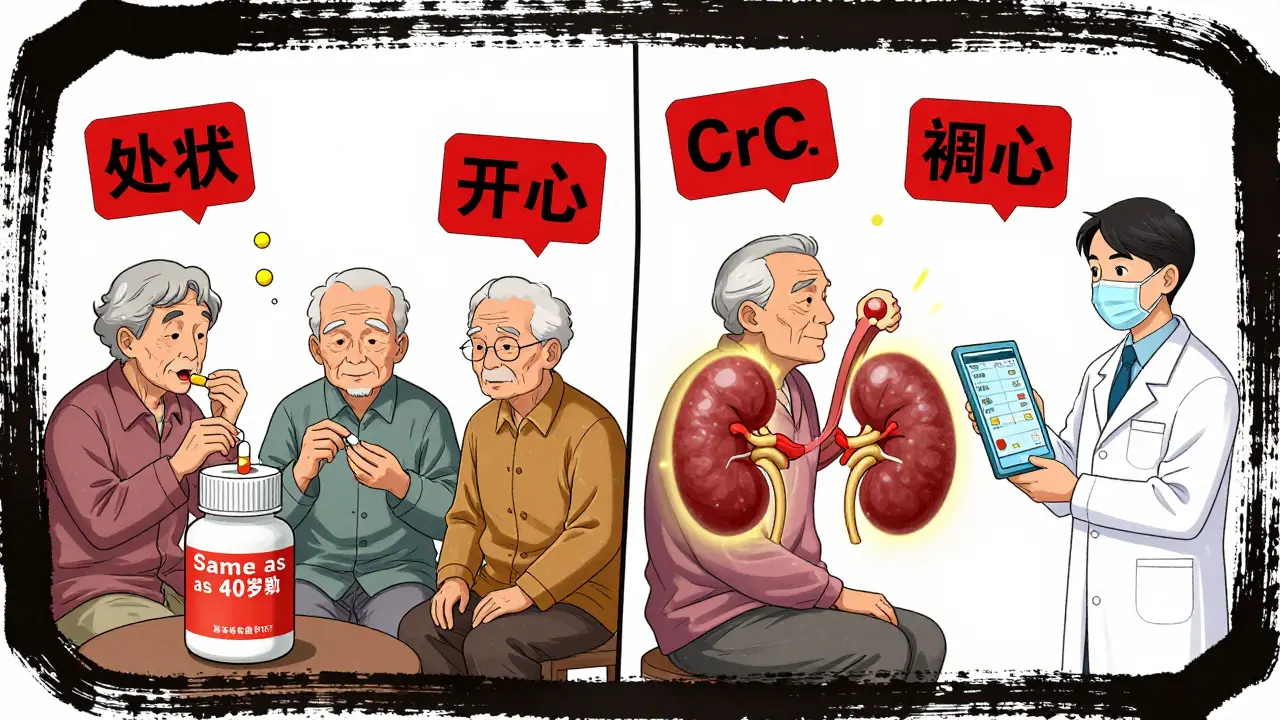
When you're over 65 and your kidneys aren't working like they used to, taking the same dose of a medication as you did at 40 can be dangerous. It's not about being frail or old-it's about biology. Your kidneys filter out drugs, and when that filter slows down, those drugs build up. That buildup doesn't just cause side effects. It can lead to falls, confusion, hospital stays, or even death. The truth is, medication dosing for elderly patients with renal impairment isn't optional-it's life-saving.
Why Kidney Function Matters More After 65
Your kidneys don't just clean waste. They remove drugs from your bloodstream. As you age, kidney function naturally declines. By age 70, most people have lost 30-50% of their kidney filtering capacity. That’s not a guess. It’s measured by something called glomerular filtration rate (GFR). A normal GFR is above 90 mL/min/1.73 m². If it drops below 60, you’re in Stage 3 chronic kidney disease. And here’s the kicker: about 38% of adults over 65 have GFR levels that low. That means nearly four in ten older adults are at risk of drug toxicity because their bodies can’t clear medications properly.Many doctors still rely on blood tests that measure creatinine alone. But creatinine can be misleading in older people. Muscle mass drops with age, so creatinine levels look normal-even when kidneys are failing. That’s why using the wrong calculation can lead to underdosing or overdosing. The Cockcroft-Gault equation, developed in 1976, is still the most practical tool for dosing in elderly patients. It uses age, weight, sex, and serum creatinine to estimate creatinine clearance (CrCl). For women, you multiply the result by 0.85. For example, a 78-year-old woman weighing 60 kg with a creatinine of 1.3 mg/dL has a CrCl of about 38 mL/min. That’s not normal. That’s a red flag.
Which Medications Are Most Dangerous?
Not all drugs are created equal when it comes to kidney clearance. Some are safe. Others? They’re ticking time bombs.Take metformin. It’s the go-to drug for type 2 diabetes. But if your CrCl drops below 30 mL/min, you shouldn’t take it at all. Even at 30-45 mL/min, the dose must be cut in half. Why? Metformin isn’t metabolized-it’s excreted entirely by the kidneys. Buildup causes lactic acidosis, a rare but deadly condition. The American Diabetes Association says avoid it if serum creatinine is above 1.5 mg/dL in men or 1.4 mg/dL in women. But European guidelines are more flexible. That’s why confusion happens.
Allopurinol, used for gout, is another silent killer. Most people take 300 mg daily. But if your CrCl is below 10 mL/min, you need 100 mg every other day. Too much? You get skin rashes, liver damage, or even a life-threatening reaction called Stevens-Johnson syndrome.
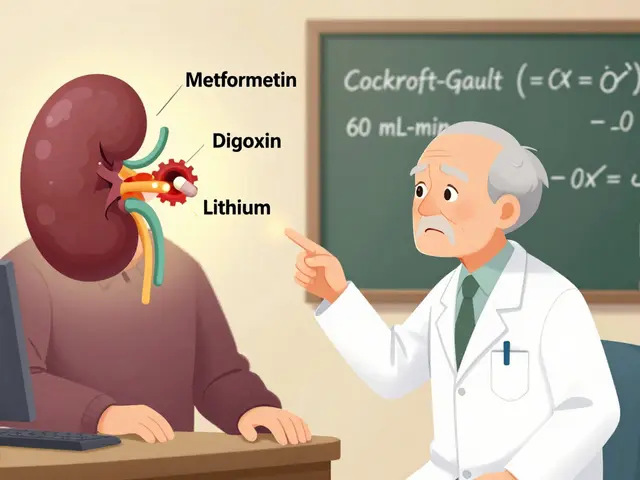
Digoxin is even more dangerous. Its therapeutic range is razor-thin: 0.8 to 2.0 ng/mL. One level above that, and you get nausea, blurred vision, and irregular heartbeat. In elderly patients with kidney impairment, digoxin levels can double without any change in dose. That’s why you need a blood test 15-20 days after starting it-not 5-7 days like in younger patients.
Then there are antibiotics. Cefepime, for example. Standard dose: 1 gram every 6 hours. But if CrCl is between 10-29 mL/min? Switch to every 12 hours. Below 10? Once a day. Get this wrong, and you risk seizures or brain toxicity.
The Three Ways to Adjust Dosing
There are only three ways to keep drugs safe when kidneys fail: reduce the dose, extend the time between doses, or do both.- Dose reduction: Cut the amount you take. Gabapentin, used for nerve pain, is often reduced from 300-1200 mg daily to 100-300 mg daily if CrCl is below 30 mL/min.
- Interval extension: Take the same amount, but less often. Vancomycin, an antibiotic, might go from every 12 hours to every 48 hours.
- Combination approach: Both. Piperacillin/tazobactam drops from 3.375g every 6 hours to 2.25g every 8 hours.
There’s a shortcut some doctors use: the "50% rule." If a drug is 50% or more cleared by the kidneys, cut the dose in half when CrCl falls below 50 mL/min. Sounds simple. But it’s wrong for 22% of high-risk drugs. Vancomycin, for example, has nonlinear kinetics-its clearance doesn’t drop linearly with kidney function. Use the 50% rule here, and you could overdose.
What Gets Missed: Active Metabolites
Here’s the part most prescribers forget. A drug might be cleared by the liver-but its metabolites? Those are cleared by the kidneys.Take glibenclamide, a diabetes drug. It’s metabolized by the liver. But its active metabolite? Excreted by the kidneys. So even if the liver is fine, the kidney can’t flush out the poison. That’s why combining metformin with glibenclamide in elderly patients with CrCl below 30 mL/min is a recipe for severe hypoglycemia. The American Society of Nephrology calls this "one of the most dangerous combinations in geriatric prescribing."
Same with lithium. It’s not metabolized. It’s excreted unchanged. A dose that’s safe at 40 becomes toxic at 70. The therapeutic range is 0.6-0.8 mmol/L for chronic use. Go above 1.0? You’re in danger. No symptoms at first. Just tremors, confusion, fatigue. By the time it’s noticed, it’s too late.
Why Errors Keep Happening
A 2015 study found only 43.7% of doctors consistently adjusted doses in elderly patients. The worst offenders? Gabapentin (68% error rate), rivaroxaban (52%), and allopurinol (47%). Why? Because:- Doctors don’t check CrCl regularly.
- Electronic health records don’t flag high-risk drugs.
- Prescribers rely on outdated creatinine values.
- They assume "normal" creatinine means "normal" kidney function.
One hospital in Nebraska installed alerts in their EHR system that popped up whenever a high-risk drug was prescribed to a patient with CrCl below 50 mL/min. Within a year, inappropriate dosing dropped by 37%. That’s not magic. That’s system design.

What Works: Pharmacists, Tools, and AI
The most effective way to prevent toxicity? Put a clinical pharmacist in charge.At Mayo Clinic, when pharmacists managed dosing for elderly patients on renally cleared drugs, adverse events dropped by 58%. Pharmacists know the numbers. They check GFR. They cross-reference drug databases. They talk to patients about side effects.
Tools help too. Apps like Epocrates Renal Dosing have been downloaded over 1.2 million times. They let you input age, weight, creatinine-and instantly get adjusted doses for 200+ drugs. But they’re only as good as the data you put in. If your creatinine is from six months ago, the advice is useless.
Now there’s something new: AI-powered dosing platforms. DoseOptima, approved by the FDA in early 2023, pulls real-time lab data from EHRs, calculates CrCl using cystatin C (a more accurate marker in elderly patients), and recommends exact doses. In a trial of 15,000 patients, it was 92.4% accurate. That’s not science fiction. That’s here.
The Bottom Line
You don’t need to be a kidney specialist to prevent toxicity. You just need to know three things:- Check CrCl-not just creatinine-before prescribing to anyone over 65.
- Know which drugs are high-risk: digoxin, lithium, metformin, allopurinol, gabapentin, vancomycin, and anticoagulants like rivaroxaban.
- Use the Cockcroft-Gault equation. Don’t trust eGFR alone. It underestimates function in older adults by 15-20%.
And if you’re managing care for an elderly loved one? Ask: "Has their kidney function been checked this year?" If the answer is no, push for it. A simple blood test can prevent a hospital trip, a fall, or worse.
Medication safety in older adults isn’t about being cautious. It’s about being precise. One wrong number. One missed calculation. One unadjusted dose. That’s all it takes. And in a population where 38% already have kidney disease, we can’t afford to guess anymore.
How do I know if an elderly person has renal impairment?
The most reliable way is to calculate creatinine clearance (CrCl) using the Cockcroft-Gault equation. This uses age, weight, sex, and serum creatinine. A CrCl below 60 mL/min indicates moderate to severe renal impairment. Blood tests for serum creatinine alone are not enough because muscle mass declines with age, making creatinine levels misleading. For more accurate results, especially in frail elderly patients, cystatin C-based equations are now preferred over creatinine-based ones.
What is the best equation to estimate kidney function in the elderly?
The Cockcroft-Gault equation is still the most practical for dosing decisions in elderly patients, despite being developed in 1976. It’s more conservative than eGFR equations like MDRD or CKD-EPI, which tend to overestimate kidney function by 15-20% in older adults. The 2023 KDIGO update recommends using cystatin C-based equations for confirmation, especially when CrCl is borderline. But for daily prescribing, Cockcroft-Gault remains the gold standard because it reduces the risk of underdosing.
Can I still give metformin to an elderly patient with kidney problems?
Yes-but only if CrCl is above 30 mL/min. If CrCl is between 30-45 mL/min, reduce the dose to no more than 1,000 mg daily. If CrCl is below 30 mL/min, stop metformin entirely. The risk of lactic acidosis increases sharply when kidney function drops. Some European guidelines are more lenient, but U.S. standards are strict. Always check serum creatinine before prescribing and recheck every 3-6 months.
Why do some drugs need dose adjustments even if they’re not cleared by the kidneys?
Because many drugs are metabolized into active compounds that are cleared by the kidneys. For example, glibenclamide is broken down by the liver, but its metabolites are excreted by the kidneys. If those metabolites build up, they cause dangerous low blood sugar. Lithium, digoxin, and phenytoin are also cleared by the kidneys, even if they’re not primarily metabolized there. Always check whether the drug or its metabolites are renally excreted-not just the parent compound.
What should I do if I suspect a medication overdose in an elderly patient?
Stop the medication immediately. Check the patient’s most recent creatinine and CrCl. Review all medications for renal excretion. Look for signs like confusion, dizziness, nausea, irregular heartbeat, or weakness. For drugs like digoxin or lithium, check serum levels. Contact a pharmacist or nephrologist. Never wait for symptoms to worsen. In elderly patients, toxicity can progress silently and rapidly.
Are there tools or apps that help with renal dosing?
Yes. Epocrates Renal Dosing, Micromedex, and DoseOptima (FDA-approved in 2023) integrate real-time lab data and provide automatic dose adjustments for over 150 high-risk medications. Many electronic health records now include built-in renal dosing alerts. These tools reduce errors by up to 41%. But they’re only effective if you input accurate, up-to-date creatinine values. Never rely on a creatinine test from more than three months ago.
marjorie arsenault
Just wanted to say this post saved my dad's life. He was on metformin and gabapentin for years, and no one ever checked his CrCl. When we finally did, it was at 28. They switched him off both, and within weeks, his confusion cleared up. He's back to gardening and even made me a pie. Don't wait for a fall or ER visit. Ask for the math. It's simple, and it matters.
Thank you for writing this.
Deborah Dennis
Ugh. Another one of these ‘meds are dangerous’ rants. People have been taking digoxin for 200 years. Now we’re overcomplicating everything. Creatinine? It’s fine. If they’re not vomiting, dizzy, or turning blue-leave it alone. Doctors aren’t idiots. You’re just scaring people with numbers.
Levi Viloria
Interesting how we treat kidneys like a faucet you can just turn down. But here’s the thing-aging isn’t a defect. It’s a process. We’ve built a system that treats every decline like a bug to be patched. Maybe instead of recalculating doses for every drug, we should be asking: why are we prescribing so many drugs in the first place?
I’ve seen 80-year-olds on 12 meds. Not because they need them. Because it’s easier than changing their life.
Just food for thought.
Richard Elric5111
It is of paramount importance to acknowledge that the physiological diminution of renal function in geriatric populations is not merely a biomarker of aging, but rather a fundamental ontological shift in homeostatic equilibrium. The pharmacokinetic paradigm, as currently operationalized, remains tethered to a reductionist model predicated upon youthful renal architecture, thereby constituting an epistemological incongruence with the lived biological reality of the aged organism. Consequently, the reliance upon the Cockcroft-Gault equation-despite its historical pedigree-represents a hermeneutic artifact of 20th-century clinical empiricism, insufficiently attuned to the dynamic, non-linear pharmacodynamics of polypharmacy in senescence.
Dean Jones
Let’s cut through the noise. The real problem isn’t that doctors don’t know how to dose. It’s that they’re overworked, underpaid, and buried in EHR pop-ups that say ‘adjust dose’ but don’t tell them how. I’ve sat in on rounds where a 79-year-old got 500mg of gabapentin because the system auto-filled it from her 65-year-old record. No one caught it. The pharmacist was on lunch. The resident was on their third shift this week. This isn’t about math. It’s about a broken system that treats elderly patients like data points with legs.
And yes, I’ve seen someone go into lactic acidosis because of this. I still see their face.
We need more pharmacists. Not apps. Not alerts. People. Who talk to patients. Who ask, ‘How are you feeling?’ before they hit ‘send’ on that prescription.
Zacharia Reda
Okay, but why is everyone acting like CrCl is the holy grail? I’ve got a 72-year-old patient with a CrCl of 52, but her cystatin C says she’s at 41. ESRD-level. She’s fine. No symptoms. Walking 3 miles a day. So we cut her dose? Or do we actually look at the person?
Numbers are tools. Not oracles.
Also-can we talk about how ‘normal’ creatinine is a myth? I had a patient with a creatinine of 0.9 who couldn’t climb stairs. Her muscle mass was gone. Her kidneys were toast. But according to the chart? ‘All good.’
Jeff Card
My mom’s on lithium. We didn’t know she needed a dose change until she started forgetting her own name. We thought it was dementia. Turns out, it was toxicity. Took three weeks to get her back. I wish someone had told us this sooner.
Thank you for saying what needs to be said.
Mike Dubes
So i just found out my grandpa’s been on allopurinol for 10 years at 300mg. His crcl is like 8. I’m so mad. Why didn’t his doc catch this? I’m calling the pharmacy right now. This post is a lifesaver. Seriously. I’m printing it out and taking it to his next appt.
ps: i’m not a doc. just a grandkid who googled ‘why is grandpa so tired’.
Helen Brown
Did you know the FDA and Big Pharma are in cahoots to keep elderly people sick? They want you to keep taking pills. They don’t want you to know that kidney decline is natural. They invented CrCl to sell more tests. I read on a forum that cystatin C is a scam too. They’re all just profit machines. Your dad’s confusion? Probably the vaccines. Or the water. Or the 5G towers. Check your home for EMF. And stop trusting doctors. They’re paid by the drug companies.
John Smith
Man. I’ve been in this game 30 years. I’ve seen patients drop dead from digoxin because someone thought ‘creatinine is normal’ and left the dose alone. I’ve seen nurses cry because they gave a dose they knew was wrong but were told ‘it’s in the system.’
This isn’t about math. It’s about humility. It’s about saying ‘I don’t know’ and asking for help. It’s about listening when a patient says ‘I feel weird.’
And yeah, I’m still mad about the 2019 case where a guy got 2g of cefepime because the computer auto-filled it. He seized. For 47 minutes. We had to intubate him.
Don’t let your EHR be your brain.
Sharon Lammas
I think about how we treat aging like a disease to be fixed, instead of a chapter of life to be honored. We pour energy into adjusting doses, but what about adjusting care? What about home visits? What about letting someone rest instead of filling their day with meds?
Maybe the real solution isn’t more calculations. Maybe it’s more presence.
Shivam Pawa
In my practice in India, we rarely use Cockcroft-Gault. We use eGFR CKD-EPI because it's standardized across labs. But I do adjust for weight and frailty. A 55kg woman with CrCl 40? She gets half. A 90kg man with same CrCl? Full dose. Context matters more than equations. Also, many elderly here take herbal remedies-those aren't in any app. Need to ask. Always ask.
Diane Croft
This is why I tell everyone: if you’re over 65 and on more than 5 meds, get a pharmacist review. No joke. It’s free at most clinics. They’ll catch things doctors miss. I did it for my mom. Saved her from a hospital stay. You don’t need to be a genius. Just be persistent. Ask. Push. Repeat. You’re worth it.