
Euglycemic DKA Ketone Risk Checker
Euglycemic DKA Ketone Risk Checker
Enter your blood ketone level (mmol/L) to see if you're at risk for euglycemic DKA
Most people think diabetic ketoacidosis (DKA) means high blood sugar. If your glucose is below 250 mg/dL, you’re safe-right? Wrong. In patients taking SGLT2 inhibitors like Farxiga, Jardiance, or Invokana, DKA can sneak in without warning, with blood sugar levels that look normal or only slightly elevated. This is called euglycemic DKA, and it’s deadly if missed.
What Is Euglycemic DKA?
Euglycemic diabetic ketoacidosis (EDKA) is a dangerous form of DKA where the body burns fat for fuel, producing toxic ketones, but blood glucose stays below 250 mg/dL. It’s not rare. About 2.6% to 3.2% of all DKA hospital admissions today are euglycemic. And nearly half of all SGLT2 inhibitor-related DKA cases now fall into this category. SGLT2 inhibitors work by making your kidneys flush out extra sugar through urine. That sounds good-it lowers blood sugar and helps with weight loss. But here’s the catch: when sugar leaves the body, your brain thinks you’re starving. It triggers glucagon, a hormone that tells your liver to make more glucose. But because the drug blocks sugar reabsorption, that glucose just gets flushed out too. The result? Your body runs out of glucose but still has no insulin to stop fat breakdown. Ketones pile up. Acid builds up. And you’re in trouble-even if your glucose monitor says everything’s fine.Who’s at Risk?
You don’t have to have type 1 diabetes to get EDKA. While SGLT2 inhibitors aren’t officially approved for type 1 patients, about 8% of them use them off-label. In this group, DKA rates jump to 5%-12%. But even people with type 2 diabetes-who’ve never had DKA before-are at risk. Around 20% of EDKA cases happen in these patients. Certain situations make EDKA much more likely:- Illness (like the flu, pneumonia, or a urinary tract infection)
- Reduced food intake (dieting, fasting, or nausea from illness)
- Surgery or major stress
- Pregnancy
- Drinking alcohol
Why Is It So Hard to Spot?
The biggest danger isn’t the disease-it’s the misdiagnosis. Emergency rooms, urgent care clinics, and even primary care offices still assume DKA means high blood sugar. If your glucose is 180 mg/dL, many providers won’t even check ketones. But that’s exactly when EDKA is hiding. Patients show up with nausea, vomiting, belly pain, and extreme fatigue. They might breathe fast (Kussmaul breathing) or feel confused. Their blood sugar? Maybe 140 mg/dL. The provider says, “You’re not in DKA-you’re just sick.” They send them home with anti-nausea meds. Hours later, they’re back in cardiac arrest. A 2015 study in Diabetes Care tracked 13 cases where this exact mistake happened. All patients were on SGLT2 inhibitors. All had normal glucose. All were delayed in treatment. Two died.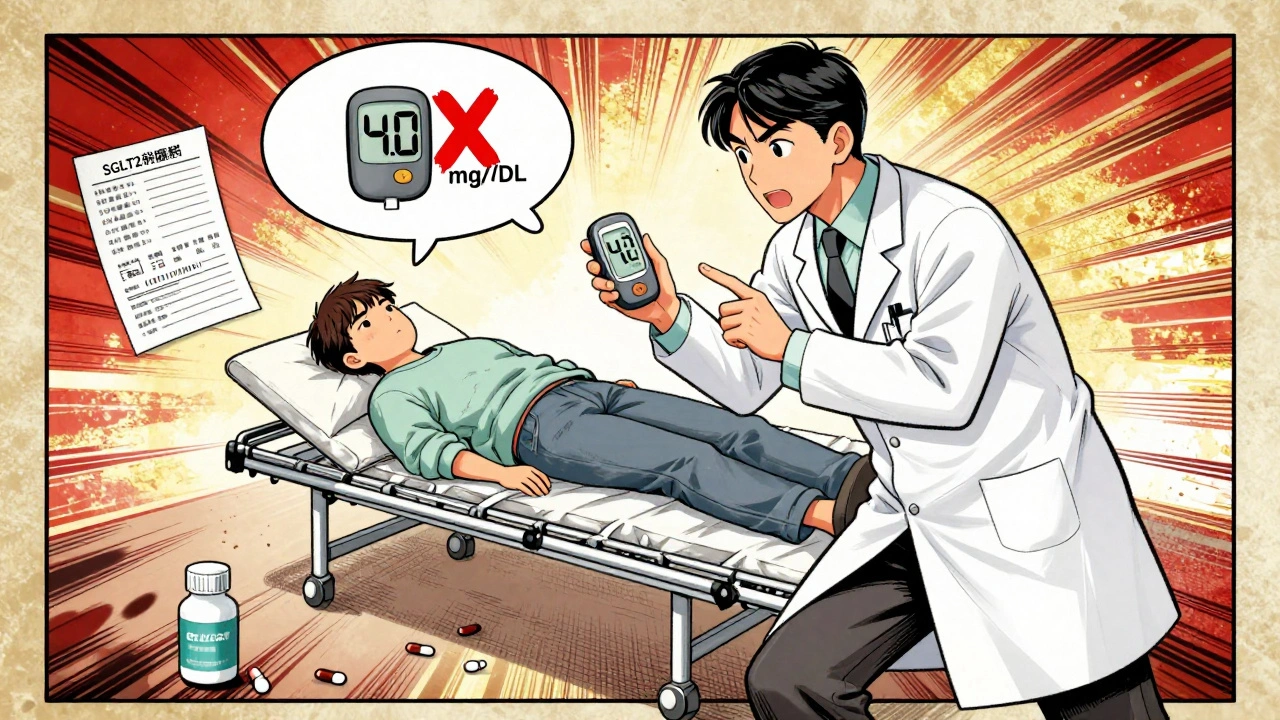
How Is It Diagnosed?
If you’re on an SGLT2 inhibitor and feel unwell, don’t wait for high blood sugar to confirm DKA. Test for ketones-right away. The diagnostic triad is simple:- Blood glucose < 250 mg/dL
- Arterial pH < 7.3 or serum bicarbonate < 18 mEq/L
- Elevated ketones (serum beta-hydroxybutyrate > 3 mmol/L)
Emergency Treatment: What Works
Treatment is similar to classic DKA-but with critical twists. Fluids: Start with 0.9% saline at 15-20 mL/kg in the first hour. But don’t overdo it. These patients are often volume-depleted from sugar loss and vomiting. Too much fluid too fast can cause brain swelling. Insulin: Begin at 0.1 units/kg/hour. But here’s the key: you can’t wait for glucose to rise before adding sugar to the IV. In classic DKA, you hold glucose until blood sugar hits 200-250 mg/dL. In EDKA, you add dextrose (5% or 10%) much earlier-often after the first hour. Why? Because your glucose can crash fast as insulin starts working. Hypoglycemia is a real risk. Potassium: Nearly 65% of EDKA patients have low total body potassium-even if their blood test looks normal. Potassium gets pushed out of cells by acidosis and flushed out by glucosuria. You must replace it aggressively. Check levels every 2-4 hours. Monitoring: Track ketones, pH, and glucose every 1-2 hours. Don’t assume improvement just because glucose drops. Ketones can still be rising.
How to Prevent It
Prevention is simpler than you think:- Stop the drug during illness. If you’re sick, have surgery, or are fasting, pause your SGLT2 inhibitor. Restart only after you’re eating normally and feeling better.
- Check ketones if you’re unwell. Even if your glucose is normal. Use a blood ketone meter if you have one. Urine strips work too-just don’t wait for symptoms to get worse.
- Don’t fast or go low-carb. Low-carb diets increase ketone production. Combine that with an SGLT2 inhibitor? Dangerous.
- Know the warning signs. Nausea, vomiting, belly pain, fatigue, fast breathing-these aren’t just “the flu.” If you’re on an SGLT2 inhibitor, treat them like a medical emergency.
What’s Changing Now?
Awareness has improved since 2015. Overall DKA cases linked to SGLT2 inhibitors have dropped by 32%. But EDKA now makes up 41% of those cases-up from 28%-because doctors are finally testing ketones when they should. New research is trying to predict who’s at highest risk. A 2023 study found that patients with high acetoacetate-to-beta-hydroxybutyrate ratios in their blood, 24 hours before symptoms, are far more likely to crash. Another study is testing whether HbA1c swings and low C-peptide levels can flag high-risk type 2 patients. But the real breakthrough isn’t a new test. It’s a mindset shift. You can’t rely on glucose alone. You have to think differently about DKA.Final Takeaway
SGLT2 inhibitors are powerful tools. They reduce heart failure, kidney disease, and weight. But they carry a hidden risk-one that kills quietly because it looks normal. If you’re on one of these drugs, know this: normal blood sugar doesn’t mean safe. If you’re sick, vomiting, or just not feeling right, test for ketones. If they’re high, go to the ER. Don’t wait. Don’t assume. Don’t be reassured by a number on a screen. Your life might depend on it.Can you get euglycemic DKA if you have type 2 diabetes?
Yes. While it’s more common in type 1 diabetes, about 20% of euglycemic DKA cases occur in people with type 2 diabetes who have never had DKA before. SGLT2 inhibitors can trigger this even in those who manage their diabetes well with diet and oral meds.
Should I stop taking my SGLT2 inhibitor if I’m sick?
Yes. If you have an infection, are vomiting, are fasting, or are having surgery, stop your SGLT2 inhibitor until you’re eating normally again. Talk to your doctor about when to restart. Don’t wait for symptoms to get worse.
Do I need a special ketone meter?
You don’t need one if you’re healthy, but if you’re on an SGLT2 inhibitor, having a blood ketone meter (like Abbott’s Precision Xtra or Roche’s Ketostix) is strongly recommended. Urine strips work too, but they’re less accurate in early or mild cases. Blood ketones give you real-time, reliable data.
Why don’t doctors always test ketones in the ER?
Because for decades, DKA meant high blood sugar. Many providers still associate DKA with glucose above 300 mg/dL. But guidelines from the American Diabetes Association and emergency medicine groups now say: test ketones in any diabetic on SGLT2 inhibitors with nausea, vomiting, or abdominal pain-regardless of glucose. Awareness is growing, but old habits die hard.
Is it safe to use SGLT2 inhibitors for type 1 diabetes?
The FDA hasn’t approved them for type 1 diabetes. But some doctors prescribe them off-label for weight control or insulin reduction. This increases DKA risk significantly-up to 5-12% in this group. The American Association of Clinical Endocrinology advises against starting them in type 1 patients unless closely monitored and only if other options have failed.
Can alcohol cause euglycemic DKA?
Yes. Alcohol suppresses liver glucose production and can trigger ketosis. When combined with an SGLT2 inhibitor, it creates a perfect storm. Even one or two drinks during illness or fasting can push someone into EDKA. Avoid alcohol completely if you’re on these drugs and feeling unwell.
Ashley Skipp
This is why I stopped my Jardiance after my last flu
sandeep sanigarapu
Very important post. I work in a clinic in India and we see this often. Many patients don't know the drug can cause DKA even when sugar looks normal. We now teach all SGLT2 users to check ketones when sick. Simple change. Big difference.
Nathan Fatal
The real issue isn't the drug-it's the medical system's refusal to update its mental model of DKA. For decades, we were taught that high glucose = DKA. That's outdated thinking. The body doesn't care about your glucose monitor. It cares about insulin availability and fuel starvation. SGLT2 inhibitors create a metabolic trap: you're burning fat because your cells think they're starving, even though your blood sugar is technically in range. The glucose is just being flushed away. This isn't a side effect-it's a pharmacological paradox. We need to retrain every ER doc, every nurse, every primary care provider. This isn't rare. It's inevitable if we keep ignoring the physiology.
Robert Webb
I’ve been thinking a lot about this lately, especially since my brother was hospitalized last year with what they initially called "gastroenteritis"-he was on Farxiga, had a low-grade fever, and his glucose was 160. They sent him home. Three hours later, he was back in respiratory distress. They didn’t check ketones until his blood gas showed a pH of 7.1. He’s fine now, but it was terrifying. I’ve been pushing everyone I know on SGLT2 inhibitors to get a blood ketone meter. I even bought one for my mom. It’s not expensive. It’s not complicated. It’s just… not common. And that’s the problem. We assume normal glucose means safety, but biology doesn’t care about our assumptions. The body doesn’t lie. Ketones don’t lie. Glucose? Sometimes it’s just the messenger carrying bad news.
nikki yamashita
Yessss! This is why I always keep ketone strips in my purse now 💪
Adam Everitt
weird how the fda only got around to putting a box warning after people started dying… like always, its too little too late
wendy b
Actually, the data shows that EDKA is still extremely rare-less than 0.1% of users. People are overreacting because of anecdotal horror stories. The benefits of SGLT2 inhibitors for cardiovascular and renal protection far outweigh this theoretical risk. If you're not in ketosis, why are you even worried? This is fearmongering dressed as medical advice.
Rob Purvis
Wait-so if someone is on an SGLT2 inhibitor, and they’re sick, and their glucose is 180, and they’re vomiting, and their breath doesn’t smell fruity, and their white count is high-should they still go to the ER? Yes. Yes, they should. And if the ER doesn’t check ketones immediately, they should demand it. And if the ER refuses? They should ask for a second opinion. And if that’s not available? They should go to a different hospital. Because this isn’t a "maybe." This is a "you will die if you wait." And the fact that this is still not protocol in 2024 is unacceptable. Please, if you’re on one of these drugs, print this out. Give it to your doctor. Tape it to your fridge. Make it part of your emergency plan.
Laura Weemering
I’ve been on Invokana for 2 years. I’ve had 3 episodes of "unexplained fatigue" and nausea. Each time, they said "viral" or "stress." But I always felt like something was off-like my body was screaming but no one was listening. I finally tested ketones last month after a bad cold. Beta-OHB was 4.2. My glucose was 190. They told me to "just drink water." I didn’t go back. I stopped the drug. I’ve been fine since. I think this is a pharmaceutical scam. They knew. They knew this would happen. They pushed these drugs hard because they’re profitable. Now they’re pretending it’s rare. It’s not rare. It’s just hidden.
Audrey Crothers
My sister almost died from this. I didn’t even know what ketones were until last year. Now I carry a meter everywhere. If you’re on SGLT2, get one. It’s $30. It saves lives. ❤️
Stacy Foster
Did you know that the FDA approved these drugs after a 3-month trial? And the company that makes Jardiance paid off 3 of the 5 reviewers? And the ketone testing guidelines were buried in a footnote? This isn’t medicine-it’s corporate murder. They don’t care if you die. They care if you keep buying. And they’re still selling these like candy. I’m not taking it anymore. And I’m not letting anyone I love take it either.
Nathan Fatal
Stacy, your anger is valid-but it’s not helpful. The problem isn’t conspiracy. The problem is inertia. The system moves slowly. But awareness is growing. Hospitals are changing protocols. Emergency departments are now training staff to check ketones on any diabetic on SGLT2 with nausea. That’s progress. We don’t need to burn it down. We need to fix it. And the best way to fix it is by educating patients and providers. That’s why posts like this matter. Not outrage. Action.