
Every year, millions of people around the world take pills that don’t contain the right medicine-or worse, contain something toxic. Counterfeit drugs aren’t just a scam; they’re a silent killer. The World Health Organization estimates that 1 in 10 medical products in low- and middle-income countries is fake or substandard. In some regions, that number climbs to 1 in 3. And it’s not just happening overseas. With global supply chains stretched thin and online pharmacies booming, fake pills are showing up in pharmacies, mail-order deliveries, and even hospital stockrooms.
Why Fake Drugs Are More Dangerous Than Ever
Counterfeit medications aren’t just missing active ingredients. They can contain rat poison, floor cleaner, or chalk. Some fake antibiotics have zero potency, leading to untreated infections that turn deadly. Fake cancer drugs might have the wrong dosage, causing patients to overdose or underdose. And because these products look identical to the real thing, even trained pharmacists can’t tell the difference without the right tools. The problem is growing. The global anti-counterfeit packaging market hit $177.92 billion in 2024 and is on track to hit $345.93 billion by 2030. Why? Because regulators are finally forcing change. The U.S. Drug Supply Chain Security Act (DSCSA) requires every prescription drug package to have a unique serial number by November 2025. The EU’s Falsified Medicines Directive already does the same. These aren’t suggestions-they’re legal requirements with heavy fines for violations.Serialization: The Foundation of Modern Drug Security
At the core of today’s anti-counterfeit systems is serialization. This means every pill bottle, blister pack, or box gets a unique digital ID-like a fingerprint-for the entire supply chain. This isn’t just a barcode. It’s a cryptographically secured code tied to a central database that tracks where the drug came from, who handled it, and when it was shipped. By 2025, 97% of the world’s top 100 pharmaceutical companies had implemented serialization. It’s not perfect. Some systems still rely on simple QR codes, which fraudsters can easily copy. A major U.S. company lost $147 million in 2025 after their QR system was hacked-counterfeiters printed fake codes and flooded the market with lethal fakes. The lesson? Not all tracking is equal. The best serialization systems use GS1 standards, require 16GB RAM servers, and connect to warehouse and ERP systems in real time. They cut recall times by nearly 60%. When a fake is found, companies can pull only the affected batches, not entire product lines. That saves lives and millions in losses.NFC: The Smartphone That Stops Counterfeiters
The most promising innovation isn’t in the lab-it’s in your pocket. Near Field Communication (NFC) chips are now being embedded into drug packaging. Tap your phone on the box, and in under two seconds, your phone verifies if the product is real. No app needed. Just tap. NFC is cryptographically secured. Unlike QR codes, you can’t screenshot or print a fake NFC tag. Each chip has a unique digital signature that’s impossible to clone. ForgeStop’s 2025 tests showed NFC verification is 37% faster than barcode scanners and reduces false positives by 92%. In Latin America, a pharmacy chain cut counterfeit incidents by 98% in just six months after switching to NFC. The tech works on 89% of smartphones shipped in 2025-Android 8.0+ and iOS 11+. That’s nearly every phone in use today. Pharmacists in Brazil and Nigeria now verify hundreds of packages a day with a simple tap. No training required. No extra equipment. Just your phone.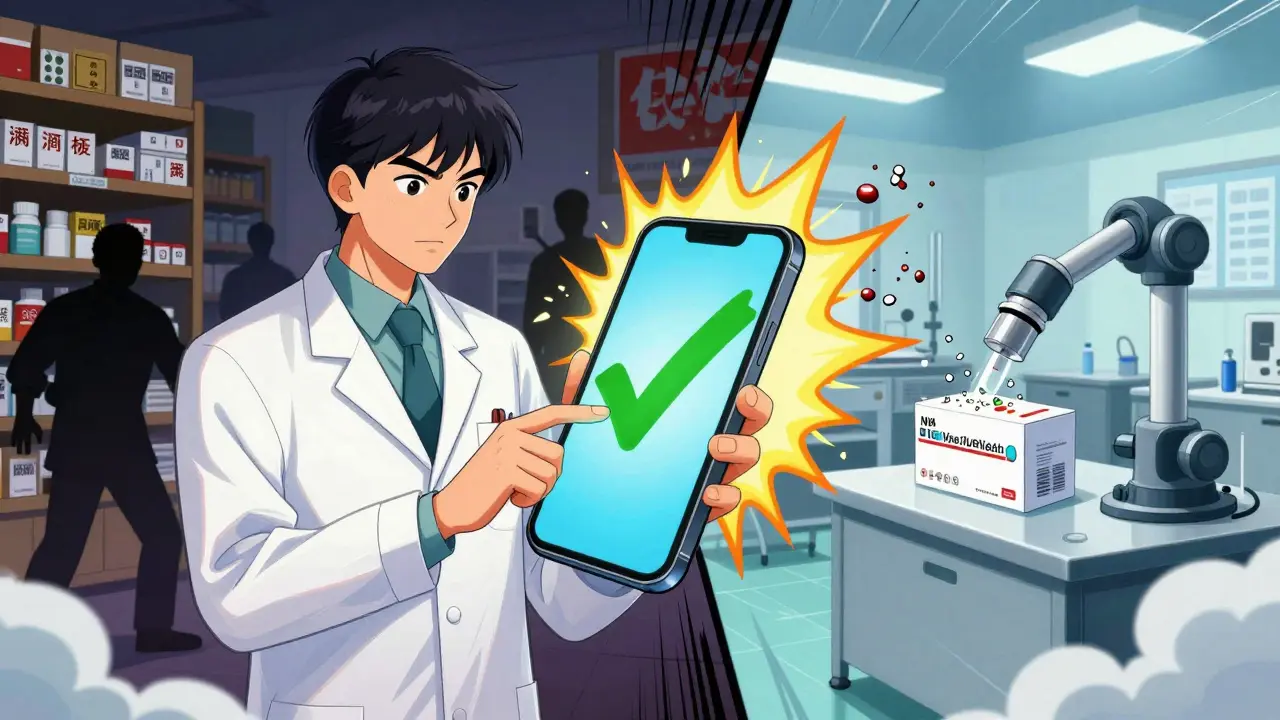
Blockchain: The Unbreakable Ledger
Blockchain isn’t just for cryptocurrency. In pharma, it’s becoming the backbone of supply chain transparency. Each time a drug moves-from manufacturer to distributor to pharmacy-a digital record is added to an immutable ledger. Temperature, humidity, location, and time are all logged. If the drug was exposed to heat during transport, that’s recorded. If it was tampered with, that’s recorded too. Companies like De Beers used blockchain to track diamonds. Now, pharmaceutical firms are adapting the same model. The EU’s upcoming Digital Product Passport rules, starting in 2027, will require this level of data transparency for every medicine. The catch? Blockchain is slow to deploy. Gartner estimates full integration takes 18 to 24 months. It’s expensive. It’s complex. But for high-value drugs like insulin or cancer treatments, it’s worth it. It’s the only way to prove a drug hasn’t been tampered with from factory to patient.DNA Markers and Forensic Inks: The Invisible Shield
Some of the most advanced anti-counterfeit tech is invisible. DNA-based authentication embeds synthetic DNA strands into packaging ink or labels. These strands are unique to each batch and can only be read with a lab scanner. Counterfeiters can’t replicate them. The cost? $0.15 to $0.25 per unit-too expensive for low-cost generics, but perfect for high-value biologics. Then there are covert inks: thermochromic inks that change color with heat, UV-reactive patterns only visible under blacklight, and holograms that shift when tilted. These aren’t new, but they’re getting smarter. Modern holograms use nanostructures that can’t be copied by standard printers. Guilloche patterns-fine, interwoven lines-are now machine-generated with precision that no human hand can match. These features work together. A single package might have a visible hologram, an invisible UV code, a serialized QR, an NFC chip, and a DNA marker. That’s called multi-layered security. And by 2027, 83% of pharmaceutical executives plan to use this approach.AI and Smart Packaging: The Eyes of the Supply Chain
While humans can’t spot fake packaging, AI can. Companies like Cognitivemarket have trained AI systems to scan drug boxes and detect subtle differences in printing, color, font, or seal alignment. In controlled tests, these systems hit 99.2% accuracy. Real-world use is trickier-lighting, angles, and packaging wear can fool the system. But accuracy is improving fast: from 89.7% in 2024 to 94.3% by mid-2025. Smart packaging is also evolving. Some blister packs now include IoT sensors that monitor temperature during shipping. If the drug was exposed to heat above 25°C, the sensor logs it. That data is sent to the blockchain. If the drug is later found to be ineffective, investigators can trace it back to a failed cold chain.
The Real Challenges: Cost, Speed, and Global Inequality
The biggest barrier isn’t technology-it’s money. Serialization systems cost small manufacturers $1-$3 million to implement. Many can’t afford it. In the U.S. and Europe, 97% of big pharma is compliant. In Africa and parts of Asia, adoption is under 30%. Tariffs are making it worse. President Trump’s April 2025 "Liberation Day Tariffs" slapped 10% to 46% taxes on pharmaceuticals and packaging materials from China and India. That raised production costs by 12-18% and delayed shipments by 3-6 weeks. For companies already struggling to pay for security tech, this is devastating. And counterfeiters aren’t standing still. They’re using AI to generate fake labels, 3D printers to replicate blister packs, and deepfakes to mimic official websites. The arms race is real.What You Can Do: Verify Before You Take It
If you’re buying medicine online-or even from a local pharmacy-don’t assume it’s real. Here’s what to check:- Look for a tamper-evident seal. If it’s broken, don’t use it.
- Check for a hologram or color-shifting ink. Tilt the package. Does it change?
- Use your phone. If there’s an NFC chip or QR code, scan it. Does it link to the manufacturer’s official site?
- Don’t buy from websites without a physical address or licensed pharmacist on staff.
- If the price seems too good to be true, it probably is.
Edith Brederode
This is so important!! 🙌 I had a friend who got sick from a fake painkiller bought online-turns out it was just chalk and battery acid. 😱 We need to spread awareness like crazy. Thank you for breaking this down so clearly!
clifford hoang
Let’s be real-this whole ‘anti-counterfeit’ push is just Big Pharma’s way of locking out generics and raising prices. They’ve been selling us overpriced pills for decades, and now they want us to trust their ‘secure’ blockchain? 🤨 The same companies that pushed opioids are now playing the hero? Wake up. The real problem is profit-driven healthcare, not counterfeit labels.
Arlene Mathison
Okay but NFC is literally magic. I scanned my insulin box last week and my phone popped up the full supply chain-manufacturer, shipping route, temp logs, everything. I cried. Not because I’m emotional, but because for the first time, I felt safe taking my medicine. This tech? It’s not hype. It’s life-saving. 💪
Emily Leigh
Ugh. Another ‘tech will save us’ article. So… we’re supposed to trust a QR code? A chip? A ‘hologram’? Please. The real solution is just stop letting people sell meds online without a license. End of story. 🙄
Carolyn Rose Meszaros
My grandma just started using her phone to check her blood pressure meds-she’s 78 and doesn’t know what ‘blockchain’ means, but she taps the box and smiles when it says ‘REAL’. That’s the win right there. ❤️
Greg Robertson
I work in a small clinic in rural Ohio. We’ve had two batches of fake metformin come through in the last year. The serialization system we finally got last month caught both. It’s not perfect, but it’s the first time we’ve had any real defense. Thanks for highlighting this-it’s not flashy, but it’s critical.
Renee Stringer
It’s irresponsible to suggest that consumers should verify drugs with their phones. Most people don’t know what NFC is. This places the burden on the vulnerable, not the corporations who profit from the chaos. The FDA should be enforcing bans-not handing out tech tutorials.
Art Gar
While the article presents a technically detailed narrative, it fails to address the fundamental epistemological flaw in relying on proprietary, opaque security systems as a proxy for public health integrity. One cannot trust a cryptographic signature if the entity issuing it has a vested interest in obscuring supply chain failures. The very architecture of these technologies replicates the power asymmetries that enabled counterfeiting in the first place. Therefore, the proposed solutions are not solutions-they are sophisticated obfuscations dressed in innovation rhetoric.
Crystal August
So… you’re telling me I need to buy a $100 phone just to check if my $5 aspirin is real? And if I can’t afford a smartphone? Or if I’m blind? Or if I’m elderly and don’t know how to tap? This isn’t safety-it’s elitist nonsense. You’re solving a problem for the rich while the poor still die from fake pills. And you call this progress?
Nadia Watson
thank you for sharing this. i’m from nigeria and we see fake drugs every day. my cousin died from fake malaria pills last year. the nfc thing? we don’t have phones that support it. the qr codes? we don’t have reliable internet. the blockchain? no servers here. this tech is amazing… but it’s not for us. and no one talks about that. please, if you’re in the us or eu, push for global funding-not just for your own safety, but for ours too. we need tech that works on a $20 android and 2g network. not just ‘smart’ stuff.
Courtney Carra
It’s funny how we celebrate tech as saviors while ignoring the human cost. DNA markers cost $0.20 per pill? That’s fine for insulin. But for antibiotics in Bangladesh? That’s a death sentence. Innovation without equity is just a luxury. And honestly? I’m tired of articles that make me feel guilty for not having a smartphone to check if my medicine is real. We need policy, not apps.