
When a patient picks up their prescription and sees a pill that looks completely different from what they’ve been taking, panic can set in. Generics aren’t just cheaper-they’re the same medicine. But patients don’t always know that. That’s where nurses come in.
Nurses are on the front lines of medication safety. Every day, they hand out pills, answer questions, and watch for signs that a patient doesn’t understand what they’re taking. And when it comes to generics, those conversations can make the difference between someone staying healthy or ending up back in the hospital.
Why Patients Worry About Generics
It’s not irrational fear. It’s confusion. A patient might have taken a white, oval pill for years-then suddenly gets a blue, round one. Same name on the bottle, but different shape, color, even taste. They think: Is this even the same thing?
According to the FDA, 68% of patients believe generics are less effective than brand-name drugs. That’s not because they’re wrong about the science-it’s because no one explained it to them clearly. Nurses hear this question all the time: “Is this generic as good as the brand?”
And the answer isn’t just “Yes.” It’s “Here’s why.”
What Nurses Actually Say
Nurses don’t just recite FDA guidelines. They translate them into real life.
They start by confirming the active ingredient matches. “This pill has the same medicine in it as your old one-levothyroxine, 50 micrograms. The FDA requires that every generic must deliver the same amount of medicine into your bloodstream within the same time frame.”
Then they address appearance. “The color and shape changed because the company that makes this generic uses different fillers and dyes. But the medicine itself? Identical. The FDA inspects their factory the same way they inspect the brand-name maker.”
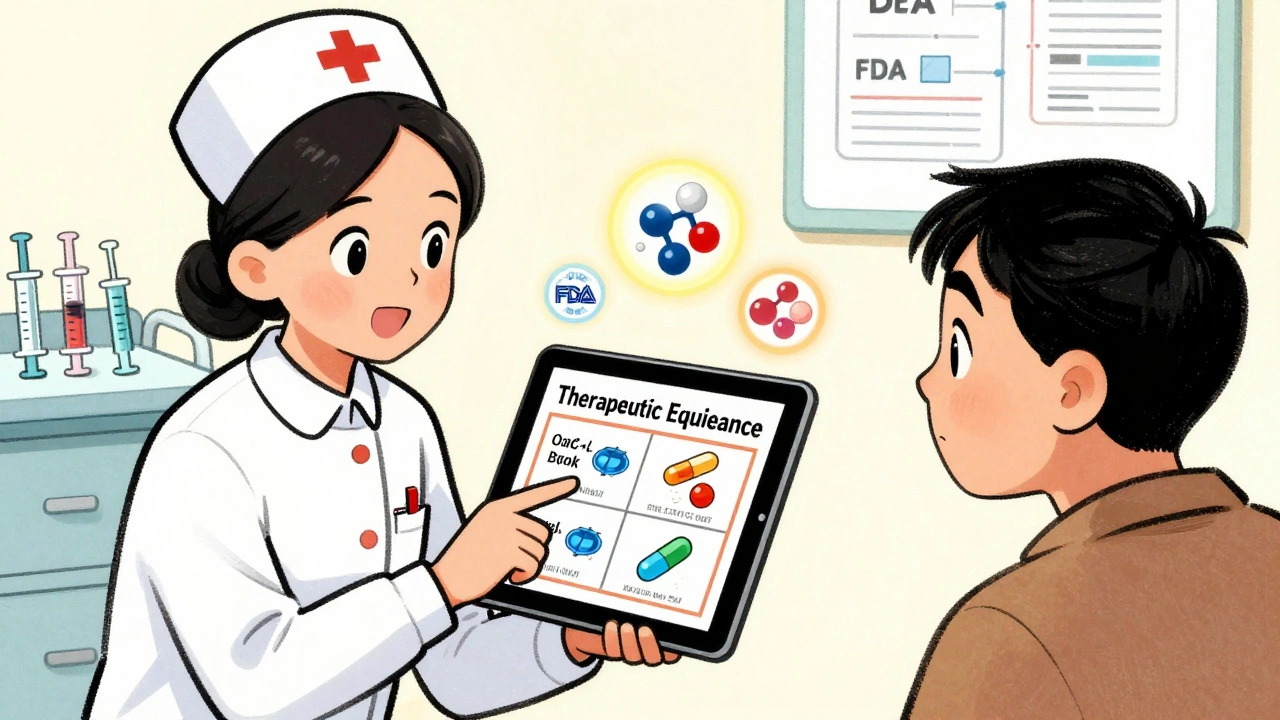
Some nurses show patients the FDA’s Orange Book on their tablet. Others use visual aids-photos of different versions of the same drug side by side. One nurse at Johns Hopkins keeps printed cards in her pocket: “Same medicine. Different look. Same effect.”
For high-risk drugs like warfarin or lithium, nurses go further. They don’t just explain equivalence-they stick with the same manufacturer unless the patient insists otherwise. “When the pill changes color every month, patients get scared. They skip doses. We avoid that by keeping consistency when we can.”
The Nursing Approach vs. Pharmacy Counseling
Pharmacists explain generics at pickup. Nurses explain them during care.
Pharmacists have more time-8 to 12 minutes. Nurses have moments: 3 to 5 minutes between checks, while adjusting an IV, or right before discharge. But they have something pharmacists don’t: continuity.
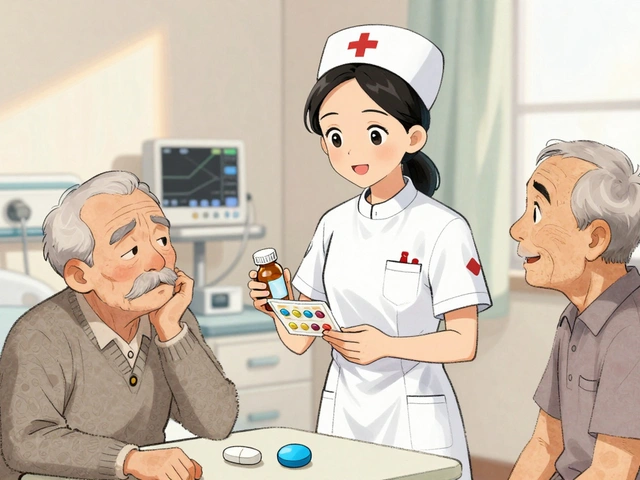
A patient might hear about a generic switch from a pharmacist, then see their nurse three hours later. That nurse notices they’re frowning at their pill bottle. “You okay?” she asks. “I thought this was supposed to be the same, but it’s not the color I’m used to.”
That’s when nursing wins. Nurses build trust over days, not minutes. A 2023 study found patients who saw the same nurse regularly had 44% fewer concerns about generics than those who only talked to pharmacists.
And when patients are confused or scared, nurses notice. They see the hesitation before swallowing. The way someone hides a pill in their cheek. The silence after a question.
What Nurses Must Know
Not all generics are created equal in practice-even if they are in theory.
Nurses need to know which drugs are narrow therapeutic index (NTI) drugs. These are medications where even tiny differences in blood levels can cause harm. The FDA lists 15 of them: warfarin, levothyroxine, phenytoin, digoxin, lithium, and others.
For NTI drugs, some hospitals require nurses to document the manufacturer name when a generic is given. If a patient was on one brand of generic and gets switched to another, the nurse flags it. “We don’t change the manufacturer unless the patient agrees and we talk to the provider first.”
Nurses also need to know state laws. In some states, pharmacists can switch generics without telling the prescriber. In others, they must notify the patient. Nurses track these differences because they’re the ones who see the fallout if a switch goes wrong.
And they must know how to use the teach-back method. Not just ask, “Do you understand?” But say, “Can you tell me in your own words why this pill is safe to take?” If the patient says, “It’s cheaper,” that’s not enough. The goal is to hear: “It has the same medicine as the brand, and the FDA checks it to make sure.”
What Goes Wrong When Counseling Fails
A 68-year-old man stopped taking his levothyroxine after his pharmacy switched to a different generic. He didn’t know it was the same drug. He felt tired. Cold. Slow. He didn’t tell anyone. Two weeks later, he was hospitalized with myxedema crisis-a life-threatening thyroid failure.
That case was documented in the American Journal of Health-System Pharmacy. It wasn’t a pharmacy error. It wasn’t a doctor’s mistake. It was a counseling gap.
Another patient, on warfarin, switched generics and didn’t realize the new pill looked different. He thought his blood thinner had changed. He stopped taking it for three days. His INR dropped. He had a stroke.
These aren’t rare. A 2022 survey found 76% of nurses hear patients ask about generic effectiveness at least once a week. And 63% of those nurses use FDA patient materials to help explain it.
But not all nurses are trained. A 2023 survey by the National Council of State Boards of Nursing found 41% of new nurses felt unprepared to counsel on generics. That’s a problem.
How Hospitals Are Fixing It
Leading hospitals are building systems to make counseling automatic.
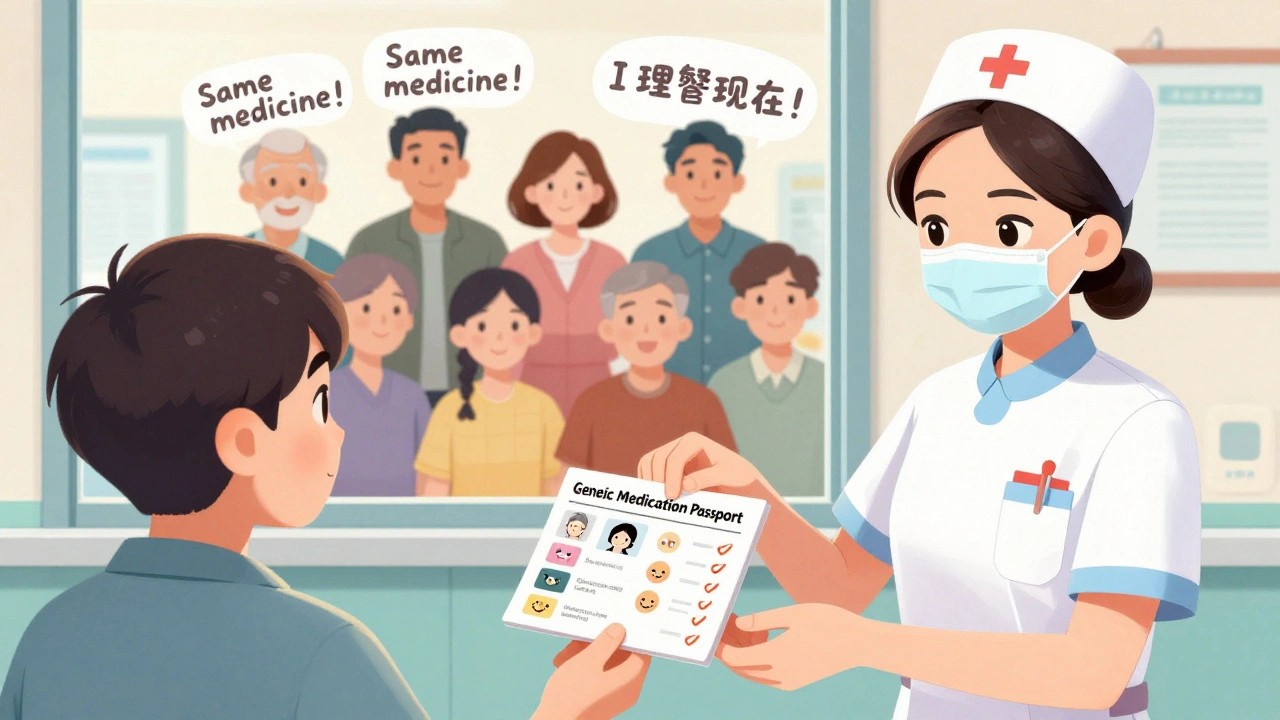
At Mayo Clinic, nurses now give patients a Generic Medication Passport-a small card that lists every generic they’ve been given, with a photo of the pill and the manufacturer. Patients keep it in their wallet. When they switch pharmacies or providers, they show it. No confusion.
Electronic health records now have mandatory fields. When a nurse administers a generic, they must check off: “Explained therapeutic equivalence,” “Addressed appearance concerns,” “Verified understanding.” If they don’t, the system won’t let them sign off.
And new tools are coming. By 2024, 45% of healthcare systems use AI-powered apps that pop up on a nurse’s tablet when a generic is dispensed. It shows: “This generic is rated AB1 by FDA. Same as brand. Manufacturer: Teva. Lookalike brand: Synthroid.”
It’s not magic. But it helps.
What Nurses Can Do Tomorrow
You don’t need a fancy app or a new policy to make a difference.
Start with these five steps:
- Ask first. “Have you noticed your pill looks different lately?” Don’t assume they know.
- Explain simply. “It’s the same medicine. Just made by a different company. The FDA makes sure it works the same way.”
- Show them. Use a photo, a card, or your phone. Visuals beat words.
- Check understanding. “Can you tell me why it’s safe to take this one?”
- Document it. Even if it’s just a note: “Patient questioned generic. Explained equivalence. Verified understanding.”
That’s it. No jargon. No lectures. Just clear, calm, human conversation.
And remember: patients aren’t resisting generics because they’re stubborn. They’re resisting because they’ve been left in the dark.
What’s Next for Nursing and Generics
The future is bigger than pills.
Biosimilars-generic versions of complex biologic drugs-are coming fast. By 2028, their use could grow 300%. These aren’t simple tablets. They’re injectables made from living cells. The differences are harder to explain. The fears are deeper.
Nurses will need new training. The American Association of Colleges of Nursing already requires all nursing graduates to understand therapeutic equivalence. That’s a start.
And soon, CMS will require all Medicare patients to receive documentation of generic counseling. That’s 60 million people. Nurses will be the ones doing it.
Generics save the U.S. healthcare system over $1 trillion a year. But money doesn’t heal people. Understanding does.
When a nurse takes the time to explain that a blue pill is just as good as a white one, they’re not just giving advice. They’re giving safety. They’re giving trust. And sometimes-they’re giving life.
Katherine Gianelli
God I love nurses who do this right. I had a grandma who stopped her thyroid med because the pill turned from white to blue and she swore it was poison. She almost didn’t make it. Then a nurse sat with her for 20 minutes showing pictures side by side and just said, 'It’s like swapping sneakers-same sole, different color.' She cried. Then she hugged her. That’s the stuff that saves lives.
Why do we make it so hard? It’s not about science. It’s about feeling safe.
Also-why don’t we give patients a little card like the passport thing? Like a 'medication ID' you keep in your wallet? So simple. So powerful.
Joykrishna Banerjee
Let’s be honest-this entire narrative is a regulatory propaganda piece masquerading as clinical wisdom. The FDA’s ‘bioequivalence’ standards are laughably lenient-±20% AUC variation is not ‘the same medicine,’ it’s pharmacological roulette. And let’s not pretend the fillers don’t matter-some generics contain lactose, gluten, or dyes that trigger adverse reactions in sensitive populations. This isn’t counseling-it’s corporate appeasement dressed in scrubs.
Also, the ‘Orange Book’ is a joke. It doesn’t account for inter-batch variability. Real clinicians know this. But you won’t hear it from a nurse who’s been trained to parrot pharma-approved talking points.
Myson Jones
I’ve been a nurse for 22 years and I’ve seen this exact thing happen over and over. Patients don’t distrust generics because they’re dumb-they distrust them because they’ve been burned before. One guy I knew took a generic statin and got rhabdo. Turns out the filler was different. He didn’t know that. He just thought he’d been poisoned.
So now I always say: ‘It’s the same active ingredient. But if you’ve had a bad reaction before, we’ll stick with what you know.’ No judgment. No rush. Just: ‘Your body, your call.’
And yes, the teach-back method? Non-negotiable. If they can’t explain it back in their own words, we haven’t done our job.
parth pandya
great post! but u forgot to mention that some generics are made in india and china and the quality control is not same as usa. i had a friend who took a generic metformin and got diahrrea for 3 weeks. it was the filler. not the drug. but still. we need to be carefull. also, the FDA does not inspect every factory. only some. so dont trust blindly.
also, in india we have 100s of generics for same drug. how do u know which one is good? no one tells u. nurses should teach patients to check the manufacturer code on the bottle.
and yes, the pill color change scares people. i saw a old lady throw away her whole bottle because it was pink instead of white. she thought it was for dogs.
Rashi Taliyan
I’m crying. I’m literally crying. I watched my aunt die because she stopped her lithium after the pill changed color. She didn’t say a word. Just stopped. She thought they gave her poison. She didn’t know how to ask. No one asked her.
This article? It’s not just about pills. It’s about dignity. It’s about not letting someone feel stupid for being scared.
Every nurse reading this-please, please, please don’t rush. Sit down. Look them in the eye. Let them hold the pill. Let them feel the weight of it. That’s how you heal.
I’m sending this to every nurse I know. This is sacred work.
Kara Bysterbusch
As someone who grew up in a household where medication was treated like sacred ritual-every pill, every time, exact same way-I can say this with absolute certainty: the emotional weight of a pill’s appearance is not trivial. It’s cultural. It’s psychological. It’s spiritual.
One of my patients, a Vietnamese grandmother, refused her new generic antihypertensive because it was ‘too round.’ She said the old one had ‘the right shape for the soul.’ We didn’t argue. We got her the old brand-paid for it out of our charity fund. She lived another 7 years. She never said thank you. But she smiled every time she took it.
Medicine isn’t just chemistry. It’s ritual. And nurses? We’re the keepers of both.
Gene Linetsky
Oh wow. So the FDA is just a puppet of Big Pharma and nurses are the new propaganda agents? How cute. Let me guess-you also believe the moon landing was real and that vaccines don’t contain microchips?
Here’s the truth: generics are often made in factories with zero oversight. The FDA inspects less than 2% of overseas plants. And the ‘same bioavailability’ claim? That’s based on healthy young men in controlled labs-not 80-year-olds with liver disease.
And don’t even get me started on the ‘teach-back’ method. That’s just corporate speak for ‘make the patient feel guilty for being scared.’
Next you’ll tell me the water is wet and gravity isn’t a hoax.
Ignacio Pacheco
So the solution to a 68% misunderstanding rate is… more paperwork and checklists? Brilliant.
Let me guess-the next step is mandatory nurses wearing little ‘I ♥ Generics’ pins and singing ‘I’m a Pill, I’m the Same!’ during rounds?
Meanwhile, real people are getting strokes because their INR wasn’t checked after a switch, and the nurse just clicked ‘verified understanding’ because the EHR forced it.
It’s not counseling if it’s a checkbox. It’s compliance theater.
Also-why does every healthcare article now sound like a TED Talk written by a marketing intern?
Jim Schultz
Let’s cut the crap. This isn’t about ‘counseling’-it’s about cost-cutting disguised as compassion. The system wants generics because they’re cheaper. Nurses are being turned into cheerleaders for corporate profit.
And don’t you dare tell me ‘the science says it’s the same.’ Science doesn’t care if your grandma’s kidneys can’t metabolize the new filler. Science doesn’t care that her insurance won’t cover the brand. Science doesn’t care that she’s terrified.
But nurses? We do. And that’s why this system is broken. We’re not here to explain pills-we’re here to fix a system that treats people like data points.
Also-Teva? Yeah, I know their factory in Puerto Rico. I’ve seen the reports. Don’t pretend this is clean.
Kidar Saleh
In the UK, we have a similar issue. Patients panic when their statin changes from blue to yellow. We don’t have the ‘passport’ system, but we do have something better: continuity of care. The same community pharmacist, the same GP, the same nurse. People trust faces, not labels.
One elderly man came in last month, trembling, because his levothyroxine was now ‘yellow.’ He’d been on the same brand for 15 years. I didn’t explain FDA guidelines. I said, ‘I remember you. You used to bring your cat in for checkups. This is still your medicine. The shape just changed.’ He cried. Took the pill. Walked out smiling.
That’s not protocol. That’s humanity.
And yes-I’m not using emoticons. Because this isn’t a meme. It’s a life.
shalini vaishnav
USA thinks it owns healthcare innovation. But in India, we’ve been using generics for 50 years. We don’t need ‘passports’ or ‘teach-backs.’ We just take the pill. We don’t cry over color.
Also, the FDA is a joke. We have 1000+ manufacturers of levothyroxine. We don’t have time to ‘explain equivalence.’ We have 300 patients a day. We give the pill. They take it. Life goes on.
Why do Americans make everything so complicated? It’s just medicine. Stop overthinking. Stop crying over pills. Just take it.
And if you’re scared? Then go to a private hospital. Pay more. But don’t blame nurses for your privilege.
Katherine Gianelli
Wow. I just read the comment from the Indian nurse who said ‘we don’t cry over color.’ And I’m not mad-I’m heartbroken.
Because she’s right. We’ve made this into a performance. A checklist. A TED Talk. While people in other parts of the world just… take the pill. Because they have no choice.
But here? We have choice. And we use it to overthink. To over-document. To over-analyze.
Maybe the answer isn’t more tools. Maybe it’s less noise.
Just sit with them. Hold their hand. Say, ‘I know this feels weird. But you’re safe.’
That’s all. Just that.