
When you pick up a prescription, you might notice two different dates on the label. One says expiration date-the same one printed on the original bottle from the drugmaker. The other says beyond-use date, often handwritten or printed in smaller text. If you’ve ever thrown out a bottle of medication because it "expired" only to find out later it was still safe, you’re not alone. Many patients get confused. But these two dates aren’t the same thing. Understanding the difference isn’t just about avoiding waste-it’s about safety, effectiveness, and knowing when to trust your pharmacist over the label.
What’s the Difference Between Expiration Dates and Beyond-Use Dates?
An expiration date is the date set by the manufacturer after rigorous testing that guarantees the medication will remain fully potent, safe, and stable under recommended storage conditions. This applies to commercially produced drugs-pills, capsules, or liquids made in large batches and approved by the FDA. The manufacturer tests each formula under controlled heat, humidity, and light to ensure it doesn’t break down before that date. If you store it properly, the drug should work as intended up to that day.
A beyond-use date (BUD) is the last date a compounded or altered medication should be used, assigned by the pharmacist after the drug has been changed from its original form. This could mean mixing powders into a liquid, repackaging bulk pills into daily doses, or adding flavoring for a child who can’t swallow tablets. Unlike expiration dates, BUDs aren’t based on manufacturer testing. They’re based on guidelines from the United States Pharmacopeia (USP) and local pharmacy rules.
Why Can’t You Use the Manufacturer’s Expiration Date on Compounded Medications?
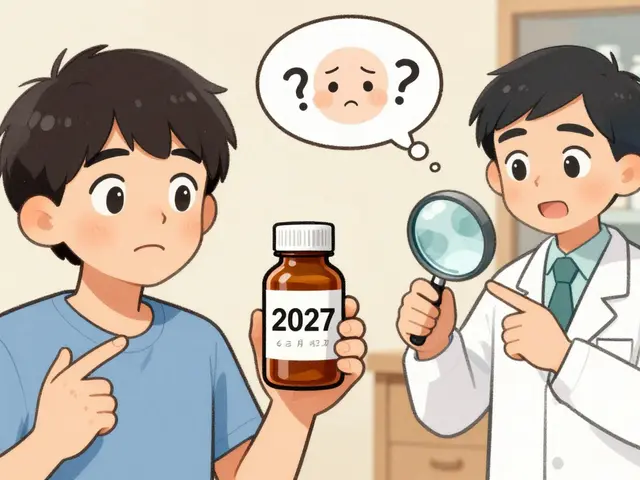
Imagine you take a capsule of amoxicillin. The bottle says it expires in 2027. Now, your doctor says you need it in liquid form because you can’t swallow pills. The pharmacy opens the capsule, mixes it with a syrup, and bottles it. That’s now a different product. The original stability testing? It no longer applies. The liquid might grow bacteria. The active ingredient might break down faster without the protective coating. The container might not be as airtight. That’s why the pharmacist gives you a new date-the BUD.
Dr. Daniel Sheridan, RPh, MS, puts it simply: "If a drug is altered in any way-for example, to make an I.V. admixture-the expiration date can no longer be used because it is valid only under the specific conditions tested by the manufacturer. Instead of an expiration date, this type of product requires a BUD, which is similar to an expiration date but typically much shorter."
This is why you’ll often see two dates on your compounded med: the original manufacturer’s date (on the bulk bottle) and the BUD (on your dispensed bottle). The BUD always takes priority.
How Long Do Expiration Dates and BUDs Last?
Expiration dates for commercial drugs usually range from 12 to 60 months after manufacturing. They’re set based on FDA-mandated stability studies that track chemical breakdown over time. The FDA requires manufacturers to prove the drug stays at least 90% potent until that date. Some studies, like one from the FDA’s Drug Expiration Program, found that 90% of tested drugs were still effective even 15 years past their expiration date-if stored perfectly. But the FDA doesn’t recommend using them past the printed date because home storage varies. A medicine left in a hot car or a damp bathroom? That’s not the controlled lab environment it was tested in.
BUDs are much shorter. Here’s how they break down:
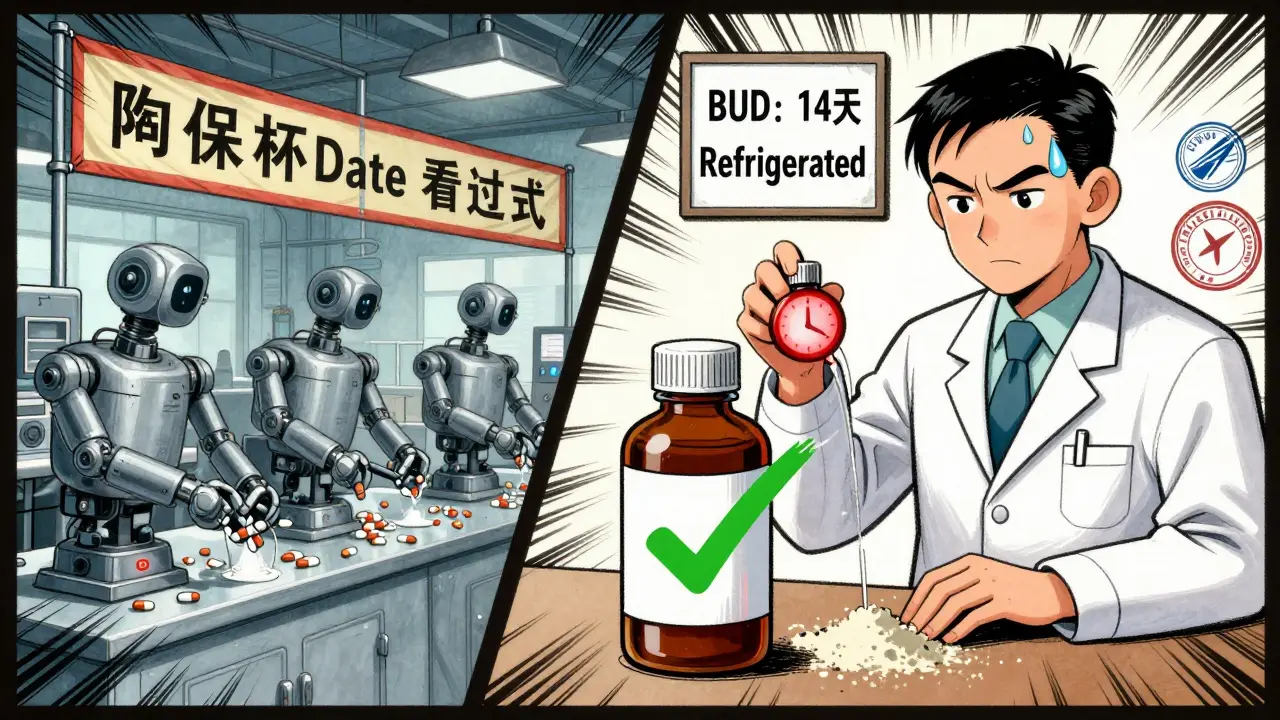
- Non-sterile compounded liquids (like flavored suspensions): 14 days if refrigerated, 34 days if stored at room temperature
- Non-sterile solid forms (like capsules or powders mixed into tablets): up to 180 days at room temperature
- Repackaged commercial drugs (e.g., blister packs): the earlier of the original expiration date or 1 year after repackaging
- Sterile compounds (like IV bags): up to 6 months if refrigerated, depending on the preparation
These limits come from USP Chapter <795>, which outlines how pharmacists should assign BUDs based on risk level. Simple mixtures get longer BUDs. Complex ones? Shorter. The goal is to prevent contamination or loss of potency.
Storage Matters More Than You Think
Expiration dates assume you store the medicine as directed: "Keep at room temperature, away from moisture." But compounded medications? They’re more fragile. A pill that didn’t need refrigeration might become unstable once mixed into a liquid. That’s why your pharmacist might tell you to keep your compounded thyroid medication in the fridge-even if the original pill didn’t say so.
Temperature swings, sunlight, and humidity all speed up degradation. A 2022 survey by the International Academy of Compounding Pharmacists found that 68% of patients threw away compounded meds because they expired before finishing the course. That’s compared to just 22% for regular prescriptions. Why? Because BUDs are short, and people forget to check them.
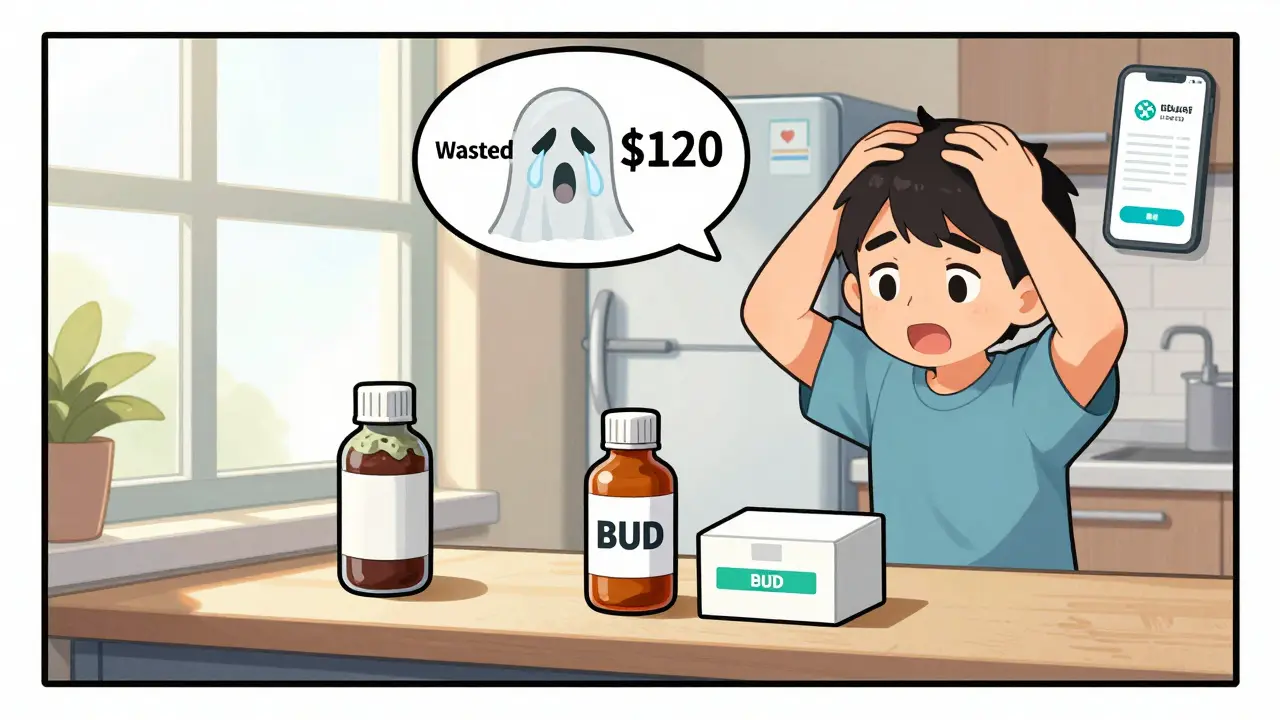
One patient in Nottingham told me: "I thought my compounded thyroid medication was good until 2024 like the bottle said, but the pharmacist told me the BUD was only 6 months from when they made it-this cost me $120 in wasted medication." That’s not rare. It’s a common point of confusion.
What Happens If You Use Expired or Out-of-BUD Medication?
Using a drug past its expiration date doesn’t usually make it dangerous. But it might not work. A study from the American Society of Health-System Pharmacists (ASHP) found that some antibiotics and insulin lose potency over time, increasing the risk of treatment failure. For chronic conditions like high blood pressure or epilepsy, that’s risky.
With BUDs, the risk is higher. Compounded meds often lack preservatives. A liquid made in a pharmacy without proper sterile technique can grow mold or bacteria. If you use it past its BUD, you could be ingesting something that’s not just weak-it’s unsafe.
The FDA doesn’t encourage using any drug past its labeled date. Dr. Sandra Kweder, Deputy Director of the FDA’s Center for Drug Evaluation and Research, says: "We know that manufacturers set expiration dates with substantial safety margins, but we cannot recommend using drugs beyond their expiration dates because storage conditions vary too much in the real world."
How to Avoid Confusion and Waste
Here’s what to do when you get a prescription:
- Check both dates. If it’s a compounded medication, the BUD is the one that matters.
- Ask your pharmacist: "Is this a compounded product? What’s the BUD?" Don’t assume it’s the same as the original bottle.
- Store it exactly as instructed. If it says "refrigerate," put it in the fridge-not the medicine cabinet.
- Set a reminder. Mark your calendar or phone for the BUD date. Many pharmacies now offer text alerts.
- Return expired meds to the pharmacy. Over 90% of U.S. pharmacies offer free take-back programs. Don’t toss them in the trash.
Some pharmacies even label compounded meds with a sticker that says: "BUD: Do not use after [date]. This is not the manufacturer’s expiration date." That’s a good sign they’re following best practices.
The Bigger Picture: Why This Matters
The U.S. compounding pharmacy market is worth over $11 billion and serves about 8 million people. These aren’t niche cases. They’re kids with allergies, seniors who can’t swallow pills, patients needing hormone replacements, or people with rare conditions. Without compounding, many wouldn’t have access to treatment at all.
But inconsistent BUD rules across states are a problem. The FDA issued 27 warning letters to compounding pharmacies in 2022 for improper dating. USP is updating its guidelines to tighten limits-especially for high-risk preparations. That means BUDs might get even shorter in the near future.
For patients, the key takeaway is simple: When the medication is altered, the original expiration date is no longer valid. Trust the BUD. Ask questions. Store it right. And don’t guess.
Is it safe to use a medication after its expiration date?
The FDA says no. While some drugs may remain effective past their expiration date under perfect storage, there’s no guarantee. Potency drops over time, and chemical changes can occur. For life-saving medications like epinephrine or insulin, even a small loss of strength can be dangerous. It’s not worth the risk.
Why does my compounded medication have a shorter date than the original bottle?
Because the original expiration date only applies to the drug in its unaltered, factory-sealed form. Once a pharmacist mixes, dilutes, or repackages it, the stability changes. Without new testing, the manufacturer’s date can’t be trusted. The BUD is a safety limit based on what’s known about how the new formulation behaves.
Can I extend a beyond-use date by refrigerating the medication?
No. The BUD is assigned based on specific storage conditions. If the pharmacist says "keep refrigerated" and gives a 14-day BUD, that’s the maximum. Refrigerating it longer won’t make it last beyond that date. The BUD already factors in refrigeration. Going past it increases contamination risk.
What if my pharmacy doesn’t give me a BUD on a compounded med?
That’s a red flag. All compounded medications must have a BUD under USP guidelines. If you don’t see one, ask for it. If they refuse or can’t explain, consider switching to a pharmacy that follows proper standards. You have the right to know when your medication is safe to use.
Do expiration dates apply to over-the-counter drugs too?
Yes. OTC drugs like pain relievers, antacids, and allergy pills have expiration dates too. They’re regulated the same way as prescriptions. While some studies show they may still work years later, manufacturers aren’t required to guarantee safety beyond the printed date. It’s best to replace them after the date passes.
What to Do Next
If you take compounded medication, keep a note of your BUD dates in your phone. Ask your pharmacist to explain the difference every time you get a new prescription. If you’re unsure whether your med is compounded, ask: "Was this made here, or did you just refill the original bottle?" Most pharmacies will gladly answer.
And if you’ve thrown away a perfectly good med because you thought the expiration date applied to everything? You’re not the only one. But now you know better. And that’s how you protect yourself-and your health.
Paul Ratliff
I used to toss all my meds when the date hit until I learned about BUDs. My grandma’s compounded thyroid stuff had a 6-month BUD but the bottle said 2025. I almost threw it out. Saved $200 that time. Pharmacist was chill and explained it like I was 5. Now I check both dates like a pro.
SNEHA GUPTA
The distinction between manufacturer expiration and beyond-use dates reveals a deeper truth about how we treat knowledge in medicine. We assume scientific authority is absolute, yet the moment a compound is altered-by human hands, in a pharmacy-the original certainties dissolve. This isn't just about chemistry; it's about humility. The body doesn't care about labels. It responds to what's present. And sometimes, what's present is more than the date suggests-but we've been trained to fear the unknown.
Gaurav Kumar
USP guidelines? Please. In India, we don't need fancy USP rules. We've been compounding since ancient times-Ayurvedic decoctions, churned oils, custom blends. Your FDA and USP are just corporate bureaucracies trying to control what should be patient-centered. My cousin in Delhi gets her asthma inhaler compounded weekly with no BUD printed. She’s been fine for 8 years. Stop overregulating. Trust the pharmacist, not the paperwork.
David Robinson
Look, I get it. BUDs exist. But here’s the thing-most pharmacies don’t even know what they’re doing. I went to three different CVS locations asking about my compounded thyroid med. Two said 'just follow the bottle.' One said 'we don’t track BUDs.' So now I’m left wondering if I’m taking poison or just ineffective junk. And don’t even get me started on the fact that the FDA lets these places operate with zero oversight in 30 states. This isn’t healthcare. It’s a legal loophole with a stethoscope.
Jeremy Van Veelen
I’m not just a patient-I’m a *laboratory*. My body is the test tube. The pharmacist? The alchemist. The BUD? A fragile, trembling candle in a hurricane of corporate indifference. When they handed me that vial with the handwritten date-"Do not use after 04/17/2024"-I felt it. The weight of trust. The fragility of science. The quiet desperation of a system that says ‘we know best’ while leaving the label smudged and the instructions vague. I wept. Not because I was scared. But because I realized: I’m not being treated. I’m being managed.
Laura Gabel
I just throw everything out. Why risk it. If it's not new, it's trash. My pharmacist said the same thing so I don't even ask anymore. Save your money and your health. Expired = bad. BUD = bad. Just get a new one. Easy.
jerome Reverdy
The real issue here isn't the BUD-it's the communication gap. Pharmacists are overloaded. Patients are overwhelmed. The system isn't broken-it's just not designed for empathy. I work in a compounding pharmacy. We put stickers on every vial: 'BUD: This is NOT the manufacturer's date.' We call patients. We text reminders. We use color-coded labels. It's not rocket science. It's basic service. But too many shops treat this like paperwork, not care. If you're a patient, ask. If you're a pharmacist-stop cutting corners. We're all in this together.
MALYN RICABLANCA
I CAN’T BELIEVE PEOPLE STILL THROW AWAY MEDS BECAUSE OF A DATE?!?!?! I have a 17-year-old with cystic fibrosis who needs a custom nebulizer blend. The BUD is 14 days. We refill every two weeks. But last month? The pharmacy forgot to write the BUD. I called the FDA. I called the state board. I posted on 12 different forums. I had a 3-hour Zoom call with USP. I sent a handwritten letter to the CEO of the pharmacy chain. I cried. I screamed. I wrote a poem. I made a TikTok. I got a press release. And guess what? They changed their policy. Now they print BUDs in 18-point font with a red border. And they send a text. And they call. And they apologize. Because I didn’t just ask-I FIGHTED. And if you’re not fighting for your meds? You’re not living-you’re surviving.