
If you’ve ever opened a bottle of pills and found them sticky, discolored, or smelling odd, you’re not alone. Moisture damage is one of the most common but often overlooked threats to medication effectiveness-and it’s happening more than you think. In fact, moisture damage is behind nearly two-thirds of medication quality issues in the U.S., according to industry reports. That’s not just a lab problem. It’s happening in your bathroom cabinet, your purse, or that old pill organizer you left on the windowsill.
Why Moisture Ruins Pills and Capsules
Pills and capsules aren’t just sugar and powder. They contain active ingredients designed to work in your body under very specific conditions. When moisture gets in, it triggers chemical reactions that break down those ingredients. This isn’t just about losing potency. It’s about safety.Take aspirin, for example. When it absorbs moisture, it turns into salicylic acid and acetic acid-basically, vinegar. That’s not just ineffective. It can irritate your stomach. Vitamin C, another common supplement, breaks down faster in humid conditions, especially when it’s exposed to air. Antibiotics like amoxicillin/clavulanate can lose their strength so quickly that they become useless against infections.
Hydrolysis and oxidation are the two big culprits. Hydrolysis is when water molecules split apart the chemical bonds in the drug. Oxidation happens when moisture helps oxygen react with the active ingredient. Both processes reduce effectiveness and can create harmful byproducts. The result? A pill that doesn’t work-or worse, makes you sick.
The Three-Layer Defense System
Pharmaceutical manufacturers don’t leave this to chance. They use three proven layers of protection. You can, too.Layer 1: The Film Coating
Not all pills are created equal. Some have a thin, invisible coating that acts like a raincoat for your medication. The best ones are made from polyvinyl alcohol (PVA), like Opadry® amb II. These coatings block moisture far better than older types made from hydroxypropyl methylcellulose (HPMC). Studies show PVA-coated tablets keep their strength even after days outside the original bottle. HPMC-coated ones? They start falling apart in just a few hours in humid air.
If you’re buying medication, ask your pharmacist: “Is this coated with a moisture-resistant film?” If they don’t know, ask for a brand that uses PVA-based coatings. It’s worth it.
Layer 2: The Right Container
HDPE plastic bottles-those common white or blue pill bottles-look safe. But they’re porous. Moisture vapor slips through them slowly over time. That’s why manufacturers add desiccants. But if the bottle is too big and you’re only taking a few pills a week, you’re creating a moisture trap. Every time you open it, humid air rushes in. A 500-pill bottle opened twice a day creates over 250 chances for moisture to get inside.
Look for bottles with child-resistant caps that seal tightly. Avoid transferring pills to glass jars or plastic containers unless they’re specifically designed for medication storage. If you use a pill organizer, only fill it for a few days at a time. Don’t store it in the bathroom.
Layer 3: The Desiccant
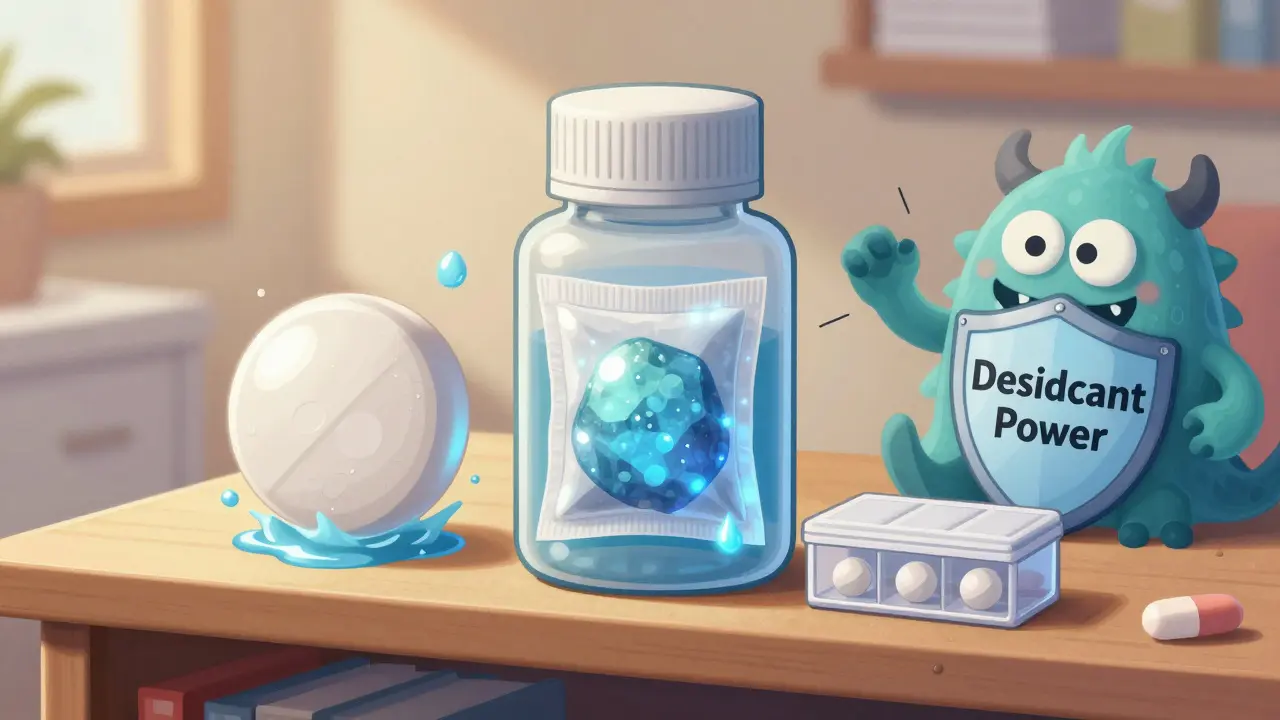
That little packet in your pill bottle? That’s silica gel. It’s not filler. It’s a moisture sponge. Silica gel can absorb up to 40% of its own weight in water. In controlled tests, properly sized desiccants kept moisture levels in pill bottles from rising more than 0.9% over six months-even under extreme heat and humidity.
Never throw away the desiccant packet. Keep it in the bottle. If it’s missing, buy replacement packs online (look for silica gel labeled for pharmaceutical use). Some brands now use Tyvek packaging, which blocks moisture better than standard plastic. If your medication came with a desiccant and it’s gone, ask your pharmacy for a new bottle.
Where NOT to Store Your Medication
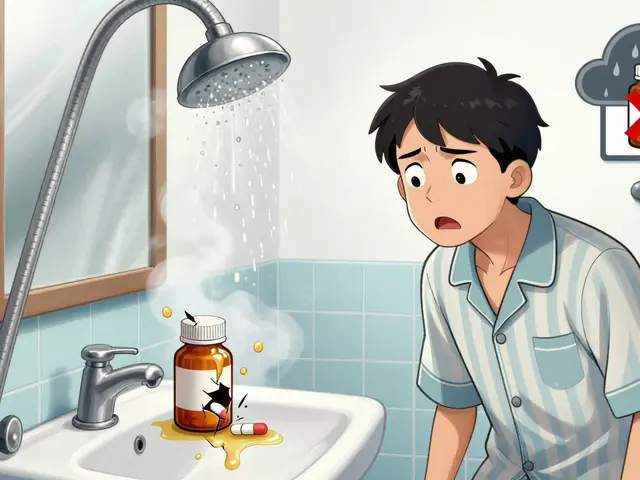
The bathroom is the worst place. It’s humid, hot, and full of steam. The kitchen is almost as bad-near the stove or dishwasher. Don’t leave pills in the car. Temperatures can hit 120°F in summer, and moisture builds up fast.The best spot? A cool, dry place. A bedroom drawer, a shelf in a closet, or a dedicated medicine cabinet in a low-humidity room. If you live in a tropical climate or near the coast, consider a small dehumidifier in the room where you store meds.
And don’t rely on the expiration date alone. That date assumes the pill was stored correctly. If it’s been in a steamy bathroom for six months, it could be degraded-even if the date says it’s still good.
What to Do If Your Pills Look Off
Check for these signs:- Sticky or clumped pills
- Discoloration (yellowing, dark spots)
- Cracking or crumbling when you touch them
- Unusual odor (vinegary, musty, or sour)
- Capsules that are soft, swollen, or leaking
If you see any of these, don’t take them. Return them to your pharmacy. Most will replace them for free. Taking degraded medication can mean your condition isn’t treated properly-or worse, it could cause side effects.
Real Stories from Real People
A pharmacist in Florida reported a 90% drop in customer complaints after switching to PVA-coated antibiotics. One patient had been getting migraines every time she took her old pills. After switching to a coated version, the headaches stopped. Turns out, the old pills were breaking down into irritants. Another case: a man in Brazil kept having his blood pressure meds fail. His bottles were always damp. He started using silica gel packs and switched to a sealed blister pack. His readings stabilized within weeks. On the flip side, a pharmacy chain in Texas had to recall 12,000 bottles of generic antibiotics because they were stored in unsealed HDPE bottles without desiccants. The moisture had turned the active ingredient into useless sludge.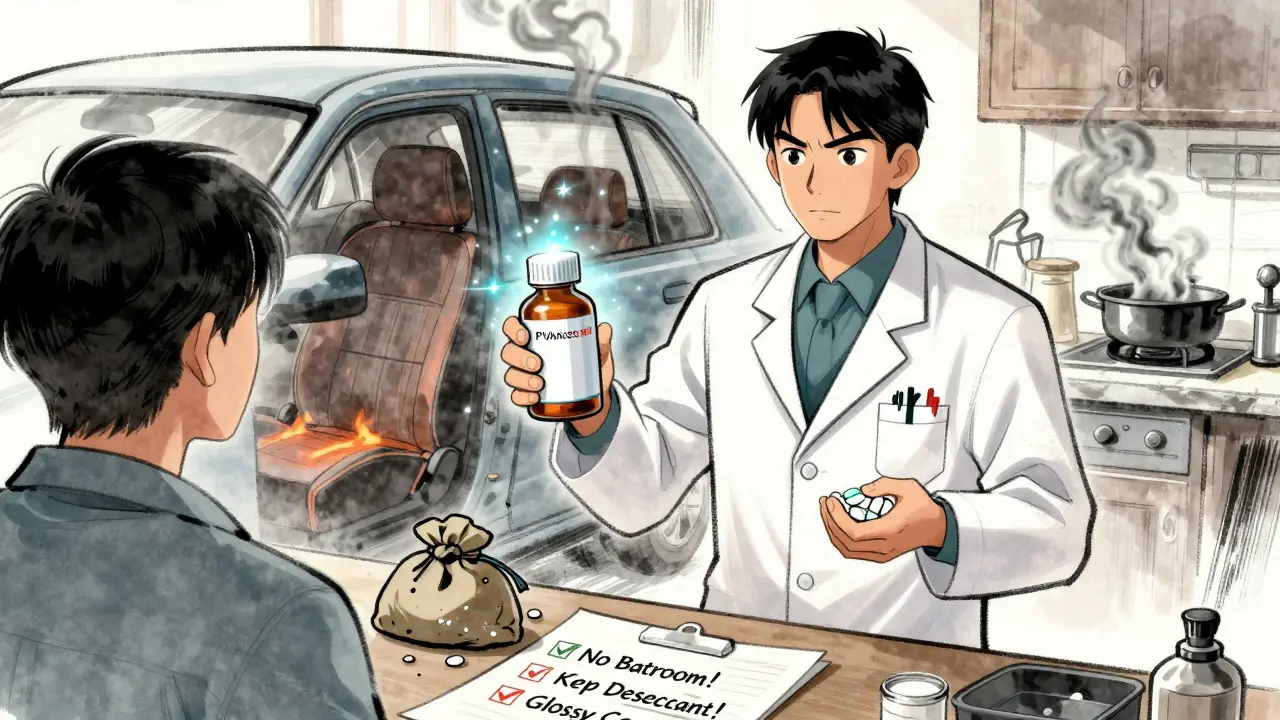
What You Can Do Today
You don’t need to be a scientist to protect your meds. Here’s your quick action plan:- Check your pill bottles. Is there a desiccant? If not, ask your pharmacist for a new bottle with one.
- Look at the pill. Is it shiny or glossy? That’s likely a PVA coating. If it looks dull or chalky, it’s probably HPMC-ask if a better-coated version is available.
- Move your meds out of the bathroom and kitchen.
- Only fill your pill organizer for 3-5 days at a time.
- Don’t store pills in your purse or glove compartment.
- When you open a new bottle, keep the desiccant inside. Don’t toss it.
These steps cost nothing. But they can save your health.
What’s Next for Medication Protection
The industry is moving fast. New coatings are being developed that don’t just block moisture-they actively absorb it from inside the pill itself. Some companies are testing color-changing labels that turn red when moisture levels get dangerous. Others are making biodegradable desiccants from plant-based materials to reduce plastic waste.For now, stick with what works: coated pills, sealed containers, and silica gel. It’s simple, proven, and effective. You don’t need the latest tech to protect your health. You just need to know what to look for-and what to avoid.
Can I keep pills in the fridge to avoid moisture?
Only if the label says to. Most pills don’t need refrigeration, and putting them in the fridge can cause condensation when you take them out. Moisture from the air can form on the bottle and seep inside. Unless your medication specifically requires refrigeration, keep it at room temperature in a dry place.
Are all desiccants the same?
No. Silica gel is the gold standard for pills because it’s safe, non-toxic, and highly effective. Avoid clay-based or calcium chloride desiccants-they’re used in electronics or industrial settings and aren’t approved for medication. Always use silica gel labeled for pharmaceutical use.
How do I know if my pill bottle has the right coating?
Look for a glossy, smooth finish on the pill. HPMC-coated pills often look dull or chalky. You can also ask your pharmacist: “Is this coated with a moisture-resistant film like Opadry?” If they’re unsure, ask for a brand known for PVA coatings-many generic manufacturers now offer them.
What if I lose the desiccant packet?
Buy replacement silica gel packs online or from a pharmacy supply store. Look for packs labeled for pharmaceutical use. You can also ask your pharmacy to refill your bottle with a new one that includes a desiccant. Don’t skip this step-especially if you live in a humid area.
Can moisture damage pills even if they’re sealed?
Yes. Plastic bottles, even sealed ones, let in moisture vapor over time. That’s why manufacturers add desiccants and use special coatings. If the pill is moisture-sensitive, the packaging alone isn’t enough. The combination of coating + desiccant + tight seal is what keeps it stable.
Do supplements like vitamins need the same protection?
Absolutely. Vitamin C, B vitamins, and probiotics are especially sensitive to moisture. A damp vitamin C tablet can lose up to 50% of its potency in a few months. Store them the same way you store prescription pills-cool, dry, and with the desiccant intact.
Siobhan K.
So let me get this straight-you're telling me my entire pharmacy experience has been a slow-motion disaster because I kept my pills next to the shower? And I thought the humidity was just making my hair frizzy.
Brian Furnell
The PVA vs. HPMC distinction is critical-seriously, if your pharmacist doesn't know the difference between polyvinyl alcohol and hydroxypropyl methylcelluplose, you're being sold outdated tech. PVA coatings have >90% moisture barrier efficiency in accelerated aging studies (ISO 10993-7), while HPMC degrades catastrophically above 60% RH. This isn't marketing-it's pharmaceutical engineering.
Adrian Thompson
Of course the government lets this happen. They don't want you to be healthy. Why? Because if you don't need pills, you don't need doctors. And if you don't need doctors, you don't need Big Pharma. It's all a scam. They're letting your meds rot so you'll buy more. And they're using HDPE bottles because it's cheaper than real science.
Stacey Smith
I threw away the desiccant packet for years. Never had a problem. Probably just paranoia.
Ben Warren
It is imperative to underscore that the degradation of pharmaceutical compounds via hydrolytic and oxidative pathways constitutes a direct violation of Good Manufacturing Practices (GMP) as codified under 21 CFR Part 211. The failure of manufacturers and consumers alike to enforce proper storage protocols represents not merely negligence, but a systemic dereliction of duty toward public health safety. The presence of acetic acid derivatives in degraded aspirin formulations is, by any objective standard, a biohazard.
Sandy Crux
I mean… technically, the entire premise assumes that pills are meant to be taken at all. Perhaps the real issue is pharmaceutical overreach? The body has innate homeostatic mechanisms-why rely on chemically engineered, moisture-sensitive tablets when fasting, meditation, and crystal alignment could restore balance?
Hannah Taylor
wait so u mean the little packet isnt just for show? i thought it was like a toy or something lol. i always toss it. now i feel like a dumbass.
Dan Adkins
The empirical evidence presented is incontrovertible. However, the cultural context of pharmaceutical storage in Western nations is fundamentally flawed. In Nigeria, we store medications in clay pots buried in dry earth-a method that predates industrialization by millennia. Modern packaging is not innovation; it is commodification of necessity.
Jay lawch
You speak of moisture as if it is the enemy. But moisture is the breath of life. Water is the universal solvent. The pill, in its artificial, dry, isolated form, is a monument to human arrogance. We extract compounds from plants, encapsulate them in plastic, and then panic when nature reclaims them. The real damage isn't to the pill-it's to our relationship with healing itself. We have forgotten that medicine was once grown, not manufactured.
Michael Ochieng
In Kenya, we call this 'bottle wisdom.' My grandma kept all her meds in a tin box on the shelf above the door-cool, dry, and never near the cooking fire. She lived to 98. Maybe the answer isn't new coatings-it's remembering old ways.
Erika Putri Aldana
I just take my vitamins with a glass of water and hope for the best. Life's too short to stress about silica gel. 😌
Grace Rehman
The real tragedy isn't moisture damage-it's that we've outsourced our health to a system that packages healing in plastic and calls it progress. We don't need better coatings. We need to stop treating our bodies like machines that need constant firmware updates.
Jerry Peterson
I used to store my meds in the bathroom. Now they're in a drawer with the desiccant. No more weird taste. Honestly? It's like night and day. Just don't overthink it. Keep 'em dry. Simple.