
FDA Drug Interaction Significance Checker
Input the pharmacokinetic data found in Section 12 of an FDA label to determine if the interaction meets the threshold for clinical significance.
FDA Reference Thresholds:
| Mechanism | Significant If... |
|---|---|
| CYP Enzyme | AUCR ≥ 1.25 or ≤ 0.8 |
| P-gp Transporter | Fold-Increase ≥ 1.5 |
| OATP1B1/1B3 | Fold-Increase ≥ 2.0 |
Ever opened a medication guide and felt like you were reading a different language? You're not alone. For healthcare providers and patients, the FDA drug interaction labeling system is the gold standard for safety, but it's not exactly intuitive. These labels are designed to prevent the estimated 1.3 million adverse drug events that happen every year in the U.S., but if you don't know where to look, you might miss a critical warning or get bogged down in technical jargon.
The goal isn't to memorize every possible interaction-that's impossible. Instead, the goal is to know exactly which sections of the FDA label hold the "what," the "why," and the "how" of a drug-drug interaction (DDI). Whether you are a pharmacist managing complex polypharmacy or a curious patient, understanding this structured framework allows you to make safer, evidence-based decisions without spending hours cross-referencing documents.
The Three-Step Map to Interaction Data
FDA labels aren't read from top to bottom like a novel. To interpret interactions efficiently, you need to jump between three specific sections. Think of it as a funnel: you start with the big-picture warning, move to the scientific proof, and end with the actual dose change.
First, head to Section 7. This is the "Action Center." About 85% of final clinical recommendations live here. If a drug is contraindicated or if you should avoid using it with another medication, Section 7 tells you explicitly. It's designed for rapid decision-making in fast-paced environments like ERs or clinics.
Next, if you need to know the evidence behind the warning, go to Section 12 (Clinical Pharmacology). This is where the science happens. It describes how the drug is metabolized, which enzymes are involved, and the results of clinical trials. While Section 7 tells you "don't do this," Section 12 explains "here is the data showing why this happens."
Finally, look at Section 2 (Dosage and Administration). This is the implementation phase. Once you've identified a significant interaction in Section 7, Section 2 provides the precise instructions on how to adjust the dose to keep the patient safe.
Understanding the Science of "Clinical Significance"
Not every interaction is a crisis. The FDA uses specific quantitative thresholds to decide if a drug interaction is "clinically significant" enough to warrant a warning. Much of this was standardized in the ICH M12 Guideline published in August 2024.
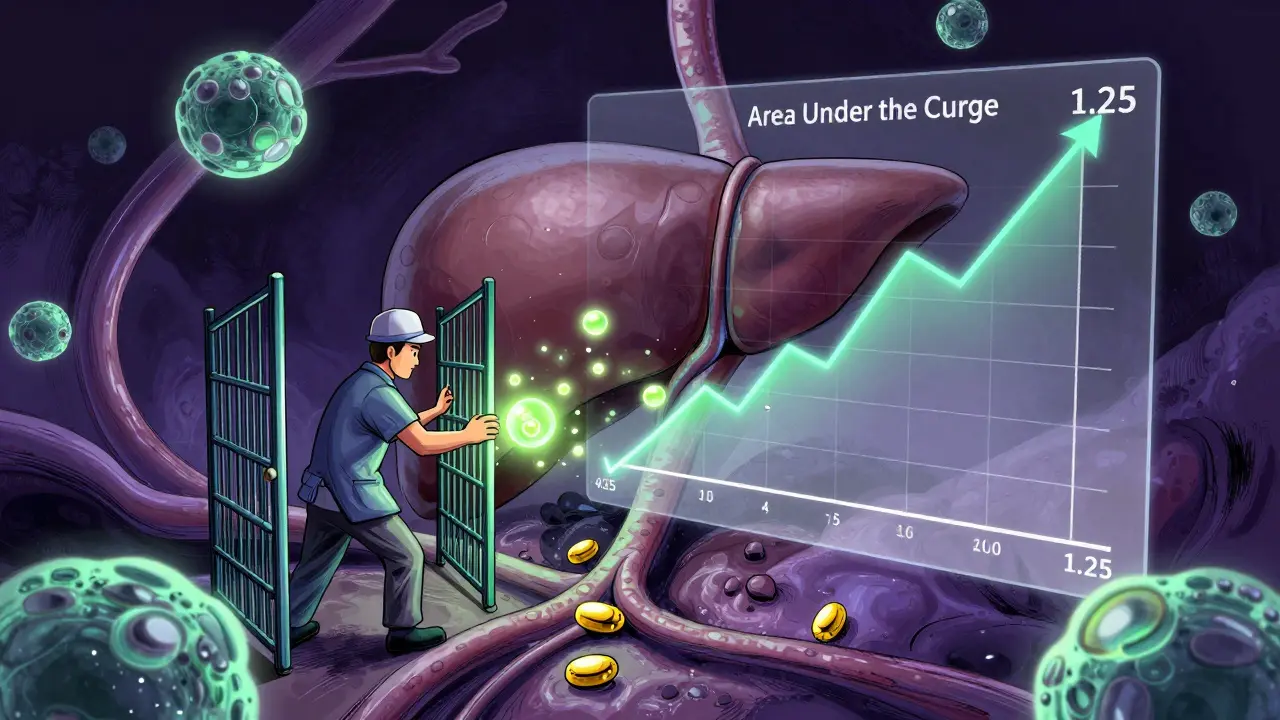
One of the most common metrics you'll see is the AUC ratio (AUCR), which refers to the Area Under the Curve-essentially a measure of total drug exposure in the bloodstream. For interactions involving CYP enzymes (the proteins in your liver that break down drugs), an AUCR of ≥1.25 or ≤0.8 is usually the tipping point for clinical significance. If the exposure increases by 25% or drops by 20%, the FDA considers it a meaningful change.
Transporters, which act like gates moving drugs in and out of cells, have different rules. For example, inhibitors of P-gp (P-glycoprotein) are flagged if they cause an AUC fold-increase of ≥1.5 for specific substrates like digoxin or dabigatran. If you see these numbers in Section 12, they aren't just random stats; they are the legal and scientific justification for the warnings in Section 7.
| Mechanism | Metric | Threshold for Significance | Example Substrate/Enzyme |
|---|---|---|---|
| CYP Enzyme | AUC Ratio (AUCR) | ≥1.25 or ≤0.8 | CYP3A4, CYP2D6 |
| P-gp Transporter | AUC Fold-Increase | ≥1.5 | Digoxin, Dabigatran |
| OATP1B1/1B3 | AUC Fold-Increase | ≥2 | Statins |
The Pitfalls of Drug Classes vs. Specific Drugs
Here is where it gets tricky. A common frustration for pharmacists and doctors is that FDA labels often group drugs into classes. For instance, a label might warn against using "strong CYP3A4 inhibitors." This is a broad category. The problem is that not every drug in that class interacts with the same intensity.
FDA internal audits from 2023 showed that 42% of labels are inconsistent in how they name these. Some list a specific drug (like ketoconazole), while others just name the class. This creates a "grey area" in clinical practice. If you see a class warning, you can't assume every member of that class is dangerous; you have to dig into the specific pharmacokinetic data in Section 12 or use the Drugs@FDA database to verify if your specific patient's medication is one of the high-risk offenders.
Practical Tips for Real-World Application
Interpreting these tables in a busy hospital or clinic requires a systematic approach. To avoid errors, the American Society of Health-System Pharmacists (ASHP) suggests a specific workflow to ensure no data is missed.
- Confirm the Action: Start in Section 7. Is the interaction "Contraindicated" (do not use), "Avoid concomitant use" (use only if absolutely necessary), or "Dose adjustment required" (use, but change the amount)?
- Verify the Magnitude: Jump to Section 12. Check the AUCR or fold-change. Is this a mild increase or a dangerous spike in plasma concentration?
- Apply the Fix: Go to Section 2. Find the specific mg/kg adjustment or the timing requirement (e.g., "administer 2 hours apart").
If you are managing a patient with polypharmacy-meaning they are on five or more medications-don't try to do this manually for every drug. Many health systems now integrate this FDA data directly into electronic health records (EHRs), which has been shown to reduce interaction errors by nearly 40%.

Looking Ahead: The Future of Labels
The days of static PDF labels are numbered. The FDA is currently moving toward "machine-readable" interaction data. This means instead of a human reading a table, a computer can instantly flag a conflict based on the exact AUCR values defined in the ICH M12 standards. By 2026, we expect to see pilot programs for "dynamic labeling," where interaction warnings can be updated in real-time as new post-marketing data emerges.
We are also seeing a push to cover the "blind spots." Currently, the system is great for CYP enzymes and transporters but weaker on UGTs (UDP-glucuronosyltransferases) and biologic therapies. If you're prescribing newer biologic drugs, be aware that the interaction data may be less comprehensive than it is for traditional small-molecule pills.
What is the difference between 'Contraindicated' and 'Avoid Concomitant Use'?
'Contraindicated' means the risk outweighs any possible benefit, and the drugs should never be used together. 'Avoid concomitant use' suggests that while the combination is risky, there may be rare clinical scenarios where the benefit justifies the risk, provided the clinician monitors the patient extremely closely.
Where can I find the most up-to-date FDA interaction tables?
The most reliable source is the Drugs@FDA database, which is updated daily. For standardized guidelines on how these interactions are studied, the August 2024 ICH M12 Guideline is the definitive international reference.
What does AUC mean in the context of drug interactions?
AUC stands for 'Area Under the Curve.' In simple terms, it represents the total amount of a drug that reaches the bloodstream over time. When one drug increases the AUC of another, it means the second drug is staying in the body longer or at higher levels, which can lead to toxicity.
Why should I check Section 12 if Section 7 already gives a recommendation?
Section 7 gives the 'what,' but Section 12 gives the 'how much.' If Section 7 says to adjust a dose, Section 12 tells you if the drug exposure increased by 25% or 300%. This helps you decide how aggressive your dose reduction needs to be, especially for patients with kidney or liver impairment.
Do FDA interaction tables cover herbal supplements?
Generally, no. Standard FDA drug labels focus on pharmaceutical products. While some labels mention well-known supplements (like St. John's Wort), about 20% of clinically significant interactions involve herbals and lack a standardized evaluation framework in the official labeling.
Next Steps for Clinicians and Patients
If you are a healthcare provider, consider taking the "Navigating Drug Interaction Information" course available through the Drugs@FDA portal. It's a free resource that helps bridge the gap between pharmacological theory and label interpretation.
For patients, the best move is to maintain a comprehensive list of all medications, including over-the-counter vitamins and herbal teas. When your doctor mentions a potential interaction, ask them specifically: "Is this a contraindication, or is it just a matter of adjusting the dose?" This forces a conversation about the actual risk level rather than a generic warning.
Daniel Trezub
Actually, just relying on these labels is a bit amateur. Most of us in the field just use Lexicomp or Micromedex because the FDA labels are notoriously slow to update with the latest post-marketing data. It's funny that people think the PDF is the final word when clinical practice evolves way faster than the regulatory paperwork does.
jack hunter
imagine beliving a goverment document is the gold standard lol. its all just a social construct to make us feel safe while they change the numbers whenever they want. who even cares about AUCR when the whole concept of 'significance' is just a guess made by some bureaucrat in a suit
Danielle Kelley
Of course they don't mention the herbal supplements! That's because Big Pharma and the FDA want to hide the fact that natural cures actually work. They keep the 'standardized framework' narrow so they can push these synthetic pills that have more side effects than the actual disease. Wake up people, the gaps in these labels are intentional!
Ethan Davis
Exactly. The fact that 42% of labels are inconsistent isn't a 'pitfall', it's a feature. It lets them slide things past the doctors. If they keep it vague with 'drug classes', they can hide the real damage until the lawsuits start piling up. It's all a game.
Brady Davis
Oh wow, a whole guide on how to read a table. I'm absolutely breathless with excitement. Truly a gripping read for the ages. I'm sure we're all just vibrating with thrill at the thought of jumping from Section 7 to Section 12. Pure adrenaline.
Stephen Luce
This is actually really helpful for someone like me who gets overwhelmed by medical jargon. It's a relief to know there's a specific pattern to look for instead of just feeling lost in the pages. Thanks for breaking it down simply.
Jay Vernon
I like this a lot! 😊 It makes things feel much easier to handle. Thanks for the tips! 👍
Nikhil Bhatia
Too much reading.
charles mcbride
It is truly heartening to see such a structured approach to patient safety being shared. The transition to machine-readable data by 2026 sounds like a marvelous evolution that will undoubtedly save many lives. I believe we are entering a golden age of precision medicine if we can just bridge these information gaps. Your dedication to clarifying the ICH M12 standards is quite commendable and should be appreciated by all who strive for clinical excellence. I am optimistic that these tools will empower patients to have more meaningful dialogues with their providers. It is a wonderful step forward for public health. Let us hope the implementation of dynamic labeling happens even sooner than expected. The synergy between EHRs and FDA data is a brilliant solution to human error. Keep sharing this knowledge, it is immensely valuable for the community. Well done on this comprehensive breakdown.
Alexander Idle
Honestly, this whole 'three-step map' thing is just kind of a joke. Like, who actually has time to bounce around a PDF in a clinical setting? It's just wild how we pretend this is a viable workflow while we're all just drowning in paperwork. Absolute chaos, really.