
Most people think a patent lasts 20 years - and that’s true, sort of. But if you’re managing a global product, especially in pharma, medical devices, or tech, that 20-year clock doesn’t tick the same way everywhere. In the U.S., it might stretch to 25 years. In Brazil, it could shrink to 15 because of backlogs. In Europe, a special extension can add five more years for drugs. This isn’t just paperwork - it’s a multi-million-dollar game of timing.
Why the 20-Year Rule Isn’t Always 20 Years
The global baseline for patent protection is 20 years from the earliest filing date. That’s the rule set by the TRIPS Agreement in 1995, signed by all 164 WTO members. Before that, the U.S. gave patents 17 years from the issue date - not the filing date. That meant a patent could sit in the USPTO for years before being granted, and still get its full 17 years. Now, if you file in the U.S. on January 1, 2026, your patent expires January 1, 2046 - unless something changes that clock.But here’s the catch: the filing date isn’t always the date you think it is. Thanks to the Paris Convention, you can file in one country, then file in others within 12 months and still claim the original date as your priority date. That’s how companies protect inventions globally without having to file everywhere at once. But that priority date becomes the anchor for the 20-year countdown in every country you enter.
How the U.S. Makes It Complicated
The U.S. has the most complex patent term system in the world. For patents filed after June 8, 1995, the term is 20 years from the earliest non-provisional filing date. But that’s just the start.First, there are patent term adjustments (PTAs). If the USPTO takes too long to examine your patent - say, more than three years - you get extra time added. In 2022, the average PTA was 558 days. That’s almost 1.5 years extra. Some patents got over 1,000 days. That’s not a bonus - it’s a legal requirement for delays caused by the patent office.
Then there are patent term extensions (PTEs) for drugs. If your new medicine took five years to get FDA approval, you can get up to five years added to the patent term. But you can’t get more than 14 years of market exclusivity after approval. This is why big pharma companies track these extensions like stock prices - one extra year can mean billions in revenue.
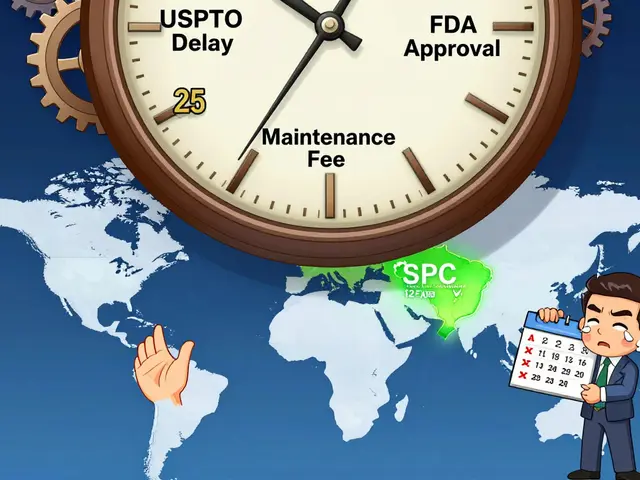
And don’t forget maintenance fees. In the U.S., you have to pay at 3.5, 7.5, and 11.5 years. Miss one, and your patent dies - even if you’re only 19 years into the 20-year term. Many small companies lose patents this way, not because they’re expired, but because they forgot to pay.
Europe: Uniform Term, Extra Extensions
The European Patent Office (EPO) grants patents with a standard 20-year term from filing. But here’s where it gets interesting: once the patent is granted, you still have to validate it in each country - unless you use the new Unitary Patent system, which went live in June 2023. That system gives you one patent covering 17 EU countries with a single renewal fee.But for drugs, Europe adds another layer: Supplementary Protection Certificates (SPCs). These can extend patent life by up to five years. If your drug got a pediatric indication - meaning it was tested on children - you get an extra six months. That’s why companies like Pfizer and Novartis file for SPCs as soon as approval comes in. In Germany or France, a drug patent might expire in 2035, but with an SPC, it’s protected until 2040.

Asia: Fast Growth, New Rules
Japan and China both follow the 20-year rule from filing date. But both now allow term extensions for unreasonable delays in examination. Japan will add time if the patent office takes more than three years to review your application. China did the same in 2021, after years of pressure from foreign companies.China’s patent office used to take over five years to approve a patent. Now, with faster processing and term compensation, companies can get closer to the full 20 years. But there’s still a catch: if you file a PCT application and enter China’s national phase after 31 months, your patent may be invalid. Deadlines are strict.
India is the outlier. No term extensions. No PTAs. No SPCs. If your patent expires in 2030, it expires in 2030 - even if your drug took seven years to get approved. That’s why Indian generic manufacturers often launch right after patent expiry. No waiting.
Canada, Australia, and Others: Mixed Bag
Canada uses the 20-year rule but still has some older patents under the old system - those expire at the later of 20 years from filing or 17 years from issue. That means a patent filed in 1998 might still be alive in 2026 if it wasn’t granted until 2009.Australia allows extensions for patent office delays under its Patents Act. If the Australian Patent Office takes too long, you get extra time. But the system is less generous than the U.S. - you don’t get automatic credits for every delay, just for those that are clearly unreasonable.
Brazil’s law says 20 years, but the backlog is so bad that many patents only get 10 to 12 years of actual protection. The patent office simply can’t process applications fast enough. That’s why multinational companies often delay filing in Brazil until the last possible moment - they don’t want to lose half their term before the patent even starts.
Utility Models: The Short-Term Alternative
In Germany, China, Japan, and about 50 other countries, you can file a utility model instead of a full patent. These are cheaper, faster, and easier to get - but they only last 6 to 10 years. They’re perfect for products with short innovation cycles, like consumer gadgets or simple mechanical parts. You can’t use them for drugs or software algorithms, but for a new type of zipper or phone mount, it’s a smart move.Some companies file both: a full patent in the U.S. and Europe, and a utility model in China and Germany. That way, they get long-term protection where it matters most, and quick, cheap protection in markets where speed counts.
What Happens When You Miss a Deadline?
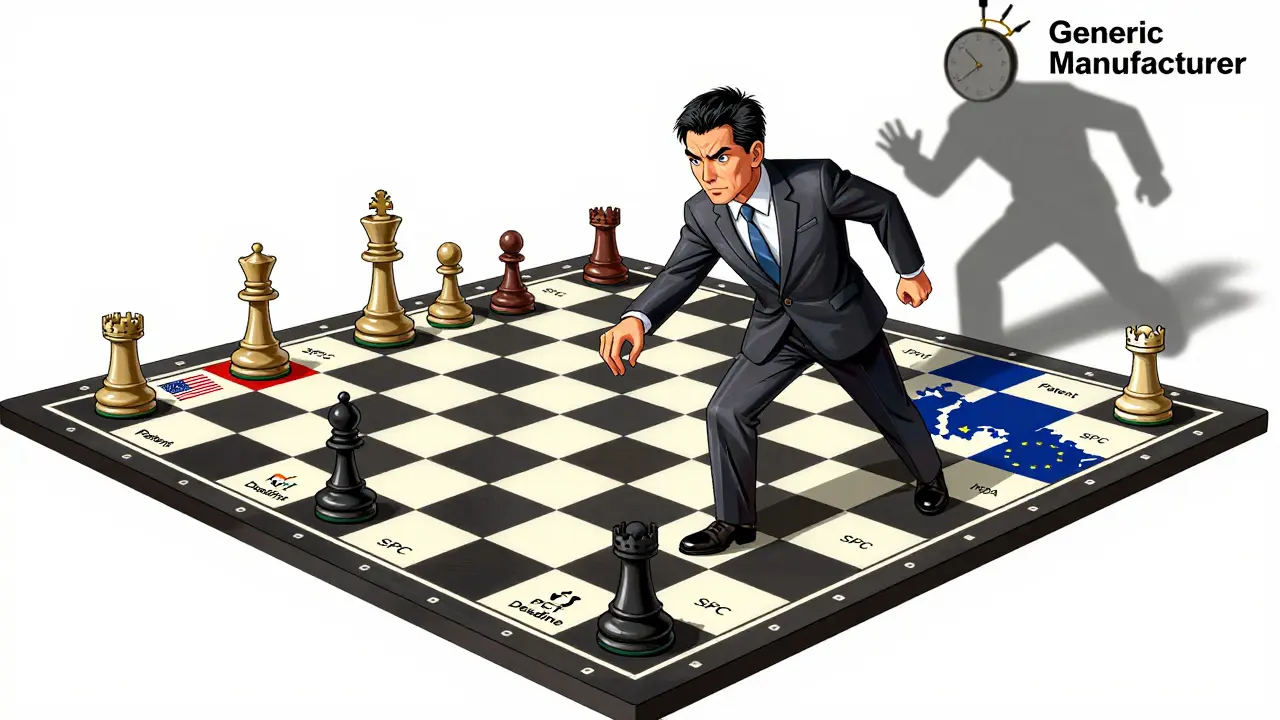
The PCT system gives you 30 or 31 months to enter national phases. The U.S. allows 30 months. Canada, China, and most of Europe allow 31. Japan lets you extend by two months if you explain why you missed it. The U.S. lets you extend with a fee.But if you miss the deadline and don’t get an extension? Your patent rights in that country vanish. No second chances. No grace period. You can’t come back later and say, “I forgot.” That’s why companies use patent management software that tracks deadlines across 100+ jurisdictions. One missed date can cost you a whole market.
Why This Matters for Real Businesses
Imagine you’re a startup that just launched a new medical device. You filed your first patent in the U.S. in January 2024. You plan to sell in Europe, Japan, and Brazil. Your patent expires in 2044 - unless:- The USPTO delays your examination by 18 months → you get 2045
- Europe grants an SPC for regulatory delay → you get 2049
- China’s patent office takes 4 years → you get 2045
- You forget to pay the 7.5-year fee in the U.S. → your patent dies in 2031
- You don’t enter Brazil’s national phase until month 32 → you get no patent there at all
That’s not theory. That’s what happens every day. Companies like Johnson & Johnson have teams of 50+ people tracking patent expirations across 150 countries. They don’t guess. They don’t use spreadsheets. They use specialized software that pulls data from patent offices, calculates extensions, and alerts them months in advance.
What You Should Do
If you’re filing internationally:- File your first application early - it sets the priority date for everything else.
- Use the PCT system to delay national phase costs until you know where you’ll sell.
- Track maintenance fees like calendar events - set reminders for 3.5, 7.5, and 11.5 years.
- For drugs or regulated products, calculate potential extensions - don’t assume 20 years is the end.
- Don’t ignore utility models - they’re cheap insurance for fast-moving markets.
- Use a professional patent attorney or software to manage deadlines. One mistake can cost more than the entire patent portfolio.
Patents aren’t just legal documents. They’re financial assets. And like any asset, their value depends on timing. Get the timeline wrong, and you lose your market. Get it right, and you protect your innovation for years - even decades - longer than you thought possible.
Dusty Weeks
lol i just thought patents expired in 20 years 😅 turns out it’s a whole damn maze. i’m glad i don’t make drugs.
Sally Denham-Vaughan
this is wild. i work in medtech and we literally have a team that just tracks patent expirations. one missed fee = millions gone. it’s less like law and more like high-stakes chess.
sharad vyas
in india, we see the other side. when patents expire, generics save lives. no extensions, no tricks. just fairness. it’s not about loopholes - it’s about access.
Richard Thomas
there’s something deeply ironic about how we treat innovation. we say we value creativity, yet we build systems where the value of an idea depends on how well you navigate bureaucratic labyrinths. the patent isn’t protecting the invention - it’s protecting the paperwork. and the people who can afford the lawyers win. always.
Paul Ong
utility models are the real MVPs for startups. cheap fast and gets you in the door. i filed one for my phone mount design in germany and china and saved 15k. no drama no waiting just get it done
Andy Heinlein
i never realized how much timing matters. i thought once you file you’re good. turns out you gotta be a calendar wizard. i’m gonna set 50 reminders now just in case lol
Ann Romine
the brazil backlog thing is insane. i’ve heard stories of companies waiting 12 years just to get a patent granted. by then the tech is obsolete. it’s like building a race car and then waiting for the track to be paved.
Bryan Anderson
thank you for this comprehensive overview. the distinction between filing date and grant date, especially in the U.S., is critical for strategic planning. many underestimate the impact of PTAs and maintenance fees. professional management is not optional - it is foundational.
Bill Medley
India’s approach is morally defensible. If a drug takes seven years to approve, the patent shouldn’t get extra time. Patients need access. Profit shouldn’t override public health.