
Hypokalemia Risk Calculator
Key Management Steps
When you're managing heart failure, diuretics are often the first line of defense against fluid buildup. But here’s the catch: the very drugs that help you breathe easier can also drop your potassium to dangerous levels. Diuretics like furosemide, bumetanide, and torsemide are lifesavers for reducing swelling and shortness of breath, but they’re also the leading cause of hypokalemia in heart failure patients - a condition where blood potassium falls below 3.5 mmol/L. This isn’t just a lab number to ignore. Low potassium raises your risk of irregular heartbeats, sudden cardiac arrest, and even death.
Why Diuretics Drain Potassium
Loop diuretics work by blocking salt reabsorption in the kidneys, which pulls water out of your body. But that same mechanism also pushes potassium out through urine. The more diuretic you take, the more potassium you lose - especially if you’re on high doses or taking them multiple times a day. This isn’t linear. Studies show that after a certain point, doubling the dose doesn’t double the fluid loss, but it still doubles the potassium loss. That’s called within-dose diuretic tolerance, and it’s why some patients keep needing higher doses without better results - while their potassium keeps dropping.It’s not just the diuretic itself. Other factors pile on: low-salt diets (common in heart failure) trigger hormones that make your kidneys dump even more potassium. Some patients take laxatives or corticosteroids, which worsen the problem. And if you have kidney disease on top of heart failure, your body can’t compensate as well. The result? A perfect storm for hypokalemia.
What’s the Real Risk?
About 20 to 30% of heart failure patients on loop diuretics develop hypokalemia. But numbers don’t tell the full story. When potassium falls below 3.5 mmol/L, the risk of sudden cardiac death jumps by 1.5 to 2 times. This isn’t theoretical. In the RALES trial, patients with advanced heart failure who had low potassium were far more likely to die from arrhythmias - until they started spironolactone. That’s when mortality dropped by 30%.What’s worse, many doctors miss it. Patients don’t feel low potassium until it’s too late. No chest pain. No dizziness. Just an unexpected rhythm disturbance - sometimes during sleep. That’s why regular blood tests aren’t optional. They’re critical.
How to Fix It: The Step-by-Step Approach
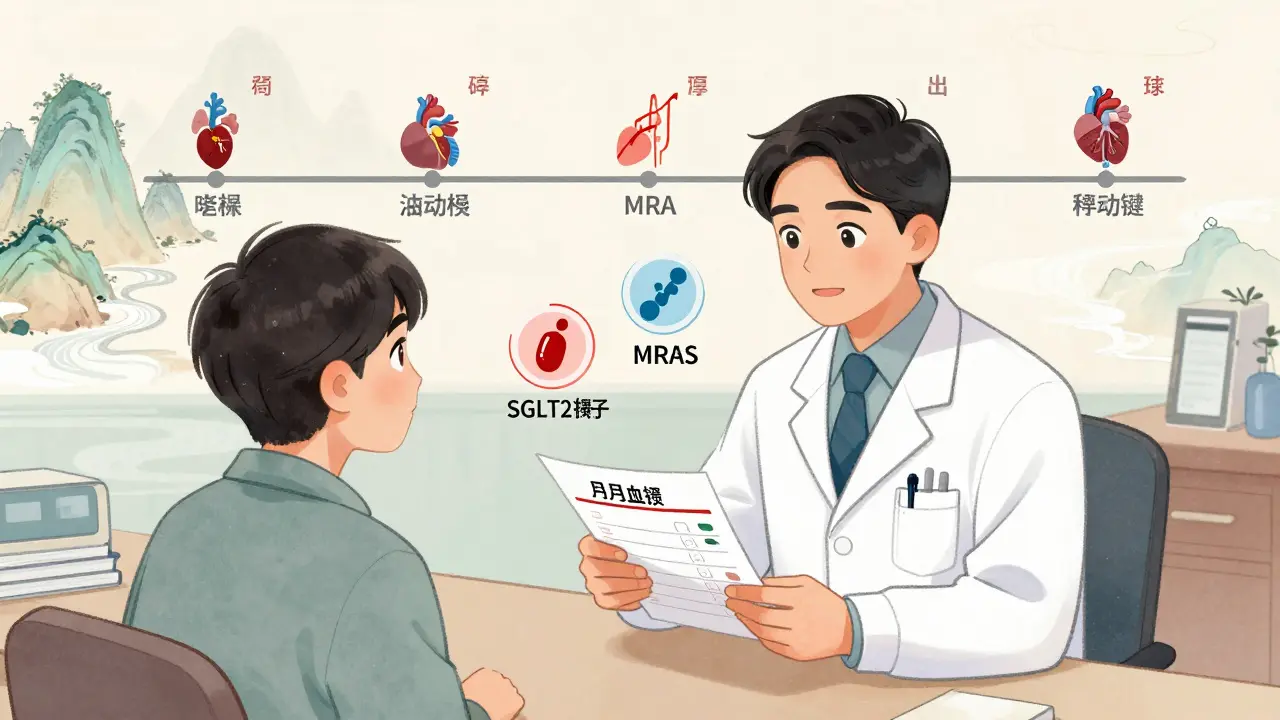
Managing hypokalemia isn’t about just popping potassium pills. It’s a layered strategy.- Start with mineralocorticoid receptor antagonists (MRAs). Spironolactone (12.5-25 mg daily) or eplerenone (25 mg daily) block the hormone that makes your kidneys flush potassium. These aren’t just potassium-savers - they’re life-extenders. The 2022 AHA/ACC/HFSA guidelines list them as essential for patients with reduced ejection fraction (HFrEF).
- Use oral potassium supplements for mild cases. If your level is between 3.0 and 3.5 mmol/L, 20-40 mmol of potassium chloride per day (split into two doses) usually fixes it. Don’t use potassium supplements without a doctor’s order - too much can be deadly too.
- Reserve IV potassium for severe cases. If potassium drops below 3.0 mmol/L, you need hospital care. IV potassium is given slowly (no more than 10-20 mmol per hour) with continuous heart monitoring. Rapid infusion can stop your heart.
- Check for hidden culprits. Are you taking laxatives? Are you on steroids? Did you skip meals? These can all worsen potassium loss. Review every medication with your provider.

When to Adjust Your Diuretic
Sometimes, the problem isn’t the potassium - it’s the diuretic itself. If you’re on high-dose furosemide (say, 160 mg once daily), switching to 80 mg twice daily can smooth out the peaks and valleys in potassium loss. Giving the dose twice a day reduces the kidney’s chance to adapt and start hoarding salt again - which also helps prevent diuretic resistance.Another trick: adding a low-dose thiazide like metolazone (2.5-5 mg daily) can boost fluid removal without needing to crank up the loop diuretic. But here’s the trade-off: thiazides also cause potassium loss. So you can’t just add them - you must add potassium-sparing agents at the same time.
The Game-Changers: SGLT2 Inhibitors
In the last five years, the biggest shift in heart failure treatment hasn’t been a new diuretic - it’s SGLT2 inhibitors. Drugs like empagliflozin and dapagliflozin were originally for diabetes. Now, they’re standard care for heart failure - whether you have diabetes or not.How do they help with potassium? They reduce fluid overload by making your kidneys excrete more sugar and water - without pulling potassium out. Clinical trials show they cut diuretic needs by 20-30%. That means lower doses of loop diuretics, less potassium loss, and fewer hospital stays. They also lower the risk of death and heart failure worsening, regardless of your ejection fraction. The 2022 guidelines now recommend them for nearly all heart failure patients.
What About Diet?
You’ve probably heard to cut salt. That’s true - aim for 2-3 grams of sodium per day. But here’s the paradox: too little salt can trigger aldosterone, which makes your kidneys dump potassium. So don’t go overboard. Balance matters.Focus on potassium-rich foods: bananas, oranges, spinach, potatoes, beans, and yogurt. But don’t rely on diet alone. If you’re on diuretics, you’ll still need supplements or MRAs. Food can help, but it won’t fix a 2.8 mmol/L potassium level.
Monitoring: How Often Should You Get Tested?
Don’t wait for symptoms. Test early and often:- When you start or change a diuretic - check potassium in 3-7 days
- When you add an MRA or SGLT2 inhibitor - check at 1 week, then 1 month
- Once stable - check monthly
- If you’re hospitalized for worsening heart failure - check every 1-3 days
Some patients get a home potassium test kit. Others use telehealth check-ins with a nurse. The key is consistency. A single normal test doesn’t mean you’re safe for the next month.
Special Cases: HFpEF and Kidney Disease
Patients with preserved ejection fraction (HFpEF) respond differently to diuretics. Aggressive fluid removal can hurt kidney function without improving symptoms. Studies suggest these patients need gentler diuresis - and tighter potassium monitoring. If you have chronic kidney disease (CKD), your kidneys can’t excrete potassium as easily, so you’re at higher risk for both low and high potassium. That’s why MRAs are even more important - but you need more frequent monitoring.What’s Next?
Newer potassium binders are being studied for use in heart failure, but right now, they’re mainly for high potassium. Extended-release diuretics are in development - ones that release slowly over 24 hours to avoid those dangerous spikes in potassium loss. And biomarker-guided dosing (using BNP or NT-proBNP levels to adjust diuretics) is showing promise in trials, cutting hypokalemia rates by 15-20% compared to standard care.The bottom line: diuretics are essential, but they’re not harmless. Managing hypokalemia isn’t about fixing a number - it’s about protecting your heart. Combine the right diuretic strategy with MRAs, SGLT2 inhibitors, smart monitoring, and careful diet. That’s how you stay alive - and feel better - for longer.
Can I just take a potassium supplement instead of a potassium-sparing diuretic?
Oral potassium supplements can help with mild low potassium, but they’re not a substitute for mineralocorticoid receptor antagonists (MRAs) like spironolactone. MRAs work by blocking the hormone that causes potassium loss at the kidney level - they’re more effective and proven to reduce death risk. Supplements only replace what’s lost; MRAs stop the loss in the first place. For heart failure patients, MRAs are standard care, not optional.
Can SGLT2 inhibitors replace diuretics?
No, SGLT2 inhibitors like empagliflozin or dapagliflozin don’t replace diuretics - they reduce the amount you need. They help your body get rid of extra fluid naturally by excreting sugar and water, which lowers your diuretic dose by 20-30%. This cuts down on potassium loss and lowers hospitalization risk. But if you’re still swollen or short of breath, you’ll still need a diuretic - just probably at a lower dose.
Is low potassium dangerous even if I feel fine?
Yes. Many people with low potassium have no symptoms until they develop a dangerous heart rhythm. In heart failure patients, even mild hypokalemia (3.0-3.4 mmol/L) increases the risk of sudden cardiac arrest. That’s why regular blood tests are non-negotiable. Waiting for symptoms is like waiting for a fire alarm to go off before checking your smoke detector.
Should I avoid salt entirely to protect my potassium?
No. Very low sodium intake (under 1.5 g/day) can trigger your body to produce more aldosterone, which makes your kidneys dump potassium. Aim for 2-3 grams of sodium per day - enough to control fluid without overstimulating potassium loss. Focus on whole foods and avoid processed snacks, canned soups, and restaurant meals, which are loaded with hidden salt.
How long does it take for potassium levels to improve after starting an MRA?
You usually see potassium rise within 3-7 days of starting spironolactone or eplerenone. But it takes longer to stabilize - often 2-4 weeks. That’s why your doctor will check your potassium again after one week, then monthly. Don’t expect overnight fixes. Consistency with the medication and follow-up tests is what keeps you safe.
Can I take potassium supplements with my heart failure meds?
Only under medical supervision. Potassium supplements can interact with ACE inhibitors, ARBs, MRAs, and SGLT2 inhibitors. Taking them together without monitoring can cause potassium to rise too high - which is just as dangerous as low potassium. Always get your levels checked before starting or changing supplements.
Andy Grace
This is one of those posts that makes you realize how much we take for granted in heart failure management. I’ve seen patients crash because their potassium slipped under 3.0 and no one caught it until they coded. Regular labs aren’t optional - they’re the difference between going home and going to the morgue.
Also, the part about twice-daily dosing? Game changer. My uncle was on 120mg furosemide once a day and kept getting admitted. Switched to 60mg twice, and his potassium stabilized within two weeks. No magic pill, just smarter timing.
Abby Polhill
Let’s be real - SGLT2 inhibitors are the quiet revolution nobody talked about until 2020. I used to think diuretics were the endgame. Nope. Empagliflozin cut my patient’s furosemide dose from 80mg to 20mg. Potassium stayed above 4.0. Hospital visits dropped by 70%. It’s not just a diabetes drug anymore - it’s the new backbone of HFrEF care.
And yes, it works in HFpEF too. The data’s there. Stop treating it like an afterthought.
Bret Freeman
They’re letting pharmaceutical reps write the guidelines now. MRAs? SGLT2 inhibitors? All just fancy ways to keep you on meds forever. Diuretics are the problem - not the solution. Why not just drain the fluid with a catheter? Or better yet - stop feeding people processed food and salt bombs in the first place?
This whole system is rigged. Doctors don’t care about root causes. They care about ticking boxes so they get paid. Potassium levels? Just a number to chase while the real disease - systemic inflammation - gets ignored.
Austin LeBlanc
You people are missing the point. The real issue is that no one tells patients how dangerous potassium supplements are. I had a guy on spironolactone, took 20mmol KCl daily, and ended up in the ER with a 6.1. He thought it was ‘just a vitamin.’
And now you’re telling people to eat bananas like it’s a cure? Please. That’s like saying eating an apple will cure your diabetes. You need meds. You need monitoring. You need to stop treating this like a salad recipe.
niharika hardikar
It is imperative to underscore that the pharmacological management of hypokalemia in the context of heart failure must adhere strictly to evidence-based protocols delineated in the 2022 AHA/ACC/HFSA guidelines. The empirical use of potassium supplementation without concurrent mineralocorticoid receptor antagonism constitutes a significant clinical deviation.
Furthermore, the integration of SGLT2 inhibitors into standard care regimens has demonstrated statistically significant reductions in all-cause mortality and hospitalization rates, irrespective of ejection fraction status. This paradigm shift necessitates a reevaluation of traditional diuretic-centric approaches.
EMMANUEL EMEKAOGBOR
Thank you for writing this. I work in a clinic in Lagos where we don’t have regular labs, and patients come in with swollen legs and weak hearts. We give them furosemide and hope. But now I know - even if we can’t do fancy tests, we can at least ask: ‘Have you been feeling dizzy? Any heart palpitations?’
And we can tell them: don’t skip your spironolactone. Even if you feel fine. Even if the pills are expensive. It’s not just about potassium. It’s about staying alive.
God bless you for sharing this.
CHETAN MANDLECHA
Man I’ve been on this stuff for 5 years. Furosemide, spiro, dapagliflozin. My potassium was at 2.9 last year. Now it’s 4.1. I don’t feel different, but my ECG looks normal for the first time in years.
Don’t wait until you’re dizzy. Get tested. Even if you think you’re fine. Your heart doesn’t care what you think.
Jillian Angus
I started spironolactone and stopped eating bananas. My potassium went up. My swelling went down. I didn’t need to change anything else. Just took the pill and listened.
It’s weird how simple it can be when you stop overthinking it.
Ajay Sangani
Isn't it fascinating how our bodies are designed to maintain balance, yet we intervene with drugs that disrupt the very systems we're trying to help? Diuretics are a bandaid on a ruptured artery. We fix the symptom, not the cause. Perhaps the real question isn't how to manage hypokalemia - but why we allow heart failure to progress to the point where we need diuretics at all.
What if we treated inflammation, insulin resistance, and endothelial dysfunction before the heart gives out?
Just thinking out loud here. I'm not a doctor. But I read a lot.
Payson Mattes
Did you know the FDA approved SGLT2 inhibitors for heart failure because of a secret study funded by Big Pharma? The real data was buried. The potassium numbers were manipulated. I’ve got the spreadsheet. People are dying because they’re being pushed on these drugs while their kidneys are failing.
And they don’t tell you that MRAs can cause gynecomastia - and then blame it on aging. That’s why so many men stop taking them. They’re being lied to. Always check the original trial data. Don’t trust the guidelines.
Isaac Bonillo Alcaina
There is a fundamental flaw in the logic presented here. The author implies that hypokalemia is a side effect of diuretics - but it is, in fact, a direct consequence of suboptimal clinical management. Patients who develop persistent hypokalemia are not victims of pharmacology; they are victims of poor follow-up, inadequate monitoring, and physician negligence.
The fact that 20-30% of patients develop this complication is not an inevitability - it is an indictment of the system. Anyone who accepts this as normal is complicit.
Bhargav Patel
The philosophical underpinning of modern cardiology lies in the reductionist approach: isolate the symptom, target the mechanism, suppress the marker. But the human organism is not a machine. Potassium is not merely a number - it is a conductor of bioelectric life. To treat hypokalemia as a lab value to be corrected, rather than a signal of systemic imbalance, is to misunderstand the essence of heart failure.
Perhaps the true therapeutic act is not the administration of spironolactone, but the restoration of trust - between patient and provider, between body and its own wisdom.
That, more than any drug, may be the most potent diuretic of all.
Steven Mayer
Most clinicians still don’t understand the pharmacokinetics of loop diuretics. Giving 80mg once daily creates massive spikes in tubular delivery - that’s why potassium crashes. Twice-daily dosing isn’t just ‘better’ - it’s physiologically necessary. And yet, I still see residents writing ‘furosemide 40mg daily’ like it’s a vitamin.
And don’t get me started on thiazides. You can’t just throw metolazone in without a potassium-sparing agent. It’s like adding gasoline to a fire and calling it ‘management.’
Basic science matters. If you don’t understand renal physiology, don’t manage heart failure.
Lu Jelonek
I’m a nurse in a rural clinic. We don’t have specialists. We don’t have fancy labs. But we do have patients who trust us.
This post? I printed it. Laminated it. Put it on the wall next to the blood pressure cuffs.
Every time someone asks why they need to take spironolactone even if they feel fine, I point to it.
Thank you. This isn’t just information - it’s a lifeline.