
When you hear the word biosimilar, you might think it’s just another name for a generic drug. But that’s not right. Biosimilars aren’t copies like the pills you pick up for high blood pressure or cholesterol. They’re complex biological medicines made from living cells - and monoclonal antibody biosimilars are among the most important ones today. These aren’t simple molecules. They’re large, intricate proteins, sometimes weighing 150,000 daltons, that target specific cells in the body to fight cancer, autoimmune diseases, and other serious conditions. And because they’re made by living systems, not chemical factories, no two batches are ever exactly alike. That’s why regulators don’t call them ‘identical’ - they call them ‘highly similar’ with no clinically meaningful differences.
What Makes Monoclonal Antibody Biosimilars Different?
Think of a small-molecule generic drug like ibuprofen. It’s made in a lab using chemical reactions. The final product is always the same molecule, every time. A biosimilar? It’s like trying to recreate a handmade sculpture using the same clay, tools, and artist - but the artist works in a different studio, with slightly different humidity, temperature, and tools. The result looks the same, feels the same, and serves the same purpose - but the tiny details, like surface texture or internal structure, might vary just enough to matter in a biological system.
That’s why regulatory agencies like the FDA and EMA require a mountain of evidence before approving a monoclonal antibody biosimilar. Manufacturers must prove similarity not just in structure, but in how the drug behaves in the body. This includes hundreds of lab tests, animal studies, and clinical trials. One of the biggest challenges? Glycosylation - the addition of sugar molecules to the protein. Even a small change in these sugar chains can affect how the immune system reacts. There was a case with cetuximab where some patients had severe allergic reactions because of a specific sugar structure called alpha-1,3-galactose. That’s why every biosimilar must be tested for immunogenicity - the risk of triggering an unwanted immune response.
Approved Monoclonal Antibody Biosimilars and Their Uses
As of 2023, the U.S. FDA has approved more than 20 monoclonal antibody biosimilars. Each one matches a well-known reference drug used in serious conditions. Here are the most common ones and what they treat:
- Bevacizumab biosimilars (like Mvasi, Zirabev, Vegzelma): These block blood vessel growth in tumors. Used for colorectal, lung, ovarian, and brain cancers. Six biosimilars are approved in the U.S. as of late 2023.
- Rituximab biosimilars (Truxima, Ruxience, Riabni): Target B-cells involved in lymphoma and leukemia. Also used for rheumatoid arthritis and vasculitis. Three approved versions are now in use.
- Trastuzumab biosimilars (Ogivri, Herzuma, Kanjinti, Hercessi): Treat HER2-positive breast and stomach cancers. Six biosimilars are available, giving doctors and patients more options.
- Infliximab biosimilars (Remsima, Inflectra, Avsola): Used for Crohn’s disease, ulcerative colitis, rheumatoid arthritis, and psoriasis. Remsima became the first monoclonal antibody biosimilar in the U.S. to get ‘interchangeable’ status in July 2023.
- Adalimumab biosimilars (Hyrimoz, Amjevita, Cyltezo): The most prescribed biologic in the world, originally Humira. Now, over a dozen biosimilars are approved or in development, with Hyrimoz approved in September 2023.
These aren’t just new names on a shelf. They’re replacing the original drugs in hospitals and clinics across the country. For example, a 2022 study in JAMA Oncology followed 1,247 cancer patients who switched from reference rituximab to Truxima. The results? No drop in effectiveness. No increase in side effects. But the cost per treatment cycle dropped by 28%.
Why Cost Savings Matter - and How Big They Are
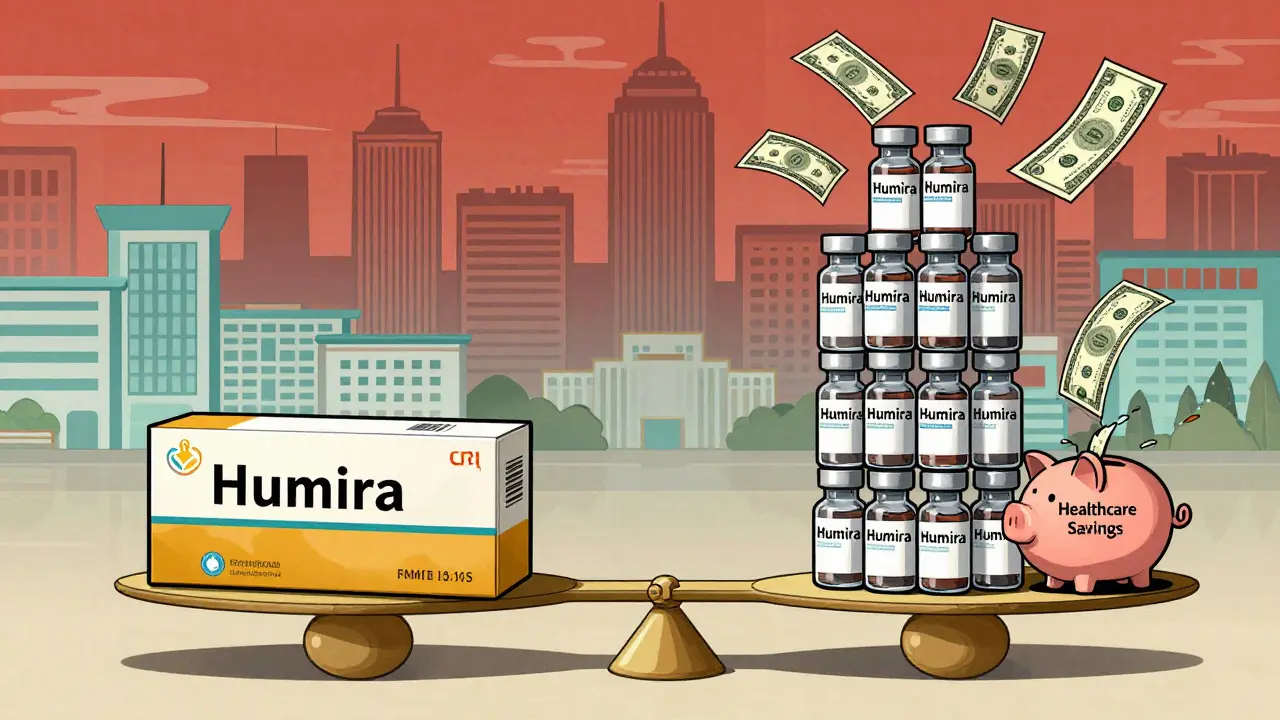
Biologics are expensive. A single dose of Herceptin or Humira can cost $5,000 to $10,000. That’s not just a burden for patients - it’s a strain on insurance systems and public health budgets. Biosimilars don’t eliminate costs, but they bring them down. Evaluate Pharma estimated that between 2023 and 2028, biosimilar monoclonal antibodies will save the U.S. healthcare system $250 billion. Bevacizumab, trastuzumab, and rituximab biosimilars alone will account for 78% of those savings.
That’s why payers are pushing for their use. Pharmacy benefit managers are putting biosimilars on preferred formularies. Hospitals are switching protocols. But it’s not automatic. Many providers still hesitate. A 2022 ASCO survey found only 58% of oncologists felt very confident prescribing biosimilars. That’s changing, but slowly. Education is key. When doctors see real-world data - like the JAMA study - confidence grows.
Interchangeable Biosimilars: The Next Step
Not all biosimilars are created equal in the eyes of pharmacists. There’s a special designation: interchangeable. This means a pharmacist can swap the reference drug for the biosimilar without asking the doctor - just like they do with generic pills. To get this status, the manufacturer must prove that switching back and forth between the two doesn’t increase risks.
Remsima (infliximab) was the first monoclonal antibody biosimilar to get interchangeable status from the FDA in July 2023. That’s a big deal. It means patients can get the biosimilar even if their doctor didn’t specifically prescribe it. This could dramatically increase access and lower costs even further. More interchangeable biosimilars are expected in 2024 and 2025, especially for adalimumab and trastuzumab.
Challenges and Barriers
Despite the progress, obstacles remain. Patent litigation is one of the biggest. A 2023 study from UC Hastings found that, on average, each monoclonal antibody biosimilar faces 14.7 patent challenges before it can launch. These lawsuits can delay market entry for years.
Another issue? Provider education. Many clinicians weren’t trained on biosimilars in medical school. They still think of them as ‘less proven.’ But data doesn’t support that. The EMA’s safety report from 2021 tracked over 1.2 million patient-years of exposure to monoclonal antibody biosimilars. Only 12 cases of unexpected immune reactions were found - a rate statistically identical to the reference products.
And then there’s the pharmacy system. Even when a biosimilar is approved, some insurance plans make it harder to get. Formulary restrictions, prior authorizations, and step therapy rules can block access. The Biosimilars Council reported in 2023 that 32% of biosimilar launches faced these kinds of barriers.
What’s Next? The Pipeline and Future Trends
The future of monoclonal antibody biosimilars is crowded - in a good way. As of September 2023, the FDA had 37 candidates in review. The biggest focus? Newer drugs like pembrolizumab (Keytruda), used in melanoma and lung cancer. Six biosimilars for Keytruda are in late-stage trials. If approved, they could save billions.
Also on the horizon: biosimilars for complex new drugs like antibody-drug conjugates (ADCs) and bispecific antibodies. The EMA plans to release new guidelines for these in early 2024. These aren’t just copies - they’re sophisticated weapons designed to deliver toxins directly to cancer cells. Making biosimilars for them will be harder than ever.
Market analysts at IQVIA predict that by 2027, monoclonal antibody biosimilars will make up 35% of all biologic prescriptions in the U.S., up from 18% in 2022. Cancer therapies will drive most of that growth - making up 62% of the volume. That means more patients will get life-saving treatments at lower prices.
Final Thoughts
Monoclonal antibody biosimilars aren’t a flash in the pan. They’re a structural shift in how we treat chronic and life-threatening diseases. They’re not generics. They’re not cheap knockoffs. They’re scientifically rigorous, clinically validated alternatives that bring real savings without sacrificing safety or effectiveness.
For patients, that means more access. For providers, it means more tools. For the system, it means sustainability. The data is clear. The approvals are growing. The savings are real. The question isn’t whether biosimilars belong in modern medicine - it’s how fast we can get them into the hands of the people who need them.
Sean Feng
Biosimilars are just pharma's way of squeezing more profit out of the same old drugs with a fancy label. The science is messy and the savings are overstated. I've seen patients get weird reactions that got written off as 'normal variation'.
Priya Patel
This is actually one of the most hopeful things I've read all year. Imagine a world where a mom with rheumatoid arthritis doesn't have to choose between rent and her meds. Biosimilars aren't just science-they're dignity.
Priscilla Kraft
So glad someone finally broke this down without jargon overload 😊 The glycosylation part blew my mind-like how a slight change in frosting can make a cake trigger allergies. And the fact that Remsima is interchangeable? Huge win. More docs need to see this.
Alfred Schmidt
Who approved this?!! This is dangerous!! You're telling me we're just swapping out life-saving drugs based on 'highly similar'?!! Where's the long-term data?! The EMA report? That's 1.2 million patient-years?! That's not enough!! We're playing Russian roulette with cancer patients!!
Michael Patterson
Okay so let me get this straight, biosimilars are like trying to recreate a Picasso using a different brush and a slightly different shade of blue, and then the FDA says it's good enough because it looks like the original from 10 feet away? But here's the thing-when you're injecting this into someone's bloodstream, 10 feet doesn't matter, 1 micron does. And the fact that companies are filing 14 patents just to delay the competition? That's not innovation, that's corporate extortion. And don't even get me started on how the insurance companies still make you jump through hoops to get a biosimilar even when it's cheaper and proven. I mean, come on. We're in 2024, not 1924. Why is this still a fight?
Matthew Miller
Let's be real. The entire biosimilar industry is a scam engineered by Big Pharma to extend monopolies under a new name. They don't care about savings-they care about market share. That 250 billion figure? It's based on optimistic modeling. Real-world uptake is slow because doctors don't trust it. And the 'interchangeable' label? That's just a marketing ploy to trick pharmacists into swapping drugs without oversight. This isn't progress. It's regression with a PR team.
Jennifer Littler
The structural characterization data for trastuzumab biosimilars is remarkably robust-comparative glycan profiling, FcγR binding assays, and ADCC potency metrics all show negligible differences from the reference product. The JAMA Oncology real-world cohort study demonstrated non-inferiority in PFS and OS with equivalent AE profiles. The pharmacoeconomic impact is undeniable, particularly in Medicaid populations where biologic cost is a primary driver of care discontinuation. The remaining barriers are largely behavioral and administrative, not scientific.
Jason Shriner
So let me get this straight… we spent 20 years making a drug that costs $10k per dose… and now we’re just… copying it? Like a high school kid tracing a Van Gogh? And the FDA says ‘close enough’? Wow. Next they’ll say ‘a slightly off Mona Lisa is still Mona Lisa.’ At least with generics, you know it’s the same molecule. Here? It’s like buying a ‘similar’ Tesla… but the wheels might fall off if you drive it in the rain.
Adewumi Gbotemi
Good post. Simple truth: if medicine can be cheaper and still work, why not? People in Nigeria pay too much for cancer drugs. Biosimilars could save lives here too.