
Most people never know they have a pituitary adenoma - until symptoms force them to look. These small, non-cancerous tumors grow in the pituitary gland, a pea-sized organ at the base of the brain that controls nearly every hormone in your body. About 1 in 10 adults has one, but only a fraction ever need treatment. The most common type is the prolactinoma, making up 40 to 60% of all pituitary adenomas. And when it grows, it doesn’t just sit there. It floods your system with prolactin, throwing your hormones out of balance and changing how your body works - sometimes in ways you wouldn’t expect.
What Happens When Prolactin Goes Too High
Prolactin isn’t just for breastfeeding. It’s a hormone that affects fertility, sex drive, and even bone health. When a prolactinoma pumps out too much of it, your body reacts. In women, the most common signs are missed periods, trouble getting pregnant, and milk leaking from the breasts even if they’ve never had a baby. Up to 95% of women with untreated prolactinomas experience at least one of these. In men, it’s less obvious. They might notice low libido, erectile dysfunction, or just feel tired all the time. Some lose body hair. Others develop breast tenderness. It’s easy to miss - until you realize you’ve been feeling off for months, maybe years.And then there’s the pressure. If the tumor grows past 1 centimeter - what doctors call a macroadenoma - it can squish the optic nerves. That’s when vision problems start: blind spots on the sides, blurry vision, or even loss of peripheral sight. This isn’t rare. About 1 in 5 pituitary tumors are this big. And if you’re losing vision, you need help fast.
How Doctors Diagnose It
It starts with a blood test. A single prolactin level can tell you a lot. If it’s over 150 ng/mL, there’s a 95% chance it’s a prolactinoma. Levels above 200 ng/mL almost always mean the tumor is larger than 1 cm. But don’t jump to conclusions. Some medications - like antidepressants, antipsychotics, or even strong antacids - can raise prolactin too. So your doctor will check your meds first.Next comes the MRI. Not just any scan - a detailed pituitary MRI with 3mm slices. That’s how they see if the tumor is hiding behind your nose, creeping into the cavernous sinus, or pressing on your optic nerve. A visual field test follows, especially if the tumor is big. You’ll sit in a dark room, stare at a light, and press a button when you see flashes on the sides. It’s simple, but it tells your doctor if your vision is already damaged.
And here’s something most patients don’t realize: a normal prolactin level doesn’t always mean the tumor is gone. Some tumors shrink without lowering prolactin much. Others stay the same size but stop producing hormone. That’s why follow-up scans matter - not just blood tests.
First-Line Treatment: Dopamine Agonists
The go-to treatment for prolactinomas isn’t surgery. It’s medicine. Specifically, dopamine agonists - drugs that trick the brain into thinking there’s enough prolactin already. The two main ones are cabergoline and bromocriptine. Cabergoline is the winner. It works better, has fewer side effects, and you take it just twice a week. Bromocriptine? You need it daily, and nausea and dizziness hit hard for a lot of people. In fact, nearly half of those on bromocriptine quit because they can’t stand the side effects.Cabergoline starts at 0.25 mg twice a week. Your doctor will slowly increase it, checking your prolactin every month. Within three months, 80 to 90% of microprolactinomas (under 1 cm) see prolactin drop to normal. Tumors shrink by 70% or more in most cases. For larger tumors, the numbers are still good - about 70% normalize prolactin. One case from Mayo Clinic showed a 34-year-old woman’s prolactin dropping from 5,200 ng/mL to 18 ng/mL in six months. Her tumor shrank by 70%. She got her period back. She got pregnant.
But here’s the catch: most people need to stay on it. About 70% of patients can’t stop without prolactin rising again. That doesn’t mean it’s forever - some people can taper off after two to five years if the tumor disappears on scan. But you can’t just quit. Missing a dose can cause prolactin to spike back up in under 72 hours.

When Surgery Becomes Necessary
Not everyone responds to pills. Some can’t tolerate them. Others have tumors so big they’re squeezing the optic nerve. That’s when surgery comes in. The standard approach is transsphenoidal - meaning the surgeon goes through the nose. No scalpels, no scars on the face. Endoscopic tools give a clear view, and recovery is quick: most people go home in 2 to 3 days.Success rates? They depend on size. For tumors under 1 cm, surgeons cure 85 to 90% of cases. For larger ones? Only 50 to 60%. Why? Because big tumors often grow into nearby structures - the sinuses, the cavernous sinus, even the brain. They’re harder to remove completely. And even when they are, they come back. About 25 to 30% of macroadenomas return within five years. Microadenomas? Only 5% come back.
Side effects? They’re real. One in 20 people get a CSF leak - spinal fluid dripping from the nose. That needs fixing. Another 5 to 10% develop diabetes insipidus - a temporary condition where you pee constantly and get thirsty. It’s treated with desmopressin. And in rare cases, the tumor bleeds suddenly (pituitary apoplexy), causing sudden headaches and vision loss. That’s an emergency.
Radiation: The Slow Option
Radiation isn’t first-line. It’s for when pills don’t work and surgery isn’t safe or didn’t fully remove the tumor. It takes years to work. You won’t feel better for 12 to 24 months. And even then, only about half of patients get prolactin levels back to normal after five years.There are three types: conventional radiation, Gamma Knife, and proton beam. Gamma Knife is the most popular now. It’s a single, precise dose - no cuts, no hospital stay. It controls tumor growth in 95% of cases at five years. It’s safer for your eyes than older radiation methods. But here’s the downside: 30 to 50% of people develop hypopituitarism - the pituitary stops making other hormones. That means you’ll need lifelong replacement therapy for cortisol, thyroid, and sometimes sex hormones. It’s a trade-off: stop the tumor, but lose your natural hormone production.
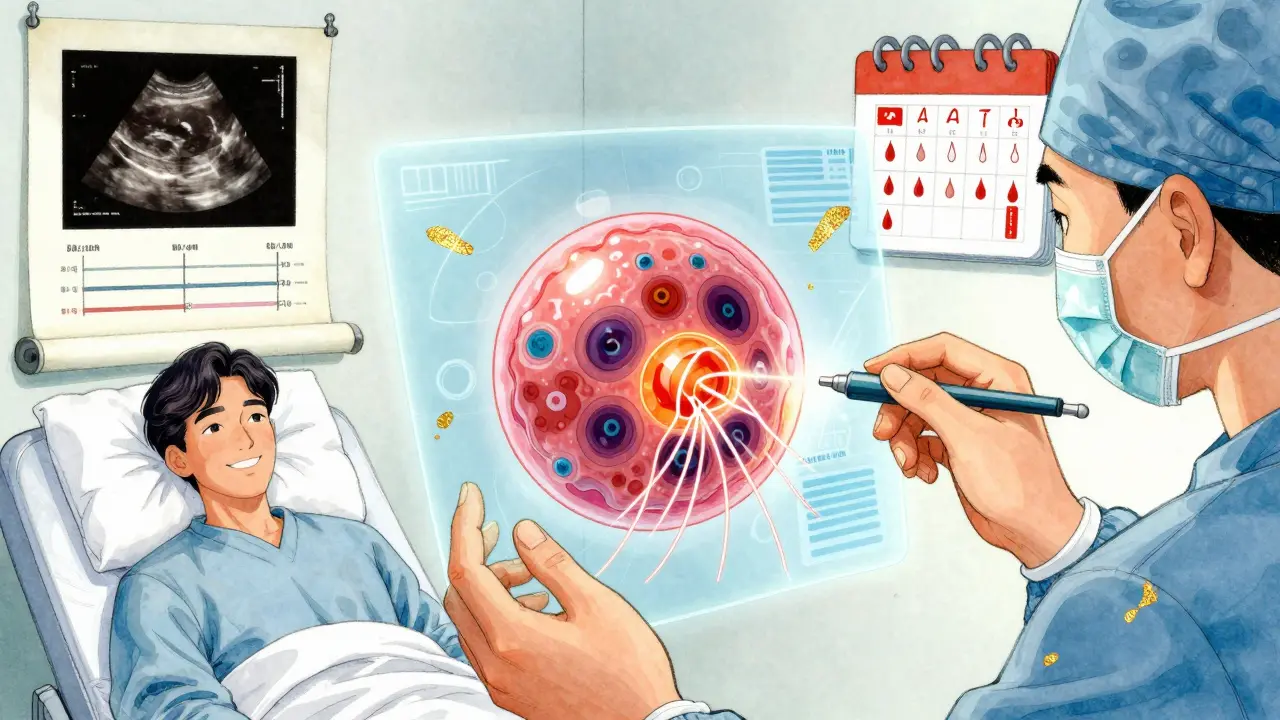
Long-Term Risks and Monitoring
Cabergoline is great - but it’s not risk-free. At doses above 2 mg per week for more than three years, it can cause heart valve problems. That’s why the European Society of Endocrinology recommends an echocardiogram every two years if you’re on high doses. It’s not common - 2 to 7% of long-term users - but it’s real.And you need to watch for other hormone losses. Even if your prolactin is normal, the tumor or its treatment might damage the rest of the pituitary. Fatigue, weight gain, cold intolerance, low blood pressure - these aren’t just stress. They could mean your adrenal or thyroid glands aren’t working. Annual blood tests for cortisol, TSH, and sex hormones are non-negotiable.
Most patients do well. In surveys, 78% report feeling better within six weeks of starting cabergoline. Those who had surgery report high satisfaction - 82% say the recovery was worth it. But 32% of people on bromocriptine quit because it made them feel awful. That’s why cabergoline is now the gold standard.
What’s Coming Next
The future of prolactinoma treatment is personal. Researchers are looking at tumor genetics - mutations in genes like GNAS and USP8 - to predict which tumors will grow fast or resist medicine. One new drug, paltusotine, is already approved for acromegaly and is being tested for prolactinomas. It’s taken orally, works longer, and might replace dopamine agonists one day.AI is helping surgeons plan better. 3D models of your tumor and surrounding nerves are being built before the operation. And in labs, CRISPR is being tested to silence the genes that make these tumors grow. It’s early, but it’s promising.
Right now, though, the best advice is simple: get tested if you have unexplained infertility, missed periods, or low sex drive. Don’t brush it off as stress or aging. A simple blood test and an MRI can change everything. And if you’re diagnosed - stick with your treatment. Prolactinomas are manageable. Most people live full, normal lives. You just need to know what you’re dealing with.
Can a prolactinoma go away on its own?
Rarely. Most prolactinomas don’t shrink without treatment. In very small cases, especially in women after pregnancy, prolactin levels may drop naturally. But even then, the tumor usually remains. Monitoring is still needed. Don’t assume it’s gone just because symptoms improve - always confirm with blood tests and scans.
Is cabergoline safe for long-term use?
Yes, for most people. Cabergoline is safe for years of use at standard doses (up to 2 mg per week). But at higher doses - over 2 mg daily for more than three years - there’s a small risk (2-7%) of heart valve thickening. That’s why doctors recommend an echocardiogram every two years if you’re on high doses. The benefits of controlling the tumor almost always outweigh this risk.
Can I get pregnant if I have a prolactinoma?
Absolutely. Many women with prolactinomas conceive after starting cabergoline. The drug restores ovulation and menstrual cycles. Once pregnant, most women stop taking it - the tumor rarely grows during pregnancy, and prolactin naturally rises. But you’ll need close monitoring. Your doctor will check your vision and hormone levels during pregnancy, especially if your tumor was large.
Why is surgery not always the best choice?
Surgery works well for small tumors, but it’s less effective for larger ones. Even the best surgeons can’t remove all of a tumor that’s grown into nearby nerves or blood vessels. Plus, surgery carries risks like CSF leaks, diabetes insipidus, and permanent hormone loss. Medication is safer, non-invasive, and often just as effective - especially for prolactinomas. Surgery is usually saved for cases where medicine fails or vision is in danger.
How often do I need follow-up tests?
When you start treatment, check prolactin every month for the first three months. Then every 3 to 6 months until levels are stable. After that, annual blood tests are enough if you’re feeling fine. MRI scans are done once a year for the first two years, then every 2 to 5 years if the tumor has shrunk and prolactin is normal. Vision tests are needed yearly if you had a large tumor or vision problems before treatment.
Can stress cause high prolactin levels?
Stress can raise prolactin slightly - like during intense exercise, illness, or emotional shock. But it won’t cause levels over 100 ng/mL. If your prolactin is above 150 ng/mL, it’s almost certainly a prolactinoma, not stress. Doctors always rule out other causes - medications, kidney failure, hypothyroidism - before diagnosing a tumor.
Dayanara Villafuerte
So let me get this straight - we’re treating a brain tumor with a pill you take twice a week, and the side effects are *less* than your morning coffee? 🤯 I’m not even mad. I’m impressed. My aunt had one of these and was on bromocriptine - she cried every time she took it. Cabergoline is basically the MVP of endocrinology. 🏆
Andrew Qu
For anyone reading this and thinking, 'I’ve been tired for years' - please, get your prolactin checked. It’s one blood test. No needles in the brain, no surgery, no guesswork. If you’re a woman with irregular periods or a man with low libido and no explanation? This could be it. Don’t let 'stress' be the lazy diagnosis. Your body’s screaming - listen.
Zoe Brooks
I used to think hormones were just for puberty and periods. Then I read about prolactin doing all this stuff - affecting bones, vision, even your motivation to get out of bed. It’s wild how one tiny gland can run your whole life. Like, your brain is basically a hormone factory, and sometimes one little glitch turns everything upside down. I’m not scared of medical stuff anymore - I’m just… curious. 🌱
Kristin Dailey
Why is America so okay with letting tumors grow for years before testing? We pay for fancy iPhones but skip basic bloodwork. Fix the system, not just the symptoms.
Aysha Siera
They say it's a tumor but what if it's the chemicals in the water? Or the 5G towers? Or the vaccines? They don't want you to know the real cause. They just want you on pills forever. Look at the pharma profits. Look at the MRI machines. Look at the doctors. They all profit. The truth is buried. I know. I've seen it.
rachel bellet
While the pharmacokinetics of cabergoline demonstrate superior D2 receptor affinity and prolonged half-life relative to bromocriptine, the clinical efficacy curve remains nonlinear in macroadenoma subpopulations. Moreover, the longitudinal risk-benefit calculus of dopamine agonist exposure must be weighted against iatrogenic hypopituitarism, valvulopathy via 5-HT2B agonism, and the confounding variable of non-adherence due to gastrointestinal intolerance. The data, while robust, is not universally generalizable - particularly in geriatric cohorts with polypharmacy comorbidities.
Pat Dean
People don’t take responsibility anymore. You get lazy, you stop exercising, you eat junk, you stress out - and now it’s a tumor? Nah. You’re just weak. Get your act together. No pill fixes a life lived like a couch potato. This isn’t a medical issue - it’s a moral one.
Selina Warren
Let me tell you something - if you’re reading this and you’re scared, good. Fear means you’re alive. But don’t let fear paralyze you. I was diagnosed with a microprolactinoma at 28. I cried. I panicked. Then I took the pill. I got my period back. I got pregnant. I’m 35 now, healthy, and I run marathons. This isn’t the end of your story. It’s the beginning of the one where you fight back. You’re not broken. You’re just untested. Go get that blood test. Now.