
Statin-Diabetes Risk Assessment Tool
Your Risk Analysis
Analysis result will appear here.
Understanding the Impact
Based on your inputs, the effect on blood sugar may be minimal.
Recommended Actions
- • Maintain regular check-ups
- • Continue current healthy habits
It sounds like a contradiction: a medication designed to save your heart might actually push your blood sugar levels higher. If you've noticed your glucose readings creeping up after starting a cholesterol drug, you aren't imagining it. While statins is a class of medications primarily used to lower cholesterol and prevent cardiovascular disease, they can trigger a measurable increase in blood sugar for some people. The real question isn't whether this happens-because the science says it does-but whether the risk is worth the reward.
The short version: Risk vs. Reward
- The Effect: Statins can cause a small but significant rise in blood sugar, potentially pushing people with prediabetes into a type 2 diabetes diagnosis.
- The Dose Matter: Higher doses of high-intensity statins generally carry a higher risk of metabolic changes.
- The Trade-off: For almost everyone, the protection against heart attacks and strokes far outweighs the risk of slightly higher blood sugar.
- The Solution: Monitoring your HbA1c and maintaining a healthy lifestyle can offset these effects.
How Statins Actually Affect Your Blood Sugar
You might wonder how a drug targeting the liver's cholesterol production ends up affecting your pancreas or insulin. It comes down to how the body processes energy. Statins work by blocking the mevalonate pathway to stop cholesterol synthesis. However, this process also reduces the production of certain metabolites like CoQ10 and isoprenoids, which your cells need to respond correctly to insulin.
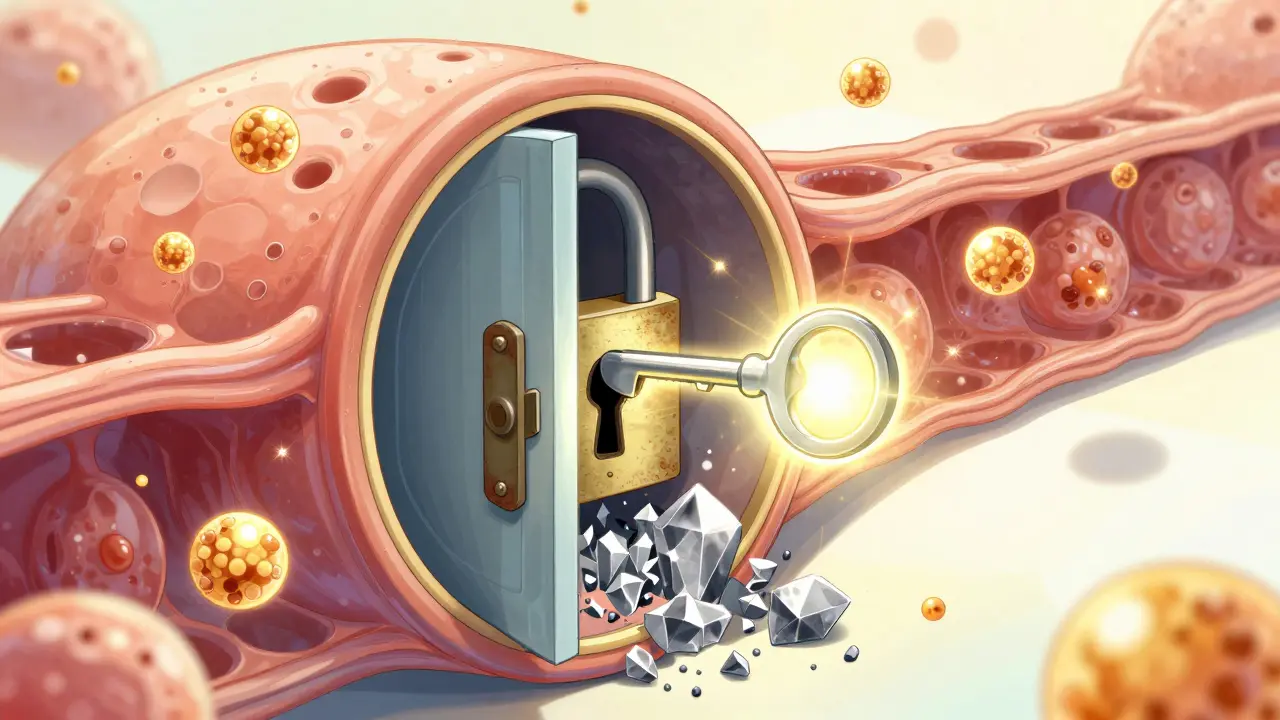
When these metabolites drop, your cells become less sensitive to insulin-a state known as insulin resistance. Essentially, the "locks" on your cells become harder to open, leaving more sugar floating in your bloodstream instead of fueling your muscles. Research from the METSIM cohort, which followed over 8,000 participants, showed that those on statins saw a 24% decrease in insulin sensitivity. In some cases, the pancreatic beta-cells-the ones that actually make the insulin-also start to struggle, which is a double hit to your glucose control.
Who Is Most at Risk?
Not everyone will see a spike in their blood sugar. For most people, the change is so tiny it never crosses the clinical threshold for diabetes. However, some people are much more susceptible than others. If you already have metabolic risk factors, you're more likely to notice a change.
Key risk factors include:
- Prediabetes: If your blood sugar is already hovering near the limit, even a small nudge from a statin can push you over the line into a formal diagnosis.
- Central Obesity: Carrying extra weight around the midsection often goes hand-in-hand with existing insulin resistance.
- Age and Genetics: As we age, our metabolic flexibility decreases. Recent studies have even pointed to specific variants in the SLCO1B1 gene that might make some people more prone to these side effects.
- Other Medications: If you're taking glucocorticoids (steroids), your blood sugar is already under pressure, and statins can compound that effect.
The Dose-Dependency Factor
The intensity of the medication plays a huge role. There is a clear pattern: the stronger the dose, the higher the risk. This is why your doctor might start you on a "moderate-intensity" dose before moving up to a "high-intensity" one if your numbers aren't improving.
| Intensity Level | Common Examples | Typical Diabetes Risk Increase | Primary Goal |
|---|---|---|---|
| Moderate | Low-dose Atorvastatin or Rosuvastatin | Approximately 10% higher risk | General cholesterol maintenance |
| High | Atorvastatin 40-80 mg / Rosuvastatin 20-40 mg | Approximately 36% higher risk | Aggressive prevention of ASCVD |
It's worth noting that Atorvastatin is often cited in clinical literature as having a slightly more pronounced effect on glycemic control compared to some other options, though the difference is often small in the grand scheme of heart health.

The Big Picture: Why Doctors Still Prescribe Them
If statins can cause diabetes, why are they still the gold standard? Because the numbers tell a very specific story. A heart attack or stroke is a catastrophic event; a slight rise in blood sugar is a manageable condition. The American Heart Association and other major health bodies point out that the absolute risk reduction for major vascular events is far greater than the risk of developing new-onset diabetes.
To put it in perspective, some data suggests that for every 2,000 to 3,000 cases of statin-related diabetes, the medications prevent roughly 50,000 major cardiovascular events. For a patient with high blood pressure and high cholesterol, the "cost" of a slightly higher A1c is a fair trade for not having a heart attack. In many cases, the diabetes that develops is mild and can be managed with simple lifestyle changes or a small adjustment in medication.
How to Manage Your Health While on Statins
You don't have to choose between heart health and blood sugar control. There are several practical ways to mitigate the risk and keep your numbers in check.
- Baseline Testing: Ask your doctor for a fasting glucose test or an HbA1c test before you start the medication. This gives you a benchmark to see if the drug is actually affecting you.
- Regular Monitoring: Don't wait for your annual physical. If you are at high risk for diabetes, check your levels every six months to catch any upward trends early.
- Focus on Fiber and Protein: Reducing refined sugars and processed carbs helps combat insulin resistance. Pairing your meals with fiber and lean protein slows down glucose absorption.
- Keep Moving: Physical activity is the most effective way to increase insulin sensitivity. Even a 30-minute brisk walk daily helps your muscles take up glucose more efficiently, countering the effect of the statin.
- Open Communication: If you're already taking diabetes meds, tell your doctor if you feel more fatigued or if your home readings are higher. They can adjust your metformin or other glucose-lowering drugs to compensate.
Should I stop taking my statins if my blood sugar goes up?
No, never stop your medication without consulting your doctor. The risk of a cardiovascular event (like a heart attack) is typically much higher than the risk associated with a small increase in blood sugar. Your doctor can help you manage the sugar levels through diet, exercise, or medication adjustments while keeping your heart protected.
Which statin is the safest for blood sugar?
While most statins have a similar profile, the risk is more about the dose and intensity than the specific brand. Moderate-intensity statins generally have a lower risk of increasing blood sugar than high-intensity ones. If you're very concerned, discuss lower-dose options or non-statin alternatives with your provider.
Can statin-induced diabetes be reversed?
In some cases, blood sugar levels can return to normal if the statin is discontinued. However, this is rarely recommended if the patient still needs cholesterol management. Instead, the "diabetes" is managed by treating the underlying insulin resistance through lifestyle changes.
Does this mean everyone on statins will get diabetes?
Absolutely not. For the vast majority of people, statins have no significant impact on blood sugar. The increase is typically modest (around 0.1-0.3% per year) and primarily affects people who were already predisposed to diabetes due to genetics, weight, or age.
What is the difference between prediabetes and statin-induced diabetes?
Prediabetes is when your blood sugar is higher than normal but not yet high enough for a diabetes diagnosis. Statins can act as a catalyst, providing the small additional push needed to move someone from the prediabetes category into the type 2 diabetes category.
Betty Kawira
Just a heads up for anyone worried about this, adding a bit of apple cider vinegar before meals or just focusing on a low-carb diet really helps keep those glucose spikes in check when you're on these meds. I've seen a lot of patients manage this just by switching to a Mediterranean-style diet without needing more meds.
Abhishek Charan
Actually, the focus on statins is misplaced!!! Many people ignore the role of fructose consumption in insulin resistance, which is far more detrimental than any pharmaceutical intervention... 🙄🙄🙄. The data presented here is simply too narrow!!!
Jean Robert
It's really important to remember that you aren't alone in this journey, and while the news about blood sugar can feel overwhelming, it's actually a very manageable hurdle if you just take it one day at a time, maybe start with a gentle fifteen-minute walk after dinner and remind yourself that your heart health is the priority right now, and with a little bit of patience and some support from your doctor, you can absolutely keep your glucose numbers stable while still getting the life-saving benefits of the medication, so just keep your head up and stay positive about the changes you're making for your long-term well-being.
Amber McCallum
Modern medicine is just a band-aid. They fix one thing and break another. It's all about control.
Justin Crice
The mechanistic link between the inhibition of HMG-CoA reductase and the subsequent reduction in isoprenoid synthesis is well-documented, yet the clinical variance in glycemic response remains puzzling. It would be interesting to see more granular data on the GLUT4 translocation inhibition specifically related to high-intensity rosuvastatin regimens.
Peter Minto
Who cares bout a little sugar? Better to have diabetes than a dead heart. America needs to stop overthinkin every little pill and just take the meds like the doc says!!!
Timothy Brown
Imagine being scared of a 0.2% A1c bump when you're literally one clot away from a stroke. People are soft these days.
Darrin Oneto
Pretty wild how the body just flips a switch like that. Kinda spooky stuff but the heart protection is a total game changer for some folks who are just dealt a bad hand geneticaly.
Thomas Jorquez
Seems reasonable enough. Just gotta keep an eye on the numbers and not panic over a slight increase in glucose.
Michael Yoste
I totally agree with the point about risk vs reward, but honestly, most people are just too lazy to fix their diet and then complain when the meds don't work perfectly. It's almost funny how people expect a pill to do all the heavy lifting while they keep eating processed junk!