
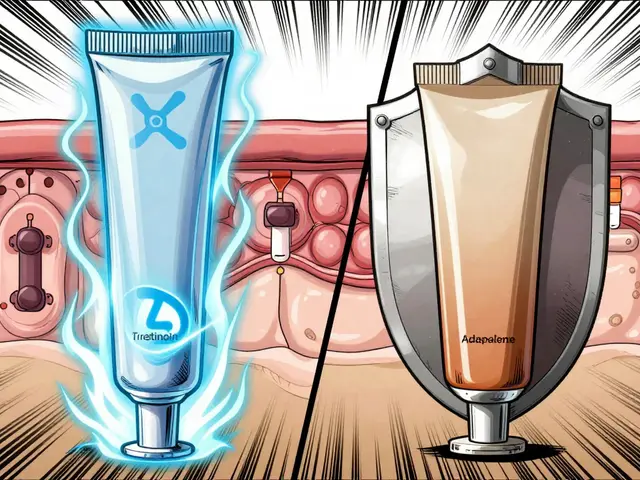
Your skin is constantly renewing itself, but sometimes it needs a little push to shed dead cells and produce fresh collagen efficiently. That’s where Retinoid Therapy comes in. It is a dermatological treatment using vitamin A derivatives to accelerate cell turnover, unclog pores, and stimulate collagen production. Among the many options available, two names dominate the conversation: Tretinoin and Adapalene. Both are powerful, both are proven, but they work differently and serve different goals.
If you’re staring at a pharmacy shelf or reading a prescription label, you might feel overwhelmed. Should you go for the over-the-counter option that promises gentle results? Or should you ask your doctor for the prescription-strength powerhouse known for reversing signs of aging? The answer isn’t one-size-fits-all. It depends on your skin type, your primary concern (acne versus wrinkles), and how much irritation you can tolerate. Let’s break down exactly how these two ingredients improve your skin so you can make an informed choice.
Understanding the Science: How Retinoids Work
To understand why tretinoin and adapalene are so effective, you need to look at what happens beneath the surface. Retinoids bind to specific receptors in your skin cells called retinoic acid receptors. Think of these receptors as switches that tell your cells what to do. When activated, they speed up the rate at which old skin cells die and new ones rise to the surface. This process, known as cellular turnover, helps unclog pores and smooth out texture.
Tretinoin, also known as all-trans retinoic acid, is a first-generation retinoid synthesized in 1954 by Dr. Albert Kligman and Dr. James Fulton. It was FDA-approved for acne in 1971 under the brand name Retin-A. Because it is a carboxylic acid form of vitamin A, it binds to both RAR-alpha and RAR-gamma receptors with high affinity. This allows it to penetrate deep into the dermis, stimulating significant collagen production. However, this potency comes with a cost: tretinoin is chemically unstable. It degrades rapidly when exposed to UV light and oxygen, which is why it must be applied at night and stored in opaque packaging.
Adapalene, on the other hand, is a third-generation synthetic retinoid developed by Galderma Laboratories. It received FDA approval in 1996 and became available over-the-counter at 0.1% concentration in 2016. Chemically, adapalene is a naphthoic acid derivative (C28H28O). Its structure makes it highly stable against light and air. More importantly, it selectively binds only to RAR-beta and RAR-gamma receptors. This selectivity means it targets the epidermal layer primarily, making it excellent for treating acne without causing the same level of deep dermal irritation associated with tretinoin.
Tretinoin: The Gold Standard for Anti-Aging
When people talk about "the best" retinoid for reversing sun damage and wrinkles, they are almost always talking about tretinoin. If your main goal is to reduce fine lines, improve skin elasticity, and fade hyperpigmentation, tretinoin is the superior choice. Clinical studies consistently show its ability to remodel the deeper layers of the skin.
A 2018 double-blind study compared 0.05% tretinoin cream with 0.3% adapalene gel for photoaging. After 24 weeks, participants using tretinoin saw a 42% improvement in fine wrinkles, compared to just 35% for those using adapalene. Another study published in the Archives of Dermatology in 2004 found that 0.05% tretinoin improved mottled pigmentation by 58%, while adapalene achieved only 47% improvement after 48 weeks. These numbers matter because they reflect real changes in skin structure, not just surface-level smoothing.
Tretinoin is available in several formulations, including creams, gels, lotions, and microspheres. The microsphere formulation, such as Retin-A Micro, encapsulates the medication in tiny spheres that release the drug slowly. This technology significantly reduces irritation, making it easier for sensitive users to tolerate higher concentrations. Common strengths range from 0.01% to 0.1%. Most dermatologists recommend starting with 0.025% or 0.05% to minimize side effects while still achieving clinical benefits.
However, tretinoin is not without drawbacks. It causes more redness, peeling, and stinging than adapalene. In pooled data from seven clinical trials, 32% of tretinoin users experienced erythema (redness) compared to 15% of adapalene users. Scaling occurred in 28% of tretinoin users versus 12% of adapalene users. If you have very sensitive skin or rosacea, tretinoin might be too harsh unless you use a buffered application method.
Adapalene: The Gentle Giant for Acne
If your primary struggle is acne-especially blackheads, whiteheads, and mild inflammatory lesions-adapalene is often the better starting point. Its stability and selective receptor binding make it less irritating while still being highly effective at clearing pores. Since becoming available over-the-counter in 2016, adapalene has democratized access to retinoid therapy, allowing millions to treat acne without a prescription.
Clinical evidence supports its efficacy. A multicenter randomized controlled trial involving 150 patients found that adapalene 0.1% reduced total acne lesions by 69-74% after eight weeks. This result was statistically equivalent to tretinoin 0.025%, but with significantly lower irritation scores (2.1 versus 3.4 on a 0-10 scale). For many users, especially teenagers and young adults, this tolerability difference is crucial. High irritation often leads to discontinuation, and if you stop using a product, it doesn’t matter how effective it is.
Adapalene is available in two main strengths: 0.1% over-the-counter (commonly sold as Differin Gel) and 0.3% by prescription. The 0.3% prescription strength offers greater comedolytic activity, showing 30% greater efficacy in clearing clogged pores according to a 2018 study in the Journal of Drugs in Dermatology. This makes the prescription version ideal for moderate acne that hasn’t responded to OTC treatments.
One major advantage of adapalene is its compatibility with other acne treatments. Because it is stable in light and air, it can be safely combined with benzoyl peroxide. Products like Epiduo (adapalene 0.1% + benzoyl peroxide 2.5%) leverage this synergy, killing acne-causing bacteria while simultaneously unclogging pores. A 2023 study in the New England Journal of Medicine showed that this combination achieved 81% acne clearance at 12 weeks, compared to 67% for adapalene alone.

Head-to-Head Comparison: Efficacy vs. Tolerability
Choosing between tretinoin and adapalene often comes down to balancing efficacy with tolerability. You want a product that works well enough to see results but is gentle enough that you can stick with it long-term. Here is how they stack up across key metrics:
| Attribute | Tretinoin | Adapalene |
|---|---|---|
| Primary Use | Anti-aging, severe acne, hyperpigmentation | Mild to moderate acne, maintenance therapy |
| Availability | Prescription only (0.01% - 0.1%) | OTC (0.1%) and Prescription (0.3%) |
| Irritation Risk | High (32% erythema incidence) | Low (15% erythema incidence) |
| Collagen Stimulation | Strong (deep dermal penetration) | Moderate (primarily epidermal) |
| Stability | Unstable (degrades in light/air) | Stable (compatible with benzoyl peroxide) |
| Time to Results | 8-12 weeks for acne; 12 weeks for photoaging | 8-12 weeks for acne; slower for anti-aging |
As the table shows, tretinoin wins on anti-aging performance, while adapalene wins on ease of use and accessibility. If you are over 35 and concerned with wrinkles, tretinoin is likely worth the extra effort and potential irritation. If you are under 30 and battling breakouts, adapalene provides a smoother entry into retinoid therapy.
Navigating the "Retinization" Period
No discussion of retinoids is complete without addressing the "retinization" period. This is the initial phase where your skin adjusts to the increased cell turnover. Symptoms include dryness, flaking, redness, and sometimes a temporary increase in breakouts known as "purging." Purging occurs because trapped impurities are pushed to the surface faster than usual. It typically lasts 2-6 weeks.
A 2023 survey of 412 dermatology patients revealed that 63% discontinued treatment within the first four weeks due to improper expectations about this phase. Many users mistake purging for an allergic reaction or assume the product is damaging their skin. In reality, it is a sign that the retinoid is working. Persistence is key. Community data from Reddit and Amazon reviews indicates that 87% of users who persist beyond 12 weeks achieve significant improvement.
To minimize irritation during retinization, dermatologists recommend the "sandwich method." Apply a thin layer of moisturizer to clean, dry skin, wait 20 minutes, apply a pea-sized amount of retinoid, then apply another layer of moisturizer. A 2022 clinical trial found this technique reduces irritation by 47%. Start by using the retinoid 2-3 nights per week, gradually increasing frequency as your skin builds tolerance. Never apply retinoids to wet skin, as water enhances absorption and increases the risk of irritation.

Essential Safety and Usage Guidelines
Retinoids make your skin more sensitive to sunlight. Daily use of a broad-spectrum SPF 30+ sunscreen is non-negotiable. Failure to do so can lead to increased photosensitivity, resulting in 3.2 times more adverse events such as sunburn and hyperpigmentation, according to a five-year retrospective study. Apply sunscreen every morning, even on cloudy days, and reapply every two hours if you are outdoors.
Pregnancy is another critical consideration. Both tretinoin and adapalene are classified as FDA Pregnancy Category C. While topical absorption is low, systemic exposure can potentially harm fetal development. Women who are pregnant, planning to become pregnant, or breastfeeding should avoid retinoids entirely. Consult your healthcare provider before starting any retinoid therapy if there is any chance of pregnancy.
Cost is also a practical factor. Prescription tretinoin averages $45.75 per tube without insurance, though coverage often reduces this to $10-20. Over-the-counter adapalene costs around $14.99 for a standard tube of Differin Gel. While tretinoin may seem expensive, its dual benefit for acne and anti-aging can justify the investment for many users. Adapalene offers a budget-friendly alternative for those focused solely on acne control.
Expert Recommendations and Future Trends
Dermatologists generally agree on a tiered approach. Dr. Diane Berson, Associate Professor of Dermatology at Weill Cornell Medicine, states that "adapalene represents the optimal starting point for 80% of new retinoid users due to its favorable tolerability profile." For those seeking anti-aging benefits, Dr. Joshua Zeichner notes that "tretinoin remains the gold standard," especially with newer micronized formulations like Altreno that reduce irritation.
Looking ahead, the future of retinoid therapy lies in personalization. Genetic testing may soon allow clinicians to predict individual irritation responses, optimizing the choice between tretinoin and adapalene for each patient. Combination therapies, such as adapalene paired with niacinamide or hyaluronic acid, are also gaining traction to enhance tolerability and hydration. Despite these innovations, tretinoin and adapalene will remain foundational due to decades of safety data and proven efficacy.
Can I use tretinoin and adapalene together?
No, you should not use tretinoin and adapalene simultaneously. Both are retinoids that work through similar mechanisms, and combining them increases the risk of severe irritation, peeling, and barrier damage without providing additional benefits. Choose one based on your primary skin concern: adapalene for acne, tretinoin for anti-aging.
How long does it take to see results from retinoid therapy?
Most users begin to see improvements in acne within 8-12 weeks of consistent use. For anti-aging benefits like wrinkle reduction and pigment correction, results typically become visible after 12-24 weeks. Full benefits often require 6-12 months of continuous application. Patience is essential, as the initial "purging" phase can temporarily worsen skin appearance.
Is adapalene effective for wrinkles?
Adapalene has some anti-aging properties due to its ability to increase cell turnover, but it is less effective than tretinoin for reducing deep wrinkles and stimulating collagen. Studies show adapalene improves fine lines by about 35%, compared to 42% for tretinoin. If anti-aging is your primary goal, tretinoin is the superior choice. Adapalene is best suited for acne treatment and maintenance.
Why does my skin peel when using retinoids?
Peeling is a common side effect caused by accelerated cell turnover. As old skin cells shed faster, they can accumulate and flake off. This is part of the "retinization" process. To minimize peeling, use the sandwich method (moisturizer-retinoid-moisturizer), start with a lower frequency (2-3 times per week), and ensure your skin is completely dry before application. Hydrating serums with hyaluronic acid can also help mitigate dryness.
Can I use retinoids if I have sensitive skin?
Yes, but caution is required. Adapalene is generally better tolerated by sensitive skin due to its lower irritation profile. Start with a low concentration (0.1% OTC adapalene) and apply it sparingly, perhaps once a week initially. Always buffer with moisturizer and avoid combining retinoids with other active ingredients like AHAs, BHAs, or vitamin C until your skin builds tolerance. Consult a dermatologist if you have conditions like rosacea or eczema.
Write a comment