
When your kidneys stop working properly, your body starts to drown in its own waste. It’s not just about peeing less - it’s about feeling like you’re slowly poisoning yourself. Nausea that won’t quit. An itch that makes you scratch until your skin bleeds. Sleepless nights. Losing weight because food tastes like metal. These aren’t just inconveniences. They’re red flags that your kidneys are failing - and dialysis might be the only thing that can bring you back to life.
What Exactly Are Uremic Symptoms?
Uremia isn’t a disease. It’s the result of your kidneys no longer being able to clean your blood. When they fail, toxins like urea, creatinine, and chemicals called middle molecules build up. These aren’t just numbers on a lab report. They’re what make you feel awful. The term comes from urea, a waste product, and -emia, meaning in the blood. So uremia literally means urea in the blood - and that’s when things go south.
By the time you start feeling symptoms, your kidneys are already working at less than 15% of their normal capacity. That’s stage 5 chronic kidney disease, or end-stage kidney disease (ESKD). About 89% of people who start dialysis already have these symptoms. You don’t wait for a doctor to tell you it’s time - your body screams it.
Nausea: The Constant, Unrelenting Feeling
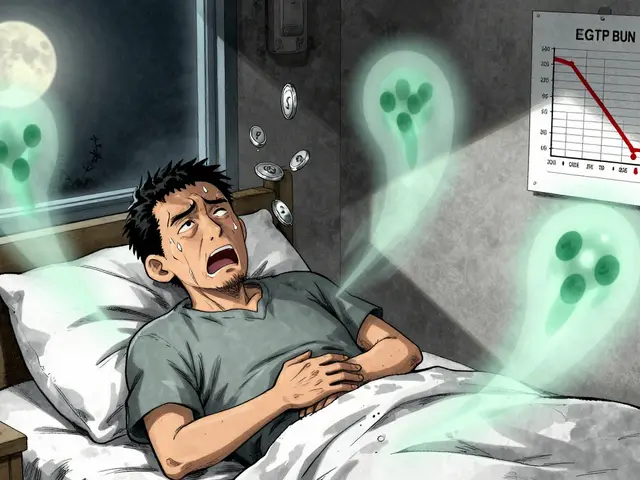
Imagine waking up every morning with the same sick feeling you get after eating bad sushi - but it doesn’t go away. For many people with advanced kidney disease, nausea is constant. It’s not just a mild upset stomach. It’s vomiting after eating, losing your appetite for weeks, and watching your weight drop even though you’re trying to eat.
Studies show 68% of people with stage 5 CKD have this symptom. Why? Toxins like p-cresyl sulfate and indoxyl sulfate build up and trigger the brain’s vomiting center. When your blood urea nitrogen (BUN) hits above 80 mg/dL, nausea becomes almost guaranteed. One study found 92% of patients had nausea for 6 to 12 weeks before starting dialysis.
And it’s not just about food. Many describe a metallic taste that makes everything taste like pennies or blood. One Reddit user, DialysisDad, said he lost 18 pounds in two months because eating felt like swallowing sand. That’s not an exaggeration - it’s a real, documented experience.
Doctors treat this with ondansetron (Zofran) or domperidone. But these only help so much. The only thing that truly fixes it? Dialysis. Once toxins are flushed out, nausea fades - often within days.
Itch: The Silent Killer of Sleep and Sanity
If you’ve ever had a mosquito bite, you know itch. Now imagine that feeling - but everywhere. On your back, legs, arms. Worse at night. So bad you wake up with bloody scratches. That’s uremic pruritus, or chronic kidney disease-associated pruritus (CKD-aP).
It affects 37% of people not yet on dialysis and nearly 70% of those who are. It’s not dry skin. It’s not an allergy. It’s your kidneys failing to remove inflammatory chemicals. Studies show people with this itch have CRP levels nearly triple those without it. That’s inflammation burning inside you.
The International Forum for the Study of Itch says it’s uremic if it lasts more than six weeks, affects large areas of skin, and no rash shows up. The 5-D Itch Scale measures it by how long it lasts, how bad it is, where it spreads, how much it messes with your life, and how it makes you feel emotionally. A score over 12 means severe. Over 15? That’s when doctors start pushing for dialysis.
One patient on the American Kidney Fund forum said her sleep score on Fitbit dropped from 85 to 42 for six months straight. Another said she changed careers because she couldn’t focus at work. This isn’t just discomfort - it’s disabling.

When Exactly Should You Start Dialysis?
This is the biggest question. And the answer isn’t just a number.
Years ago, people waited until they were barely conscious before starting dialysis. Now, we know better. But that doesn’t mean you start dialysis just because your eGFR hits 10 or 12. The IDEAL trial proved that starting early - at eGFR 10-14 - doesn’t save your life compared to starting later, at 5-7. But here’s the catch: if you wait until you’re vomiting, itching, and can’t sleep, you’ve already suffered.
Current guidelines say: start dialysis when symptoms become unbearable - not when a number says so. The 2023 KDOQI guidelines say dialysis should begin when:
- eGFR is below 10.5 mL/min/1.73m² and
- BUN is over 70 mg/dL and
- creatinine is above 8 mg/dL
But even those numbers aren’t the whole story. If you’re losing weight because you can’t eat, if you’re scratching your skin raw, if you’re too tired to get out of bed - those are the real triggers. Dr. Adeera Levin says it best: “The decision must be individualized based on symptom burden, not eGFR alone.”
Some doctors argue for earlier dialysis to prevent complications. Others say wait until you’re truly suffering. The truth? It’s a balance. You don’t want to start too early and spend years on a machine unnecessarily. But you also don’t want to wait until your body breaks down.
What Happens If You Wait Too Long?
Waiting too long isn’t just uncomfortable - it’s dangerous.
Uremia doesn’t just cause nausea and itch. It can lead to:
- Uremic pericarditis - fluid building up around your heart
- Confusion or seizures from toxin buildup
- Bleeding problems because your blood can’t clot right
- Fluid overload - your lungs fill with water, making it hard to breathe
One study found people who waited until they were in crisis had a 58% higher risk of dying in the first year of dialysis compared to those who started before things got this bad.
And the delays aren’t just medical. A 2022 poll found 41% of patients saw three or more doctors before someone finally said, “Your kidneys are failing.” The average delay? Over eight months. That’s eight months of unnecessary suffering.

How Are These Symptoms Treated Before Dialysis?
Before dialysis, you’re managing symptoms - not curing them. But you can make life better.
For nausea:
- Ondansetron (Zofran) - 4 mg three times a day
- Domperidone - 10 mg four times a day (but watch for heart risks)
- Small, frequent meals. Avoid greasy or strong-smelling foods
For itch:
- Optimize dialysis if you’re already on it - make sure Kt/V is above 1.4
- Gabapentin - start at 100 mg at night, slowly increase to 300 mg three times a day
- Nalfurafine or difelikefalin - newer drugs approved specifically for kidney itch. Difelikefalin (Korsuva) reduces itch by over 30% in days
- Moisturize daily. Avoid hot showers. Use fragrance-free soap
And don’t forget phosphate. High phosphate levels make itch worse. Your doctor should be checking your calcium-phosphorus product. If it’s over 55, you need a phosphate binder like sevelamer or lanthanum.
What’s Changing in 2026?
The future of dialysis is personal. The 2024 KDIGO guidelines are expected to include patient-reported outcomes as official triggers. That means if your itch score hits 15 on the new PROMIS-Itch scale, you qualify for dialysis - even if your eGFR is still at 11.
New drugs are coming fast. Nemifitide, a new kappa-opioid agonist, showed 45% better itch relief than placebo in late-stage trials. And research is finally focusing on disparities: Black patients wait 3.2 months longer than White patients before starting dialysis. That’s not just unfair - it’s deadly.
The NIH just poured $47 million into uremic symptom research. Why? Because we’re learning: it’s not about how long you live. It’s about how well you live while you’re waiting for a transplant - or while you’re on dialysis.
What Should You Do If You’re Experiencing These Symptoms?
If you have kidney disease and you’re:
- Throwing up every day
- Scratching until you bleed
- Losing weight without trying
- Not sleeping because of itch or nausea
- then you need to talk to your nephrologist today. Don’t wait for your next appointment. Don’t think it’s “just part of the disease.” These are signs your body is in crisis.
Ask for:
- Your latest eGFR, BUN, and creatinine numbers
- A 5-D Itch Scale assessment
- A discussion about dialysis timing - not just if, but when
And if your doctor says, “You’re not quite there yet,” ask: “What’s the plan if I get worse?” If they don’t have one, get a second opinion. Your quality of life matters as much as your lab values.
Uremia doesn’t care about your schedule. It doesn’t wait for insurance approvals. It doesn’t care if you’re scared. It’s happening now. And the sooner you act, the sooner you’ll feel like yourself again.
Can you have uremic symptoms without knowing you have kidney disease?
Yes. Many people don’t realize their kidneys are failing until symptoms like nausea, itch, or fatigue become impossible to ignore. Kidney disease often has no early warning signs. By the time symptoms appear, kidney function may already be below 15%. Regular blood and urine tests are the only way to catch it early.
Does dialysis cure uremic symptoms?
Dialysis doesn’t cure kidney disease, but it removes the toxins causing uremic symptoms. Most people notice a dramatic improvement in nausea and itch within days of starting dialysis. However, some symptoms like itch may linger if other factors like high phosphate or inflammation aren’t controlled. Dialysis manages the problem - it doesn’t fix the root cause.
Is uremic itching the same as dry skin?
No. Dry skin itch is usually localized, responds to moisturizers, and doesn’t cause bleeding. Uremic pruritus is widespread, worse at night, and doesn’t improve with lotions. It’s caused by toxins and inflammation in the blood, not dryness. If moisturizer doesn’t help and you’re scratching your skin raw, it’s likely uremic.
Why do some people start dialysis earlier than others?
It depends on symptoms, not just lab numbers. Someone with severe nausea, weight loss, or pruritus may start dialysis at eGFR 12, while another person with no symptoms might wait until eGFR 8. Doctors now focus on how you feel, not just what the numbers say. Your quality of life is the deciding factor.
Can diet help with uremic nausea and itch?
Yes - but only as a support, not a cure. Limiting phosphorus, potassium, and sodium helps reduce toxin buildup. Avoiding processed foods, dairy, and dark sodas can lower phosphate levels, which worsens itch. Eating small, bland meals helps with nausea. But diet alone won’t fix uremic symptoms once kidney failure is advanced. Dialysis is still needed.
Are there new treatments for uremic itch on the horizon?
Yes. Difelikefalin (Korsuva) is already FDA-approved and works within 48 hours. Nemifitide, a new drug in phase 3 trials, shows 45% better itch reduction than placebo. Researchers are also testing non-opioid alternatives to gabapentin because many patients take unsafe doses for kidney disease. These treatments are changing how we manage this debilitating symptom.
Hilary Miller
I had no idea itching this bad was a sign of kidney failure. My mom went through this and no one told us it was related. She just kept using lotion until she started dialysis. Then boom - she slept for the first time in months.
Brenda King
This post is a lifeline for people who feel like their symptoms are being dismissed. I wish more doctors read this. The 5-D Itch Scale should be standard. 🙏
Keith Helm
It is imperative to note that initiating dialysis based solely on symptomatology may lead to overtreatment in some populations.
Daphne Mallari - Tolentino
One must question the epistemological foundations of relying on patient-reported outcomes as clinical triggers. The reduction of complex physiological phenomena into subjective scales is a dangerous precedent.
arun mehta
In India, many wait till they collapse before dialysis. No insurance, no access, no awareness. This info could save lives. 🙏❤️
Chiraghuddin Qureshi
My uncle started dialysis after scratching his arms raw for 6 months. He said it felt like ants crawling under his skin 24/7. Now he’s back to cooking for us. 🤍
Kenji Gaerlan
why do people even bother with dialysis if they're just gonna feel like crap anyway? just let em go
Oren Prettyman
The notion that symptom burden should override objective renal function metrics is not only clinically unsound but potentially catastrophic. The IDEAL trial demonstrated no mortality benefit from early initiation, and yet clinicians are increasingly disregarding evidence-based thresholds in favor of anecdotal suffering. This is not personalized medicine - it is medicalization of subjectivity. One must ask: if we begin dialysis for every patient who reports nausea, where does the line get drawn? Will we soon be initiating therapy for patients who merely describe a 'bad taste in their mouth'?
Jasmine Bryant
Wait so if your BUN is over 70 and you're itchy but your eGFR is 11... do you start dialysis? My doc says wait till 8 but I'm losing weight and can't sleep. I'm confused.
Liberty C
Of course the medical establishment ignores suffering until it’s visible enough to be inconvenient. They’d rather see you on a ventilator than admit they should’ve acted sooner. This isn’t medicine - it’s bureaucratic cruelty dressed in white coats.
Malik Ronquillo
I used to think dialysis was just a machine. Now I know it's the only thing between me and screaming all night. My skin was on fire. I didn't eat for 3 weeks. I thought I was dying. It took 4 doctors to finally say it. Don't wait. Please.
shivani acharya
You know who benefits from all this? The dialysis companies. They make billions. Meanwhile, patients are told to 'wait until you're really sick' because insurance won't cover it until then. And guess what? The same companies lobby to keep the guidelines vague so they can keep billing. This whole system is rigged. They want you desperate. Then they'll 'save' you... for a price.