
Medication Side Effect Assessment Tool
Assess Your Side Effect
This tool helps you determine if your side effect is mild and tolerable or serious enough to require immediate medical attention.
Everyone taking medication has faced it: that dry mouth, the drowsiness after lunch, the stomach upset that makes you wonder if the pill is worse than the problem it’s supposed to fix. But here’s the truth most people don’t talk about - not every side effect needs to be fixed. Some are just part of the deal. Others? They’re warning signs. Knowing the difference can mean the difference between sticking with your treatment and quitting it - or worse, ending up in the ER.
What Counts as a Side Effect?
A side effect isn’t always a bad thing. The FDA defines it simply: an unintended response to a drug at normal doses. That means if you take your medication as prescribed and feel something unexpected, it’s a side effect. But not all side effects are equal. Some are mild and temporary. Others are serious - even dangerous.
For example, if you’re on an SSRI for depression, around 35-40% of people feel drowsy in the first week. That’s common. If you’re on an antipsychotic, 60% will get dry mouth. Still common. These aren’t signs the drug isn’t working. They’re signs your body is adjusting.
But if you start vomiting blood, can’t breathe, or feel like your brain is fogged up to the point you can’t find your way home? That’s not a side effect. That’s an emergency. The CDC reports over 1.5 million emergency visits each year in the U.S. because of medication problems. Most of them? People waited too long to speak up.
When to Tolerate - And Why
Here’s the rule most doctors use: if the side effect doesn’t stop you from living, it’s probably worth tolerating - at least for a while.
Take drowsiness from antidepressants. Many people feel wiped out for the first few days. But studies show that in 70% of cases, it fades within 7 to 10 days. If you’re struggling with treatment-resistant depression, that temporary fatigue might be the price of finally feeling like yourself again. The beMedWise program says: if the medication is treating something serious - like severe anxiety, bipolar disorder, or chronic pain - and the side effect is mild, it’s often smarter to wait it out.
Same goes for dry mouth. It’s annoying. It makes swallowing hard. But if it’s just dryness - no sores, no trouble speaking - you can manage it. Drink more water. Chew sugar-free gum. Use a humidifier at night. The FDA’s Patient Communication Network found that 30-40% of people who moved their medication to bedtime cut their drowsiness in half. No dosage change needed.
Even nausea from antibiotics? A 62-year-old patient in a 2023 report reduced her nausea from 5-6 times a day to just 1-2 by taking her pills with a small handful of almonds or a boiled egg. Food isn’t just fuel - it’s a tool.
Bottom line: if you can still work, sleep, walk, or laugh - and the side effect isn’t getting worse - give it time. Most mild ones fade. Your body adapts.
When to Call Your Doctor - Immediately
Now, here’s where people get it wrong. They think, “It’s just a headache,” or “I’m a little dizzy - I’ll tough it out.” But some side effects don’t wait.
If you have:
- Fever, rash, swelling of the face or throat - especially after starting a new drug
- Black stools, vomiting blood, or severe abdominal pain
- Sudden confusion, memory loss, or trouble walking
- Difficulty breathing or chest pain
- you don’t call your doctor tomorrow. You go to urgent care now. These aren’t side effects. They’re red flags. The FDA’s Drugs@FDA database lists specific medications with “black box warnings” - the strongest alert they can give. Allopurinol, for example, carries a 0.1% risk of a life-threatening skin reaction. One rash. One sign. Stop it. Call your provider. Don’t wait.
For older adults, the National Institute on Aging says even mild dizziness or confusion can lead to falls, hospitalization, or permanent damage. If you’re on more than three medications - which 40% of people over 65 are - side effects can pile up. A 2022 CDC alert found that 5-7% of elderly patients on multiple drugs develop neurological side effects. That’s not normal aging. That’s a signal to reevaluate.

How to Track Side Effects Like a Pro
Most people tell their doctor: “I feel weird.” That’s not helpful. Doctors need details.
Start keeping a simple log. For a week, write down:
- What happened - “Stomach cramps,” “Headache,” “Feeling shaky”
- When - “30 minutes after taking my pill,” “Every morning at 8 a.m.”
- How bad - Rate it 1-10. Is it a 2 (annoying) or a 7 (can’t focus on work)?
- What you did - “Drank water,” “Took with food,” “Slept it off”
- Did it change? - “Worse after 3 days,” “Better after I switched to bedtime”
Dr. Michael Chen at Johns Hopkins found that patients who track side effects this way are 4.2 times more likely to get the right fix. Why? Because vague complaints lead to vague answers. “I feel bad” might mean your dose is too high. Or your timing is off. Or you need a different drug. You can’t know unless you’ve got data.
What Your Doctor Can Do - And What They Won’t
When you bring your log to your doctor, they have three real options:
- Adjust the timing - Move your pill from morning to night. For drowsiness, insomnia, or nausea, this works in 30-35% of cases.
- Change the dose - Lower it slightly. Many side effects drop off at lower doses. This fixes mild issues in 45-50% of cases.
- Switch medications - If you’re on an SSRI and can’t handle the weight gain, there are other antidepressants that don’t cause it. This works in 15-20% of cases - especially when side effects drag on past four weeks.
What they won’t do? Let you quit cold turkey. The CDC found that 28% of people stop their meds because of side effects. And 73% of those cases ended in treatment failure - their original condition came back harder than before.
And no, your doctor won’t say, “Just live with it.” That’s not care. That’s neglect. If your side effect is affecting your sleep, your job, your relationships - they owe you a better option.
What to Ask Your Doctor
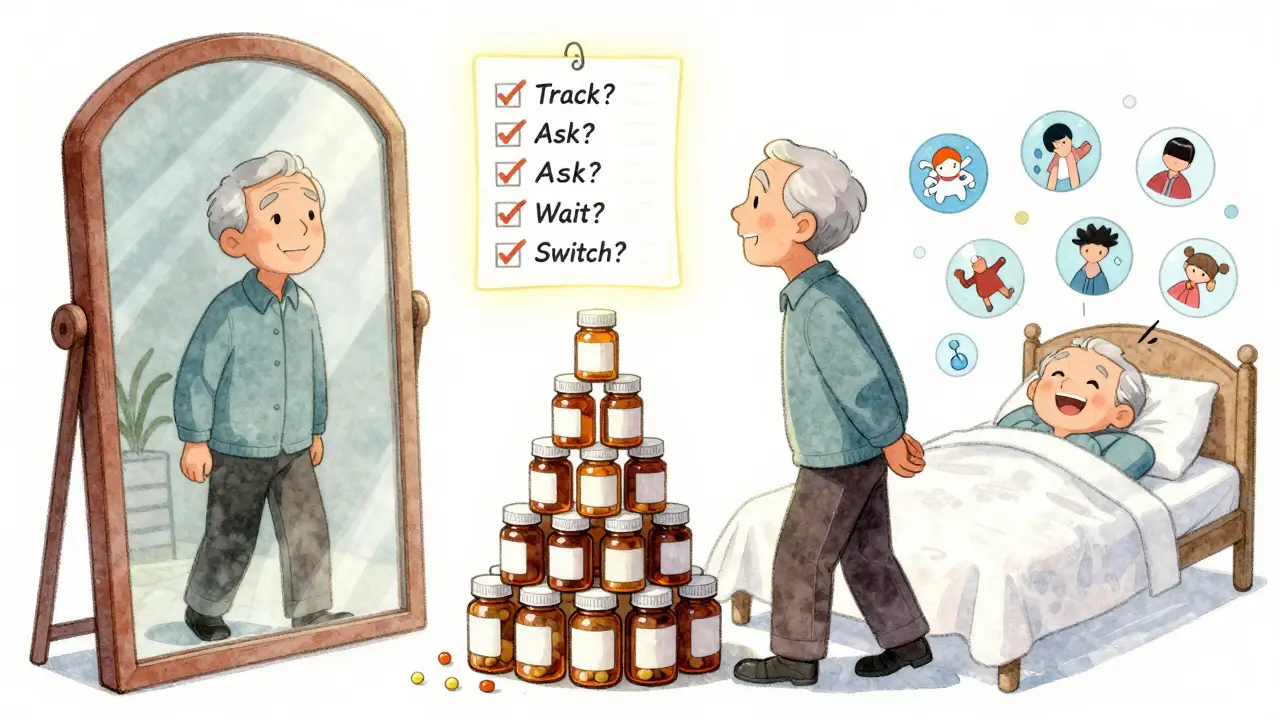
Don’t go in silent. Bring your log. Ask these three questions:
- “Is this side effect expected with this medication?” - Some side effects are common. Others are rare. Knowing which is which helps you decide.
- “What’s the timeline for this to go away?” - If it’s supposed to fade in 10 days and you’re on day 14, it’s time to talk.
- “What should I do if it gets worse?” - Get clear on red flags. When to call. When to go. When to wait.
A 2023 JAMA study tracked 1,200 patients. Those who asked these questions resolved their side effects 32% faster. No magic. Just clarity.
The Real Cost of Ignoring Side Effects
Money plays a role too. A Kaiser Family Foundation study found 37% of people stick with a drug they hate - because it’s cheaper than the alternative. They take nausea, fatigue, weight gain - all because switching means a higher co-pay. That’s not smart. It’s survival.
But here’s the flip side: stopping meds because of side effects leads to hospitalization, ER visits, and lost work. The real cost isn’t the pill. It’s the collapse of your health.
For cancer patients, 60-70% endure nausea because the alternative - letting the tumor grow - is worse. For someone with mild high blood pressure? Even a 20% drop in daily function means it’s time to switch. The American Heart Association says: if side effects interfere with more than 20% of your daily life, don’t wait. Ask for a change.
Final Rule: Don’t Guess. Communicate.
Side effects aren’t a test. You’re not supposed to suffer silently. Your job isn’t to endure. Your job is to report. Track. Ask. Push.
Medication isn’t magic. It’s a tool. And tools can break, wear out, or fit wrong. If your pill is making your life harder than your illness - that’s not normal. That’s a signal. And signals deserve answers.
So next time you feel off after taking your pill - don’t just assume it’s ‘just a side effect.’ Write it down. Talk about it. And if it’s not getting better? Demand a better option. Your health isn’t a sacrifice. It’s your right.



Sabrina Sanches
I took sertraline for 6 months and the drowsiness was brutal at first but by day 9 it just vanished like it never existed. I didn't even think to track it until now. This post is a game changer. Just keep going. Your body isn't broken it's just learning.
Also sugar-free gum saved my life. Dry mouth felt like sandpaper but chewing gum made it bearable. No need to panic.
Shruti Chaturvedi
In India we often just live with side effects because we can't afford to switch meds. I had hypertension and the diuretic gave me constant cramps. I drank coconut water and walked every morning. It helped. Not perfect but better. You don't need fancy logs. Just notice what your body tells you. Small changes matter more than you think.
Katherine Rodriguez
I hate how this article makes everything sound so manageable. What about people who work 12-hour shifts and can't afford to 'wait it out'? My cousin went from 70% drowsiness to 90% after two weeks. She lost her job. No one talks about that. This is privileged advice wrapped in wellness fluff.
Devin Ersoy
Let’s be real - if you’re still taking SSRIs because ‘they’re just side effects’ you’re basically letting Big Pharma do your emotional heavy lifting. I’ve seen people on six different meds because ‘the first one didn’t work’ and now they’re walking zombies with a pharmacy on their nightstand. It’s not adaptation. It’s chemical whack-a-mole.
And dry mouth? Try switching to a different SSRI. Celexa’s got less anticholinergic baggage than Zoloft. I’m not a doctor but I read a lot of PubMed.
Scott Smith
The tracking method described here is exactly what my therapist recommended. I started writing down times and symptoms in a notebook. Within three days I noticed a pattern - nausea only happened after I took my pill with coffee. Switched to tea. Gone. No dose change needed. Simple. But nobody tells you this stuff. This is practical medicine.
Emma Deasy
I must say, I am utterly astonished by the sheer lack of urgency in this narrative. To suggest that one should simply ‘wait it out’ for drowsiness or dry mouth - when these symptoms can be harbingers of systemic imbalance - is, frankly, irresponsible. I have witnessed a dear friend lapse into delirium after dismissing ‘mild confusion’ as ‘just aging.’ This is not a lifestyle tweak. This is a medical imperative. We must demand precision, not patience.
Rosemary Chude-Sokei
I appreciate this post. It's thoughtful and grounded. I've been on gabapentin for nerve pain and the brain fog was awful. I didn't know it could fade. I started taking it at night. After 11 days, I could read again. No one told me that. Thank you for normalizing the idea that some side effects are temporary. I wish more doctors said this.
Noluthando Devour Mamabolo
As a pharmacovigilance coordinator in Johannesburg, I can confirm: adherence drops 40% when side effects aren't contextualized. The key metric isn't symptom severity - it's functional impact. If the patient can't hold their child or get to work, that's the threshold. We use the WHO-5 Well-Being Index as a triage tool. Also - hydration + electrolytes = 68% reduction in GI side effects. Data doesn't lie.
Leah Dobbin
I suppose the implication here is that if you're not tracking your side effects with a spreadsheet and a baseline blood panel, you're just... not trying hard enough. I mean, really. Who doesn't have a daily log? And if you're on more than three meds, shouldn't you have a clinical pharmacist on speed dial? It's not that I'm judgmental - I just expect everyone to operate at peak optimization.