
What Are Bone-Conduction Hearing Aids?
Traditional hearing aids amplify sound through the air and send it into your ear canal. But what if your ear canal is blocked, infected, or malformed? That’s where bone-conduction hearing aids come in. Instead of relying on your outer or middle ear, these devices send sound vibrations straight through the bones of your skull to your inner ear. It’s like tapping your skull and hearing the sound vibrate inside your head-except it’s designed to restore clear hearing, not just create a weird sensation.
This isn’t science fiction. The technology dates back to the 1970s, when Swedish doctors first used titanium implants to fuse with skull bone. Today, brands like Cochlear, Oticon Medical, and MED-EL make devices that help people who can’t use regular hearing aids because of chronic ear infections, birth defects like aural atresia, or single-sided deafness. These are not just backup options-they’re often the only way to hear properly in certain cases.
How Do They Work?
Your ear has three parts: outer, middle, and inner. Air-conduction hearing aids work on the outer and middle parts. But if those are damaged, sound can’t reach the cochlea-the inner ear organ that turns vibrations into nerve signals. Bone-conduction devices skip those parts entirely. They use a small processor that picks up sound and turns it into vibrations. Those vibrations travel through your skull bone, bypassing the blocked or damaged areas, and reach the cochlea directly.
There are two main types: percutaneous and transcutaneous. Percutaneous systems have a metal post sticking out of the skin behind your ear. The sound processor clips onto it. Transcutaneous systems sit flush against the skin, using magnets to hold the external part in place while the internal component is implanted under the skin. The latter avoids skin infections but loses a little bit of sound power because the skin and tissue dampen the vibrations.
Studies show that for people with conductive or mixed hearing loss, bone conduction improves speech understanding in noisy places by 25-40% compared to traditional aids. For those with single-sided deafness, it’s even more life-changing-many report hearing birds, traffic, or conversations from their deaf side for the first time in years.
Who Benefits the Most?
These devices aren’t for everyone. They’re designed for three specific groups:
- Conductive hearing loss: When the outer or middle ear is blocked by wax, fluid, or malformation. People with chronic ear infections often can’t wear regular hearing aids because they irritate the ear canal. Bone conduction avoids that entirely.
- Mixed hearing loss: A combination of conductive and sensorineural loss. If the inner ear still works but the outer/middle doesn’t, bone conduction can help.
- Single-sided deafness (SSD): When one ear is completely deaf and the other works normally. Traditional hearing aids can’t help here. CROS aids (which send sound from the deaf side to the good ear) exist, but they distort direction and sound quality. Bone conduction devices restore natural hearing balance.
Success rates are high: 85-90% for children born with aural atresia, and 75-80% satisfaction among adults with SSD. If your ears are healthy but your inner ear is damaged (severe sensorineural loss), these devices won’t help much. The cochlea still needs to work.
Implant vs. Non-Implant: What’s the Difference?
There’s a big difference between wearing a device and having surgery. Most bone-conduction systems require a minor surgical procedure. But not all do.
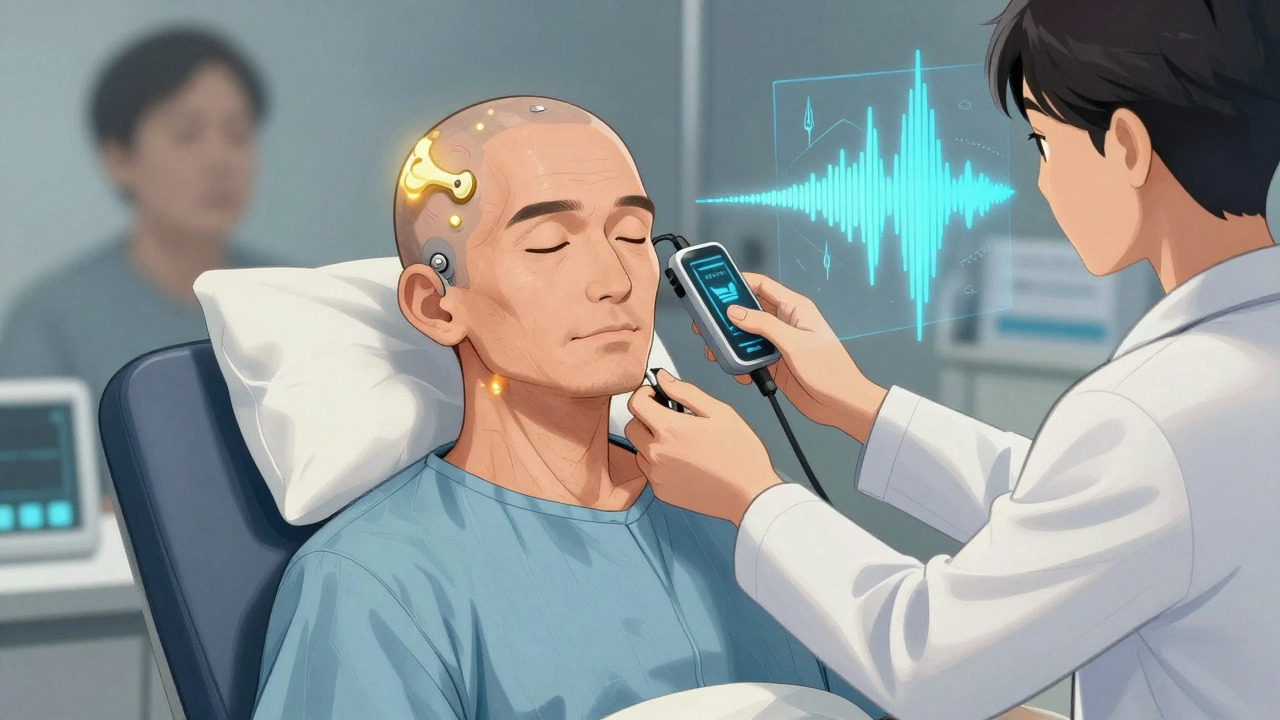
Percutaneous systems (like Cochlear BAHA Connect and Oticon Ponto) need a titanium implant fused into your skull bone. This takes 3-6 months to fully integrate. Then, an external processor snaps onto a small abutment sticking out of your skin. These offer the strongest sound output-up to 50 dB of gain-and are best for severe hearing loss. But they require daily cleaning with alcohol to prevent skin infections. About 28% of users report skin issues, and 8% need revision surgery.
Transcutaneous systems (like MED-EL Bonebridge and Cochlear BAHA Attract) don’t have anything sticking out. The sound processor sits on your skin, held by magnets. The internal part is under the skin, connected to a small titanium magnet. These are invisible when not in use, and there’s no open wound. But because sound has to pass through skin, they lose 10-15 dB of power. That’s fine for mild to moderate loss, but not ideal for severe cases.
Since 2019, transcutaneous systems have become the preferred choice-now making up 63% of new implants. Why? Fewer infections, no daily cleaning, and better cosmetic results.
Cost, Insurance, and Market Trends
These aren’t cheap. Implantable bone-conduction systems cost between $4,000 and $7,000 per ear. That’s two to three times the price of premium air-conduction hearing aids ($1,500-$3,500). But insurance often covers them if you have a documented medical need-like chronic infections or congenital ear defects. Medicare and many private insurers classify them as medically necessary, not cosmetic.
The market is growing fast. Bone conduction devices make up just 5.2% of the global hearing aid market, but they’re growing at 8.7% a year-more than double the rate of traditional aids. Cochlear leads with nearly half the market, followed by Oticon Medical and MED-EL. Adoption is highest in Sweden, where the technology was invented. In the U.S., only 0.4% of hearing-impaired people use them, even though an estimated 9 million have single-sided deafness.
New models are coming. Cochlear’s BAHA 6 Max, released in 2023, has Bluetooth 5.3 and a 30-hour battery. MED-EL’s Bonebridge 3, launching in early 2024, uses AI to adjust sound in real time. The next big leap? Fully implantable devices with no external parts. Sonova’s prototype is in final trials and could be approved by late 2024.

What to Expect After Surgery
Surgery is quick-30 to 60 minutes under local anesthesia. Most people go home the same day. Recovery is fast: you can return to work in 48 hours. But you can’t use the device right away.
With percutaneous systems, you wait 3-4 months for the implant to fuse with bone. Then your audiologist programs the processor. With transcutaneous systems, you can start using the device the same day. The first few weeks feel strange. Sound is different-sometimes tinny, sometimes too loud. That’s normal. Your brain needs 2-4 weeks to adjust. Audiologists recommend listening exercises: start with quiet environments, then move to noisy ones. Practice identifying where sounds come from.
After that, maintenance is simple. Clean the skin around the abutment daily with 70% isopropyl alcohol. Keep the processor dry. Replace batteries every 5-10 days. Some users report the processor slips off during exercise-especially with percutaneous models. A retention clip or headband helps.
Limitations and Risks
Like any medical device, bone conduction isn’t perfect.
- MRIs are a problem: The titanium implants can heat up or move during MRI scans. You’ll need to have the magnet removed before a 1.5T or 3T scan. Some newer models are MRI-safe, but you still need to check with your doctor.
- Not for severe sensorineural loss: If your cochlea is damaged, no amount of vibration will help. These devices rely on a working inner ear.
- Skin complications: Around 15-30% of percutaneous users develop redness, itching, or infection. Good hygiene reduces this, but it’s still a risk.
- Cost and access: Not all clinics offer them. You need an ENT specialist trained in implantation. In rural areas, finding one can be hard.
Still, for the right person, the benefits far outweigh the risks. One Reddit user wrote: "I heard my daughter’s voice from my left side for the first time in 15 years. I cried." That’s the kind of moment these devices make possible.
What’s Next?
Bone-conduction technology is evolving fast. The trend is clear: fewer open wounds, more invisible designs, smarter sound processing. By 2026, complication rates are expected to drop below 10%. By 2027, the market could hit $1.1 billion.
If you or someone you know has chronic ear infections, a birth defect, or single-sided deafness, don’t assume hearing aids are your only option. Talk to an audiologist who specializes in bone conduction. Ask about the latest models, insurance coverage, and surgical outcomes. This isn’t a last resort-it’s a targeted, effective solution for people who’ve been told there’s nothing else to do.


Doug Hawk
So bone conduction skips the eardrum entirely? That’s wild. I had chronic ear infections as a kid and my docs kept saying "just avoid water" like that was a fix. This tech feels like it was made for people like me.
John Morrow
Let’s not romanticize this. The 28% skin infection rate with percutaneous systems is not trivial-it’s a chronic management burden. And let’s not forget the 8% revision surgery rate. This isn’t a magic bullet, it’s a high-maintenance prosthetic with a premium price tag. The marketing makes it sound like a cure, but it’s really just a workaround with complications.
Kristen Yates
I work with kids who have aural atresia. The first time they hear their mom’s voice clearly-it changes everything. Not just the sound. The way they look at people after. Like they’re seeing the world differently.
Saurabh Tiwari
bro this is next level 🤯 i had no idea this existed. my uncle lost hearing in one ear after an accident and he’s been using those cros aids for years. imagine hearing birds again lol
Michael Campbell
Of course the government doesn’t push this hard enough. Private companies own the patents. They’re milking the system. If this was free, everyone would have it.
Victoria Graci
There’s something poetic about sound traveling through bone. We’re made of stardust and calcium, and here’s this ancient physics-vibrations through solid matter-restoring connection. It’s not just tech. It’s a reweaving of the self. The skull becomes a resonator for belonging.
Saravanan Sathyanandha
In India, access remains a major hurdle. Even if insurance covers it, finding a trained ENT specialist outside metro cities is nearly impossible. The cost barrier is real, but the social isolation caused by single-sided deafness is even more devastating. This technology should be treated as a basic right, not a luxury.
alaa ismail
My cousin got the BAHA Attract last year. No more poking around with alcohol swabs. She forgets she’s even wearing it. That’s the win right there.
ruiqing Jane
If you’re considering this, don’t wait. Find an audiologist who specializes in bone conduction. Ask for the latest models. The tech has improved dramatically in the last three years. You deserve to hear your child laugh again.
Fern Marder
MRIs are a nightmare 😬 I know someone who had to get the magnet removed before a scan. Then it took 3 weeks to reattach and reprogram. Worth it? Yeah. But don’t go in blind.
Carolyn Woodard
It’s fascinating how the cochlea remains the bottleneck. We can bypass the outer and middle ear with precision, but if the sensory epithelium is degraded, no amount of mechanical vibration will restore function. The real frontier is neural interfaces, not bone conduction. This is a bridge, not the destination.
Allan maniero
One thing people overlook is the psychological impact of invisibility. With transcutaneous systems, you don’t have a metal rod sticking out of your skull. You can wear your hair however you want. You can hug someone without fear of dislodging a device. That dignity matters more than decibels sometimes.
Anthony Breakspear
Yo if you’re on the fence, just go talk to someone who’s had it. I’ve seen grown men cry when they hear their kid say "dad" from the side they couldn’t hear for 10 years. It’s not just hearing. It’s coming back to life.
Zoe Bray
It is imperative to underscore that the clinical efficacy of bone-conduction auditory prostheses is contingent upon meticulous preoperative audiological and radiological evaluation. The absence of a functioning cochlea constitutes an absolute contraindication, and patient selection must be rigorously adhered to in order to mitigate postoperative dissatisfaction.
Girish Padia
Why are we letting corporations profit off people’s hearing loss? This should be public domain. Anyone with a 3D printer and a magnet could build this. The real enemy isn’t deafness-it’s capitalism.