
Imagine sitting in a busy café, trying to follow a conversation. Someone speaks to your right, but you can’t hear them. Not because they’re whispering - because your right ear is completely deaf. This is single-sided deafness (SSD), a condition where one ear has little to no hearing, while the other works normally. It’s not rare - about 4 to 5 people out of every 100,000 develop it each year. For many, the biggest problem isn’t just missing sounds - it’s understanding speech in noise, knowing where sounds come from, and feeling like you’re always one step behind in conversations.
What Happens When One Ear Doesn’t Work?
Your brain relies on both ears to make sense of sound. When one ear is deaf, sounds from that side get blocked by your head before they reach the good ear. This is called the head shadow effect. High-pitched sounds like ‘s’ or ‘th’ disappear completely. In a noisy room, your brain gets confused - it hears background noise from the deaf side, but can’t separate it from speech. That’s why people with SSD often say, ‘I can hear fine, but I can’t understand what people are saying.’
Two main devices help: CROS hearing aids and bone-anchored systems. Neither restores normal hearing. But both fix the head shadow problem - just in very different ways.
CROS Hearing Aids: Wireless Sound Transfer
A CROS (Contralateral Routing of Signals) hearing aid has two parts: a tiny microphone on your deaf ear and a hearing aid on your good ear. The microphone picks up sound from the deaf side and sends it wirelessly - via Bluetooth or magnetic signals - to the hearing aid on your better ear. Modern versions like the Phonak CROS Marvel is a wireless CROS system that transmits sound from the deaf ear to the better ear using 2.4 GHz Bluetooth, with a frequency range of 100-8,000 Hz and directional microphones that reduce background noise, Oticon CROS Free is a wireless CROS device with 12-channel compression and noise reduction algorithms designed for speech clarity in noisy environments, and Signia CROS Pure 312 features integrated tinnitus therapy and a 2-day battery life, designed for users with single-sided deafness and comorbid tinnitus don’t need wires. They look like regular hearing aids.
The big plus? No surgery. You can try one for two weeks, return it, and walk away with no risk. They cost between $2,500 and $4,000. Most people adapt within two weeks. You just need to remember to change the battery every two to three days - size 13 or 312 - and keep the device clean.
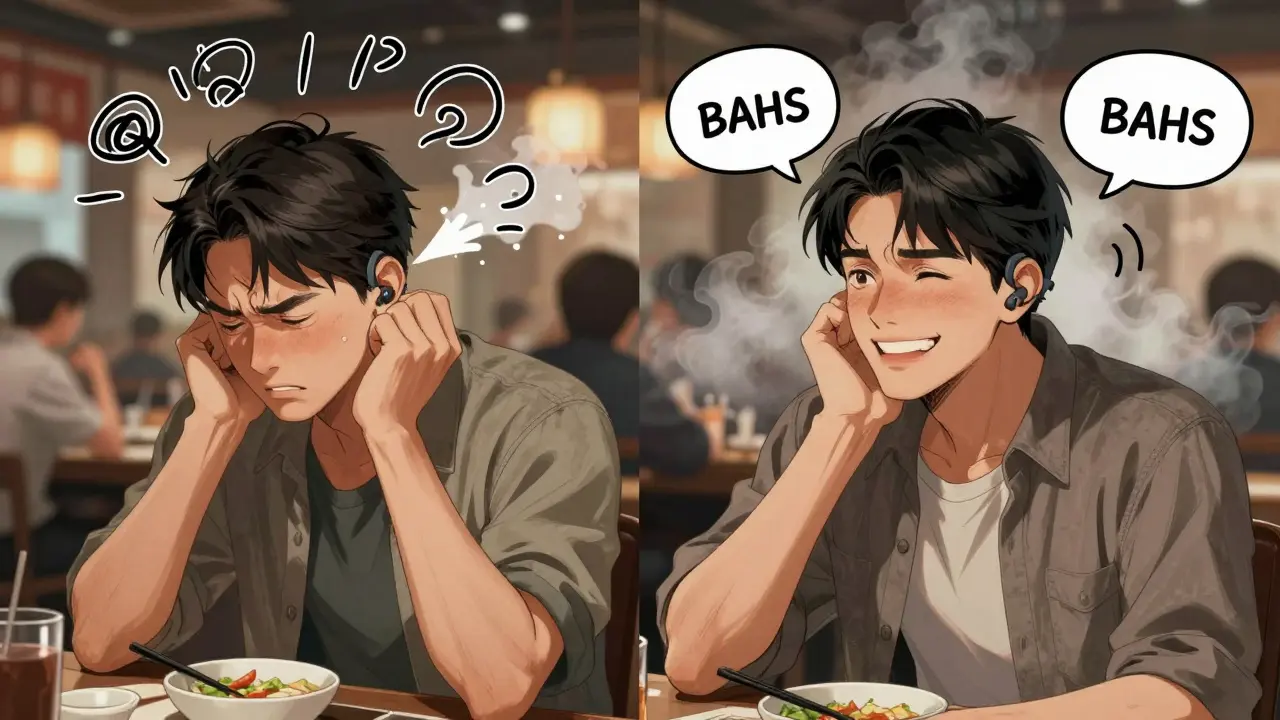
But there are downsides. Because the sound comes from your good ear, voices from your deaf side sound like they’re coming from inside your head. Some users say it feels unnatural. In noisy places - like restaurants or meetings - CROS can actually make things worse. If noise comes from your deaf side, the device picks it up and sends it straight to your good ear, drowning out speech. One study found users had 4.2 dB worse speech understanding in noise compared to not using any device at all. And 46% of people who tried CROS stopped using it within a year.
Bone-Anchored Hearing Devices: Sound Through Your Skull
Bone-anchored hearing systems (BAHS), like the Cochlear Baha 6 Max is a percutaneous bone conduction device with a titanium implant that osseointegrates with the skull, offering up to 45 dB of hearing compensation and a frequency range of 250-8,000 Hz, Oticon Medical Ponto 5 SuperPower is a transcutaneous bone conduction device using magnetic coupling through the skin, designed for users with mild to moderate hearing loss in the better ear, and MED-EL Bonebridge is an active transcutaneous implant with a subcutaneous transducer that directly vibrates the temporal bone, approved by the FDA in 2019 with a maximum output of 125 dB HL, work differently. Instead of sending sound through the air, they send vibrations directly through your skull bone to your inner ear.
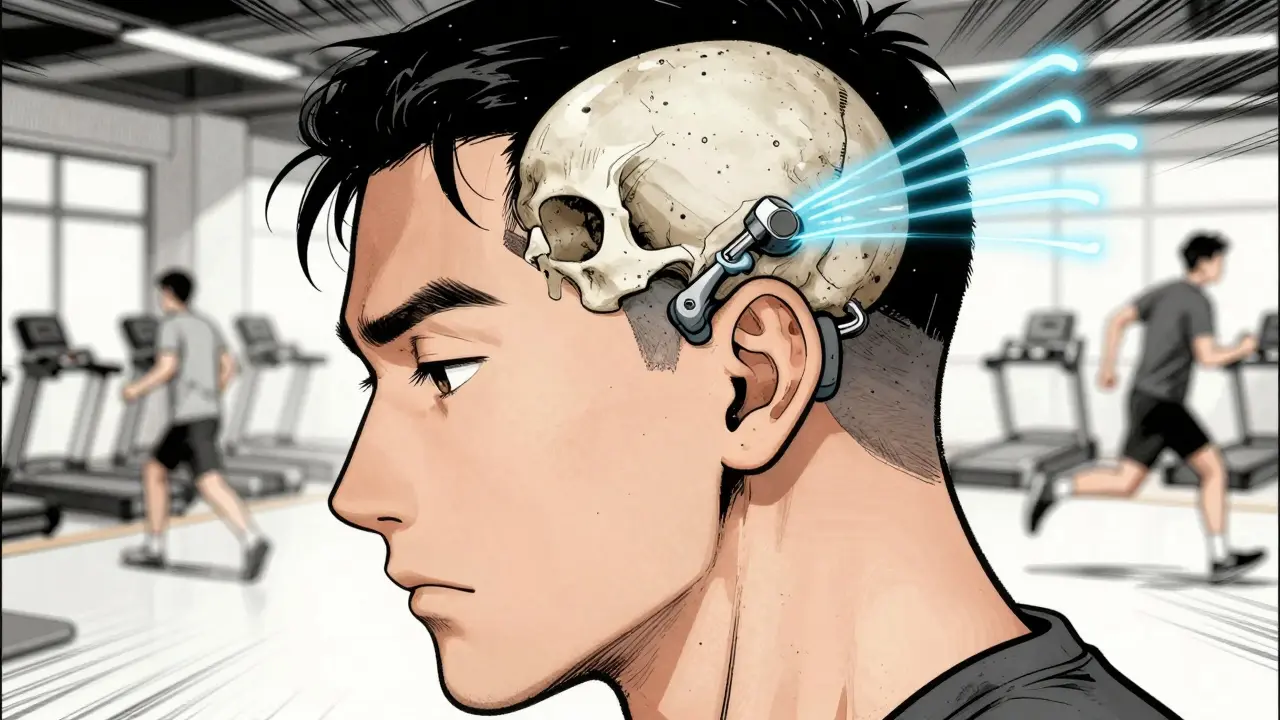
There are two types: percutaneous and transcutaneous. Percutaneous systems (like Cochlear Baha) have a small titanium screw implanted into your skull. After 3 to 6 months, the bone grows around it - a process called osseointegration. Then, a sound processor snaps onto the abutment sticking out of your skin. Transcutaneous systems (like Oticon Ponto) use magnets to hold the processor against your skin - no hole needed.
The big advantage? Sound quality. Because the vibrations travel directly through bone, there’s no acoustic distortion. Users report voices sound more natural. Wind noise is reduced. And since your ear canal stays open, you don’t get that plugged-up feeling common with regular hearing aids.
But it’s not simple. You need surgery. The procedure takes about 45 minutes and costs $3,000 to $7,000 out-of-pocket in the U.S. You’ll need a CT scan to check your bone thickness (must be at least 3.5 mm). Recovery takes weeks. And then you’ve got skin care. About 15% to 63% of percutaneous users get skin irritation, redness, or infection around the abutment. You need to clean it daily with special solutions. If you don’t, it can get worse.
Still, long-term users stick with it. In one study, 93% of BAHS users showed up for their 12-month check-up. Only 46% of CROS users did. People who work out, wear helmets, or sweat a lot prefer BAHS - it doesn’t slip or fall off. And in noisy environments, BAHS users understand speech better than CROS users - by about 3.5 dB in real-world conditions.
Which One Is Right for You?
There’s no one-size-fits-all answer. But here’s how to think about it:
- If your better ear has normal hearing (pure-tone average ≤ 25 dB HL) and you want to avoid surgery, start with CROS. Try it for two weeks. See how you feel in restaurants, meetings, and outdoors.
- If your better ear has mild hearing loss (up to 45-55 dB HL), CROS won’t work. You need BAHS.
- If you’re active - gym, running, cycling - BAHS is more stable. CROS can fall out during movement.
- If you hate the idea of surgery, skin care, or implants, CROS is safer. But be ready for battery changes and potential frustration in noise.
- If you’ve tried CROS and still feel like you’re missing half the conversation, BAHS is the next step. Many users say the improvement is worth the hassle.
One study found that 3 out of 8 people preferred CROS for sound quality, but 3 preferred BAHS for comfort. One user said: ‘CROS sounds more natural, but BAHS stays put during my morning run.’
What About Cochlear Implants?
There’s a third option: cochlear implants (CIs). They’re not for everyone. But if you’ve tried CROS and BAHS and still struggle with spatial hearing - knowing where voices come from - a CI might help. The CINGLE trial is a landmark 2015 randomized controlled study comparing CROS, bone conduction devices, and cochlear implants in 113 single-sided deafness patients, showing cochlear implants significantly outperformed other devices in sound localization accuracy showed CI users had far better sound localization than CROS or BAHS users. In 2024, the FDA expanded CI eligibility for SSD because of this.
But CIs are invasive, expensive ($30,000-$50,000), and require months of rehabilitation. Most doctors still recommend trying CROS or BAHS first. Only if those fail, and you’re still struggling with safety, job performance, or social isolation, should you consider a CI.
Real Users, Real Experiences
Reddit user ‘HearingHelp101’ wrote: ‘I love not having surgery with my Phonak CROS, but I have to change the battery every two days. And voices from my deaf side sound like they’re inside my head. I can’t use it in noisy places.’
Another user, ‘SkullVibrator,’ said: ‘My Cochlear Baha gives me skin irritation twice a month. I need antibiotic cream. But I can hear my kids calling from behind me now. I’d do it again.’
These aren’t isolated stories. A 2022 survey found 73% of CROS users complained about battery life. 58% of BAHS users had at least one skin reaction per year. But 92% of BAHS users said the device stayed in place during exercise. Only 68% of CROS users could say the same.
The Future of SSD Treatment
The market is shifting. In 2022, CROS held 42% of the SSD device market. BAHS had 39%. But BAHS is growing faster - at 8.7% per year. Why? New transcutaneous systems are reducing skin issues. AI-powered processors now filter noise smarter. And more people are realizing that CROS doesn’t fix everything.
Still, CROS isn’t going away. It’s the first step for most people. It’s affordable, non-invasive, and easy to try. Companies like Phonak and Signia are adding tinnitus therapy and better noise reduction. But experts warn: if you’re using CROS and still can’t follow conversations in group settings, you’re not alone - and you’re not failing. You just need a different solution.
One thing’s clear: the old idea that ‘CROS or BAHS’ is a simple choice is outdated. The new approach is stepped: try CROS first. If it doesn’t work after 4-6 weeks, move to BAHS. If BAHS still leaves you feeling isolated or unsafe, consider a CI. It’s not about picking the ‘best’ device. It’s about finding the one that fits your life.
What to Do Next
If you or someone you know has single-sided deafness:
- See an audiologist who specializes in SSD. Not all do. Ask if they’ve treated more than 10 SSD cases in the past year.
- Ask for a CROS trial. Most clinics offer a 2-week loaner. Test it in real situations - coffee shops, traffic, family dinners.
- If CROS doesn’t help, ask about BAHS. Get a CT scan. Talk to an ENT surgeon experienced in osseointegration.
- Don’t rush. This isn’t a decision you make in one visit. It’s a process.
- Join a support group. HearingLossHelp and Reddit’s r/Hearing have thousands of real users sharing what works - and what doesn’t.
Single-sided deafness isn’t just about hearing. It’s about connection. About feeling safe. About not missing your child’s voice from behind you. The right device won’t fix everything - but it can give you back the parts you lost.
Can CROS hearing aids restore normal hearing?
No. CROS hearing aids don’t restore hearing in the deaf ear. They only move sound from the deaf side to the good ear. You still hear with only one ear - just with better access to sounds that were previously blocked by your head. It reduces the head shadow effect but doesn’t create true binaural hearing.
Is bone-anchored hearing surgery risky?
The surgery itself is low-risk and takes less than an hour. But complications can happen. Skin reactions around the abutment occur in 15% to 63% of users, especially with percutaneous systems like Cochlear Baha. Infections, bone resorption, and implant failure are rare but possible. Transcutaneous systems like Oticon Ponto reduce skin issues but may have slightly lower sound quality. Good hygiene and follow-up care are essential.
Why do some people stop using CROS?
Many users report that CROS makes noise from the deaf side louder than speech, making conversations harder in restaurants or meetings. Others dislike the short battery life - needing changes every two days. Some say the sound feels unnatural, like voices are coming from inside their head. Studies show nearly half of CROS users stop using them within a year, often because the benefit doesn’t match their expectations.
Can I use CROS if my good ear has some hearing loss?
No. CROS systems are only designed for people with normal or near-normal hearing in their better ear (pure-tone average of 25 dB HL or better). If your good ear has mild to moderate hearing loss (above 25 dB HL), you’ll need a bone-anchored device like the Cochlear Baha or Oticon Ponto, which can handle hearing loss in both ears.
How long does it take to adapt to a bone-anchored device?
It takes longer than CROS. After surgery, you wait 3 to 6 months for the implant to fuse with your skull. Then, once the processor is activated, it takes 4 to 8 weeks for your brain to adjust to bone-conducted sound. Many users say the first few weeks feel strange - like hearing through a drum. But after adaptation, most report natural, clear sound quality.
Are there any alternatives to CROS and bone-anchored devices?
Yes - cochlear implants (CIs) are now approved for single-sided deafness in many countries, including the U.S. Since 2024, the FDA has expanded CI use for SSD patients who don’t benefit from CROS or BAHS. CIs stimulate the auditory nerve directly and offer the best sound localization. But they’re more invasive, expensive, and require long-term rehabilitation. Most doctors recommend trying CROS or BAHS first.
Does insurance cover CROS or bone-anchored hearing devices?
Coverage varies. Many private insurers cover CROS devices as hearing aids, but often with high copays. Bone-anchored systems are more likely to be covered if deemed medically necessary - especially if your better ear has hearing loss. Medicare typically doesn’t cover hearing aids, but some Medicaid plans and VA programs do. Always check with your provider before proceeding. Surgical costs for BAHS are often covered separately under medical insurance, not hearing aid benefits.
Can children use CROS or bone-anchored devices?
Yes. Children with SSD can benefit from both CROS and BAHS. CROS is often used first in younger kids because it’s non-invasive. For children under 5, soft-band BAHS (magnetic headbands) are available - no surgery needed. Once the skull is mature (around age 5-6), permanent implants can be considered. Early intervention is critical for speech and language development.
How do I know if I’m a good candidate for a cochlear implant for SSD?
You may be a candidate if you’ve tried CROS and BAHS for at least 6 months and still struggle with sound localization, safety (like not hearing cars from one side), or understanding speech in noise. Your good ear must still have functional hearing. A CI specialist will test your brain’s ability to process sound from both sides. If your auditory pathways haven’t fully reorganized, a CI can restore binaural hearing. Outcomes are best when implanted within 1-2 years of hearing loss.
Do CROS and bone-anchored devices work with phones and Bluetooth?
Yes. Modern CROS and BAHS devices all support Bluetooth. You can stream phone calls, music, and videos directly to your device. Phonak CROS Marvel, Oticon Ponto 5, and Cochlear Baha 6 Max all connect to smartphones via apps. Some even allow you to adjust volume or programs remotely. This is a major upgrade from older models and makes daily use much more convenient.


Deepika D
Okay so I’ve been living with SSD for 7 years now and let me tell you - CROS felt like a band-aid on a broken leg. I tried the Phonak CROS Marvel and yeah, it worked in quiet rooms, but in a grocery store? Absolute chaos. Every cart wheel, every beep from the self-checkout, every kid yelling ‘MOM!’ from my deaf side - it all blasted into my good ear like a firehose. I thought I was being dramatic until I saw the study about 4.2 dB worse speech understanding. I was like… wait, I paid $3,500 for this to make things worse? Then I got the Cochlear Baha 6 Max. Surgery? Yeah, scary. Skin irritation? Oh yeah, month one was hell. But now? I hear my daughter’s voice when she runs up behind me at the park. I don’t jump when someone taps my shoulder. I don’t feel like I’m always missing half the conversation. It’s not perfect, but it’s real. If you’re on the fence - try CROS, but don’t settle. Your brain deserves better.
Bennett Ryynanen
Bro CROS is a scam. I had the Oticon Free and I swear to god it made my tinnitus worse. Like, I could hear the damn battery dying before it even died. And the ‘natural sound’? Nah. It sounded like someone was whispering into my good ear from inside my skull. I spent 3 weeks trying to make it work. Then I got the Ponto 5 SuperPower. No wires. No batteries. No ‘sound from nowhere’ crap. Yeah, I got a little infection - big whoop. Clean it with saline, stop being a baby. Now I run marathons with it. I can hear my dog bark from behind me. You want to live or just be comfortable? Pick the thing that lets you hear the world, not just your own head.
Chandreson Chandreas
Life’s weird, man. One ear deaf, the other perfect - like the universe gave you a stereo system with one speaker broken. You spend years thinking you’re just ‘bad at listening’… until you find out it’s physics. Head shadow effect? Yeah, that’s real. I didn’t know that term till I read this post. But here’s the thing - CROS feels like cheating. You’re not hearing with two ears, you’re just borrowing your good one to listen to the bad side. It’s like using your left hand to hold your right hand up so you can shake someone’s hand. It works, but it’s not the same. BAHS? That’s like rewiring the whole system. It’s not magic, but it’s closer to real. And honestly? If you’re still struggling after a year, maybe it’s not the device. Maybe it’s your brain needing time to unlearn the silence. Patience, my friend. 🌱
Darren Pearson
The clinical data presented here is both compelling and methodologically sound, particularly the 2022 survey findings regarding device retention rates and the CINGLE trial’s statistically significant localization improvements. However, the casual tone and anecdotal emphasis in the original post undermine its scholarly credibility. One must not conflate user satisfaction with clinical efficacy. The 93% follow-up rate for BAHS users, while impressive, does not account for selection bias - those who abandon CROS are more likely to seek surgical intervention, skewing outcomes. Furthermore, the assertion that ‘CROS doesn’t fix everything’ is a tautology; no assistive device ‘fixes’ sensorineural hearing loss. The appropriate framing is not preference, but evidence-based triage: CROS as a diagnostic tool, BAHS as a therapeutic intervention, and CI as a last-resort neuroprosthetic. I urge clinicians to prioritize objective audiometric outcomes over subjective user testimonials.
Urvi Patel
CROS is for people who dont want to do the work. You want to hear? Then get the implant. No one cares about your battery life or your ‘unnatural sound’ - you have one ear that works and you’re whining about a $3000 device? Get over it. I work in construction. My CROS fell out during a windstorm. I had to call my boss to come get me because I couldn’t hear the crane signals. BAHS? I wear it in the rain, in the dust, I sweat under it and it doesn’t move. You think your tinnitus therapy matters? Your kids don’t care if your hearing aid has Bluetooth. They care if you hear them when they scream from behind you. Stop making excuses. Get the bone implant. End of story.
anggit marga
Why are all these devices made by American companies? In Nigeria we fix things with duct tape and prayer. My cousin had SSD and he just turned his good ear toward people and yelled louder. Works fine. Why spend $7000 on a screw in your skull when you can just sit on the right side of the table? And why are you all so obsessed with ‘sound quality’? You’re not in a concert hall. You’re trying to hear your wife say ‘dinner’s ready.’ Just turn your head. Problem solved. Also I heard a CROS device costs more than my phone. That’s insane. We need African-made hearing tech. Not this Silicon Valley nonsense.
Joy Nickles
ok so i tried the signia cros and i literally cried the first week because i thought i was going deaf in my good ear too?? like the noise from my deaf side was so LOUD and the battery died every 36 hours?? and i was like ‘is this what i paid $3800 for??’ and then i got the bonebridge and i had a skin infection that looked like a tiny volcano on my head?? but now?? i hear my cat purring from behind me and i can hear my neighbor’s dog barking from the left side and i just… i just feel whole?? like my brain finally stopped screaming ‘where is that sound??’ and i’m not even mad about the daily cleaning anymore?? it’s just… part of my life now?? like brushing my teeth??
Emma Hooper
Let’s be real - this isn’t about hearing aids. It’s about identity. CROS users are the ‘I just want it to work without surgery’ crowd. BAHS folks? They’re the ones who’ve stared into the void of isolation and said, ‘I’m not letting this win.’ And honestly? I respect the hell out of them. You’ve got a titanium screw in your skull. You clean it like it’s a sacred relic. You’ve got scars. You’ve got stories. You’ve got the quiet confidence of someone who chose pain over silence. CROS is a Band-Aid. BAHS is a badge. And if you’re still using CROS after six months? Honey, you’re not ‘trying.’ You’re just scared. And that’s okay. But don’t lie to yourself. The world is loud. And if you want to be part of it - you’ve gotta be willing to get a little bloody.