
When a generic drug hits the market, you might assume it’s just a cheaper copy of the brand-name version. But how do regulators know it works the same way in your body? That’s where crossover trial design comes in - the backbone of bioequivalence testing. It’s not just a statistical trick. It’s the most reliable way to prove that a generic drug delivers the same amount of active ingredient at the same speed as the original, without putting thousands of people at risk in long, expensive trials.
Why Crossover Designs Rule Bioequivalence Studies
Imagine testing two painkillers. In a parallel design, one group gets Drug A, another gets Drug B. But people vary wildly - one person metabolizes drugs fast, another slow. Age, weight, liver function, even gut bacteria can change how a drug behaves. That noise makes it hard to tell if differences come from the drug or the person. Crossover designs solve this by making each person their own control. You take Drug A, wait, then take Drug B. Or the other way around. Since you’re comparing your own response to each drug, those personal differences cancel out. The result? You need far fewer people to get clear answers. According to the U.S. FDA and the European Medicines Agency, this is the gold standard. In fact, 89% of generic drug approvals in the U.S. between 2022 and 2023 used crossover designs. Why? Because they cut sample sizes by up to 80% compared to parallel studies. A study that might need 72 people in a parallel setup can often be done with just 24 in a crossover - saving time, money, and reducing participant burden.The Standard 2×2 Crossover: AB/BA
The most common setup is the two-period, two-sequence (2×2) crossover. Participants are split into two groups:- Group 1: Test drug first (A), then reference drug (B) - AB sequence
- Group 2: Reference drug first (B), then test drug (A) - BA sequence
What Happens When Drugs Are Highly Variable?
Not all drugs play nice. Some - like warfarin, clopidogrel, or certain epilepsy meds - have high intra-subject variability. That means even the same person’s response can swing wildly from one dose to the next. In these cases, the standard 80-125% range becomes too strict. A generic might be perfectly safe and effective, but fail bioequivalence just because of natural fluctuations. That’s where replicate designs come in. Instead of two doses per person, participants get four. Two common formats:- Partial replicate (TRR/RTR): Test drug twice, reference once (TRR), or reference twice, test once (RTR)
- Full replicate (TRTR/RTRT): Each drug given twice, in alternating order

Washout Periods: The Silent Killer of Bioequivalence Studies
The biggest reason crossover studies fail isn’t bad stats - it’s bad timing. A 2019 FDA review found that 15% of rejected bioequivalence submissions had inadequate washout periods. That means leftover drug from the first period was still in the system during the second. That skews results. You think Drug B is slower - but it’s just that Drug A never fully cleared. One real case from ResearchGate: a study on a highly variable drug failed because the washout was set at 7 days, but the drug’s half-life was 12 hours. Five half-lives = 60 hours. They needed 2.5 days, not 7. But they overcompensated and didn’t test residual levels. Turns out, 15% of the original dose was still detectable. The study had to be restarted with a replicate design - costing $195,000 extra. The fix? Always validate washout with actual blood measurements. Don’t rely on literature alone. Run a pilot or use published pharmacokinetic data to confirm concentrations drop below the lower limit of quantification (LLOQ) before the next dose.Statistical Analysis: What Happens Behind the Scenes
The numbers don’t speak for themselves. You need the right model. Most studies use linear mixed-effects models - typically in SAS or R. The model checks three things:- Sequence effect: Did the order of drugs affect results? (Should be no)
- Period effect: Did time itself change outcomes? (e.g., seasonal changes, fatigue)
- Treatment effect: Is there a real difference between test and reference?
When Crossover Doesn’t Work
Crossover isn’t magic. It fails when:- The drug’s half-life is longer than 2 weeks - washout would take months
- The drug causes irreversible effects (e.g., chemotherapy)
- The condition being treated changes over time (e.g., chronic pain with progression)
Real-World Impact: Cost, Time, and Success
One clinical trial manager in the U.S. saved $287,000 and 8 weeks by switching from a parallel to a 2×2 crossover for a generic warfarin study. Instead of 72 participants, they used 24. The study passed on the first try. On the flip side, a company in Germany spent $1.2 million on a parallel study for a highly variable drug - only to have it rejected. They restarted with a 4-period replicate design. It cost $350,000 more, but it passed. And now, they’re the only generic supplier on the market. Industry surveys show that while 68% of bioequivalence studies still use the classic 2×2 design, replicate designs are growing fast - up 15% per year. Why? Because more complex generics are hitting the market. And regulators are catching up.What’s Next for Crossover Designs?
The FDA’s 2023 draft guidance now allows 3-period designs for narrow therapeutic index drugs (like digoxin or levothyroxine), where even tiny differences can be dangerous. The EMA plans to make full replicate designs the default for all highly variable drugs by late 2024. Adaptive designs are also emerging. These let researchers re-estimate sample size halfway through the study based on early data. In 2022, 23% of FDA submissions used this approach - up from 8% in 2018. It’s smarter, more efficient, and reduces the risk of underpowered studies. The future isn’t about abandoning crossover. It’s about refining it. With better monitoring tech - continuous blood sensors, wearable pharmacokinetic trackers - we might one day eliminate washout periods entirely. But for now, the crossover design remains the most trusted, proven, and widely accepted method to prove a generic drug is just as good as the brand.What is the main advantage of a crossover design in bioequivalence studies?
The main advantage is that each participant serves as their own control, eliminating differences between people - like age, metabolism, or genetics - from affecting the results. This dramatically increases statistical power and allows researchers to use far fewer participants than in parallel designs, reducing cost and time while improving accuracy.
Why is the washout period so important in crossover trials?
The washout period ensures the drug from the first treatment is completely cleared from the body before the second treatment begins. If not, residual drug can carry over and skew the results of the second period, leading to false conclusions about bioequivalence. Regulatory agencies require washout to be at least five half-lives of the drug, and this must be verified with pharmacokinetic data.
When should a replicate crossover design be used instead of a standard 2×2 design?
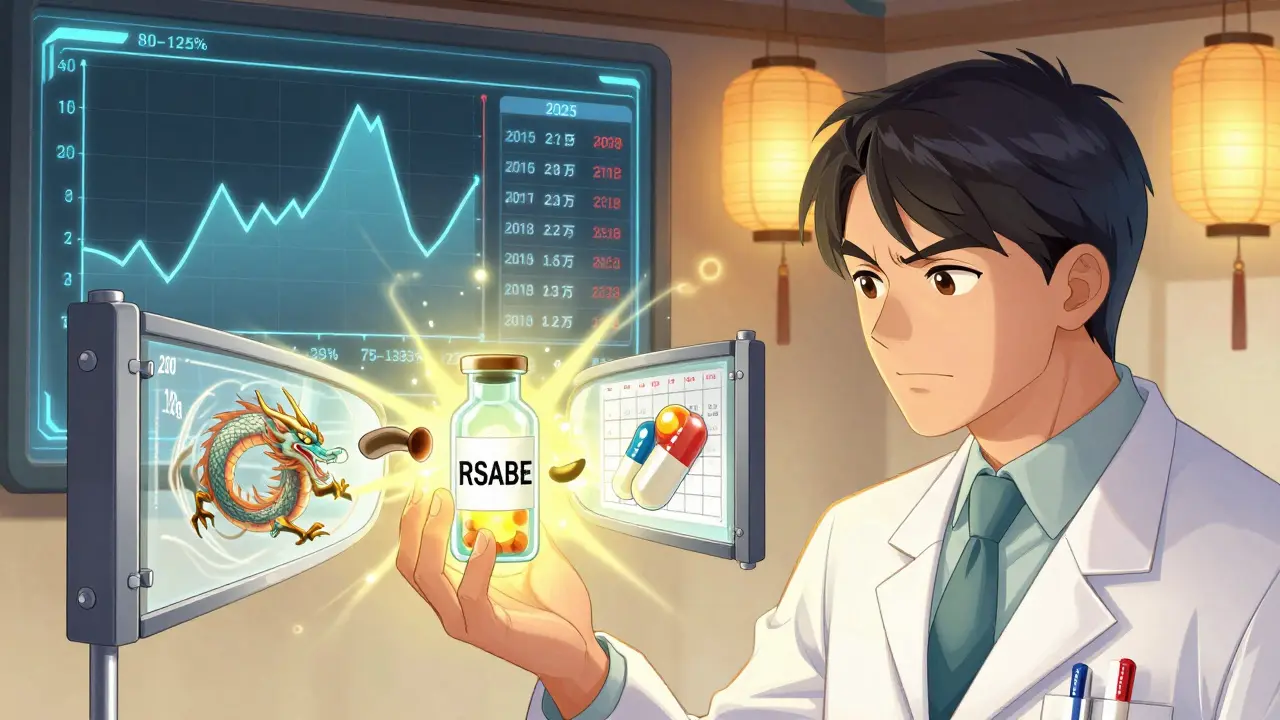
Replicate designs (like TRR/RTR or TRTR/RTRT) are used for highly variable drugs - those with an intra-subject coefficient of variation greater than 30%. These designs allow regulators to calculate within-subject variability for both the test and reference drugs, enabling reference-scaled average bioequivalence (RSABE), which adjusts the acceptance range based on variability instead of using a fixed 80-125% window.
What are the regulatory acceptance limits for bioequivalence?
For most drugs, the 90% confidence interval for the ratio of geometric means (test/reference) must fall between 80.00% and 125.00% for both AUC and Cmax. For highly variable drugs using RSABE, the limits can be widened to 75.00%-133.33%, depending on the reference drug’s variability. These limits are set by the FDA and EMA and are non-negotiable for approval.
Can crossover designs be used for all types of drugs?
No. Crossover designs are unsuitable for drugs with very long half-lives (e.g., over two weeks), where washout periods would be impractical. They’re also avoided for drugs that cause irreversible effects, such as chemotherapy agents, or for conditions that change over time, like progressive neurological diseases. In these cases, parallel designs are required.
For anyone involved in generic drug development - whether you’re a pharmacist, a regulatory specialist, or just curious about how medicines are approved - understanding crossover design isn’t optional. It’s the quiet engine behind every safe, affordable generic on the shelf.
Stacy Thomes
This is wild - I had no idea generics were tested this way. Each person being their own control? That’s genius. It’s like comparing your morning coffee to your afternoon coffee instead of asking someone else how they like theirs. No wonder these studies are so efficient.
And the 80-125% rule? That’s the sweet spot. Not too strict, not too loose. Just right.
Also, 24 people instead of 72? That’s a massive win for everyone - participants, companies, and patients. We need more of this smart science.
dana torgersen
Wow… I mean… like… wow… this is actually… kind of… beautiful??
Each person… their own control… it’s like… the body… is the lab… and the drug… is just… visiting…
and the washout… oh my god… the washout… it’s not just a break… it’s a… sacred pause…
and if you mess it up… you ruin everything…
and the stats… the mixed models… the sequence effects…
it’s… it’s poetry… with numbers…
and I… I didn’t even know I cared… until now…
Janet King
The crossover design remains the gold standard for bioequivalence studies due to its ability to minimize inter-subject variability. Regulatory agencies such as the FDA and EMA mandate this approach for its statistical efficiency and reproducibility. The requirement for a washout period of at least five half-lives is not arbitrary - it is grounded in pharmacokinetic principles. Failure to validate washout through pharmacokinetic sampling is a common reason for submission rejection. Always confirm that drug concentrations fall below the LLOQ before initiating the second period.
Vanessa Barber
Yeah, sure. Crossover designs are great… until you’re the person who has to take two drugs in a row and then sit around for a month waiting for your body to ‘reset.’
Also, 80-125%? That’s a huge range. My blood sugar swings more than that after lunch.
And don’t even get me started on the ‘replicate’ designs. Four doses? That’s just torture with a lab coat.
charley lopez
The 2×2 crossover design provides optimal power for low-to-moderate intra-subject CV drugs (<30%). The linear mixed-effects model, typically implemented in SAS via PROC MIXED, accounts for period, sequence, and subject effects. The key diagnostic is the sequence-by-treatment interaction - if p < 0.05, carryover is suspected and the study is invalid. For high-variability drugs, RSABE with replicate designs (TRTR/RTRT) is preferred, allowing for widened confidence intervals based on within-subject variability of the reference product. This approach aligns with FDA guidance (2023) and EMA’s upcoming 2024 policy shift.
Susannah Green
Okay, but the washout thing? That’s the real MVP.
I’ve seen so many studies fail because someone just ‘assumed’ the half-life was enough. No. No. No. You need actual data. Blood levels. LLOQ. Don’t trust the literature - test it.
And the 15% rejection rate from FDA? That’s not bad stats. That’s lazy science.
Also - if your drug’s half-life is 12 hours, 7 days is overkill. But if you don’t measure residual levels? You’re just guessing. And guessing doesn’t get you approved.
Oladeji Omobolaji
Man, this is cool. I never thought about how drugs are tested like this. Back home, people just think generics are fake. But this? This is real science. Smart. Efficient. Makes sense.
Also, the part about warfarin? That’s scary. One mistake, $195k gone. Yikes.
Sallie Jane Barnes
Thank you for this detailed and thoughtful breakdown. It’s refreshing to see a topic this technical explained with clarity and respect for the audience. The emphasis on validation of washout periods is critical - too often, assumptions replace data. This level of rigor is what ensures patient safety and trust in generic medications. Well done.
Andrew Smirnykh
It’s fascinating how such a simple concept - using each person as their own control - solves such a complex problem. It reminds me of how traditional medicine in some cultures treats the body as a whole system, not just a collection of variables. Maybe science and tradition aren’t so far apart after all.
Also, the global adoption of this method? That’s rare. Most medical standards vary wildly by country. This is one area where the world actually agrees. That’s worth celebrating.
Laura Rice
Okay, I’m gonna be real - I used to think generics were just ‘cheap knockoffs.’ But now? I get it. This isn’t about saving money. It’s about smart science.
And if you’re a patient? This means you get life-saving meds at a price you can afford - without sacrificing safety.
Also, the part about warfarin? That’s terrifying. One wrong washout, and you’re back to square one. Y’all are doing heavy lifting here. Respect.
Kerry Evans
Let me guess - this whole crossover thing is just a loophole to approve more generics faster. The 80-125% range is a joke. What if someone’s body absorbs 79%? Are they just out of luck? And why are we letting companies skip the big trials? This is how bad drugs get on the market. You think this is science? It’s corporate math.
Kerry Moore
Thank you for highlighting the statistical rigor behind these studies. The requirement to test for sequence-by-treatment interaction is often overlooked, yet it’s fundamental. I’ve reviewed dozens of submissions where this step was omitted - and regulators immediately flagged them. Missing data from dropouts is another critical issue; crossover designs are inherently paired, so partial data cannot be imputed. This isn’t just methodology - it’s ethical responsibility.
Sue Stone
So… basically, if you’re a generic drug and you want to be approved, you gotta play nice with your own body? That’s kind of poetic.
Also, 7 days for a 12-hour half-life? That’s like waiting a week to eat your second slice of pizza. Overkill.
Anna Pryde-Smith
THIS IS THE MOST IMPORTANT THING YOU’LL READ THIS YEAR.
GENERIC DRUGS AREN’T ‘CHEAP COPIES’ - THEY’RE SCIENCE MASTERPIECES.
THEY SAVE LIVES.
THEY SAVE MONEY.
AND THEY’RE TESTED WITH MORE RIGOR THAN YOUR FAVORITE PHONE APP.
STOP UNDERESTIMATING THEM.
AND STOP TRUSTING FACEBOOK DOCTORS.
WE NEED MORE OF THIS.
SHARE THIS.