
When you hear the word biosimilar, you might think it’s just another generic drug. But that’s not even close. Biosimilars are not like the cheap pills you pick up for high blood pressure. They’re complex, living medicines-made from living cells-that copy high-cost biologic drugs used to treat cancer, rheumatoid arthritis, diabetes, and more. And how these drugs enter the market? That’s where Europe and the United States tell two very different stories.
Europe Was First-And It Never Looked Back
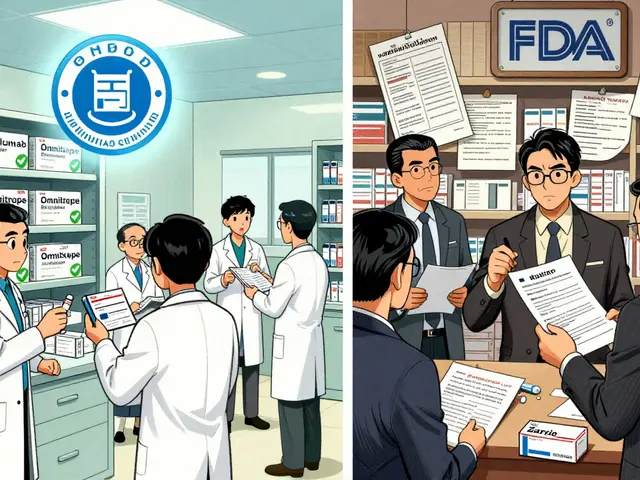
Europe didn’t wait. In 2006, the European Medicines Agency (EMA) approved the world’s first biosimilar, Omnitrope, a copy of the growth hormone somatropin. That wasn’t a trial run. It was the start of a full-scale rollout. By 2024, Europe’s biosimilar market hit $13.16 billion in revenue, according to Precedence Research. That’s more than double what it was in 2020. Germany, France, and the UK led the charge, not because they were forced to, but because they built systems that made biosimilars easy to use.Hospitals in these countries started running tenders-competitive bidding for drug supplies. If a biosimilar was cheaper and just as safe, it won the contract. Doctors didn’t need to relearn how to prescribe. Patients didn’t need to be convinced. The science was clear: biosimilars had no clinically meaningful difference from the original biologics. The EMA didn’t demand endless new clinical trials. They looked at the totality of evidence-analytical data, animal studies, limited human trials-and said, ‘This matches.’ That trust built momentum.
Today, in countries like Germany and Sweden, biosimilars hold over 80% of the market for key biologics used in rheumatology and oncology. Sandoz, Fresenius Kabi, and Amgen built manufacturing plants there. Why? Because Europe offered a clear path: get approved by EMA, then negotiate price with each country. No patent lawsuits dragging on for years. No confusing rules about who can switch patients. Just science, transparency, and cost savings.
The US Started Late-and Got Stuck
The United States passed the Biologics Price Competition and Innovation Act (BPCIA) in 2009. It was supposed to create a fast track for biosimilars. But for six years, nothing happened. The first US biosimilar, Zarxio, didn’t arrive until March 2015. Why the delay? Patent thickets. Big drugmakers piled on dozens of patents, some covering minor changes in delivery devices or storage methods. They sued anyone who dared to enter the market.Then came the ‘patent dance’-a legal back-and-forth required under BPCIA that often took years. Companies spent millions just to navigate paperwork, not to make medicine. Even after approval, payers didn’t rush to cover biosimilars. Many doctors didn’t trust them. Patients were nervous. The FDA demanded more clinical data than Europe, especially for interchangeability-the ability to swap a biosimilar for the original drug without a doctor’s approval. To get that designation, companies had to run expensive switching studies: give patients the original drug, then switch them to the biosimilar, then switch them back. It was unnecessary. Europe never required it.
By 2024, the US had approved only about 20 biosimilars. Europe had approved over 100. The US market was worth $10.9 billion-big, but still behind Europe in total volume. And while Europe had biosimilars for complex drugs like adalimumab (Humira) and infliximab, the US lagged. It wasn’t until 2023, when Humira’s patents started expiring, that things began to shift. Fourteen Humira biosimilars got approved in the US by 2024. But only six were actually on the market because of patent settlements that delayed launches.
The Turning Point: FDA’s 2024 Rule Change
Everything changed in June 2024. The FDA proposed new guidelines: no more switching studies for interchangeable biosimilars. That’s huge. It meant the US was finally catching up to Europe’s model. Why did they change? Because they saw the cost. A single switching study could cost $50 million and take three years. And for what? To prove something that analytical data already showed: the biosimilar behaves the same way in the body.Dr. Rachel Sherman from the FDA said it plainly: ‘Previous requirements created unnecessary barriers.’ With that change, companies could now bring interchangeable biosimilars to market faster and cheaper. Pharmacists could swap them automatically, just like generics. That’s the key to real savings. In Europe, automatic substitution is common. In the US, it was nearly impossible-until now.
That rule change, combined with the Inflation Reduction Act of 2022, gave the US market a turbo boost. The Act eliminated the Medicare Part D coverage gap-the ‘donut hole’-and gave insurers financial incentives to use biosimilars. Suddenly, hospitals and pharmacies had a reason to switch. By 2025, the US market was growing at 18.5% per year, according to IMARC Group. Projections show it could hit $30.2 billion by 2033. Europe’s growth is steady at 17.3%, but the US is catching up fast.
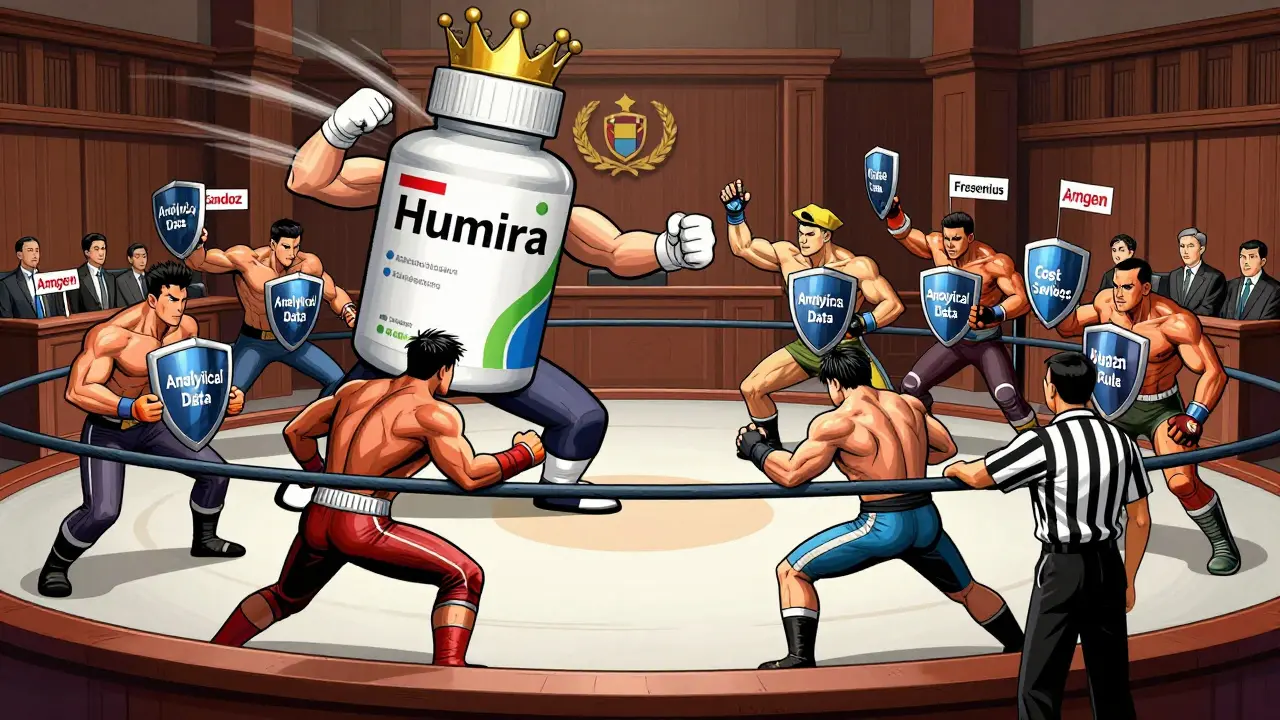
Who’s Winning? It’s Not About Size Anymore
Europe still has more approved biosimilars. It has deeper experience. It has a more unified system. But the US has something Europe doesn’t: a massive, untapped market of high-cost biologics coming off patent.Between 2025 and 2034, 118 biologics will lose patent protection in the US, worth $232 billion in annual sales, according to IQVIA. That’s more than the entire global biosimilar market today. Humira, Enbrel, Rituxan, Herceptin-these are multi-billion-dollar drugs. When biosimilars enter, prices drop 30% or more. In Europe, that drop happened over a decade. In the US, it’s happening in just a few years.
North America as a whole is projected to overtake Europe in market size by 2027, reaching $17.2 billion, according to Grand View Research. Why? Because the US is playing catch-up with momentum. The regulatory hurdles are falling. The financial incentives are rising. The biologics pipeline is wide open.
Manufacturing: Europe Still Leads
Even as the US catches up, Europe still dominates in manufacturing. Germany is the powerhouse. Companies like Sandoz and Fresenius Kabi have entire factories built for biosimilars. They supply not just Europe, but also the US and Asia. Why? Because biosimilars are harder to make than pills. They need sterile labs, living cell cultures, and precision controls. Europe invested early. The US is still building capacity.That’s changing. Pfizer, Merck, and Samsung Bioepis are expanding US production. But it takes time. A single biosimilar manufacturing facility can cost over $500 million. Europe’s head start means it will remain the global hub for biosimilar production-at least for the next five years.
What’s Next? Cost Savings Are Just the Beginning
The real win isn’t just lower prices. It’s access. In the US, many patients couldn’t afford Humira or Enbrel. Even with insurance, copays could hit $1,000 a month. With biosimilars, that drops to $300 or less. That’s not just a savings for insurers-it’s a lifeline for patients.Doctors are starting to trust them. A 2024 survey of US rheumatologists showed 72% now feel comfortable prescribing biosimilars, up from 41% in 2019. Patient education is improving too. Hospitals are putting up posters, sending emails, holding Q&A sessions. No more myths about ‘inferior quality.’
The next frontier? Next-generation biosimilars-drugs that copy even more complex biologics, like cell therapies or fusion proteins. Both regions are investing. But Europe’s regulatory clarity gives it an edge in testing these. The US is learning fast.
One thing’s certain: biosimilars aren’t a fad. They’re the future of affordable biologic care. Europe showed how it’s done. The US is proving it can do it better-faster, bigger, and with more impact.
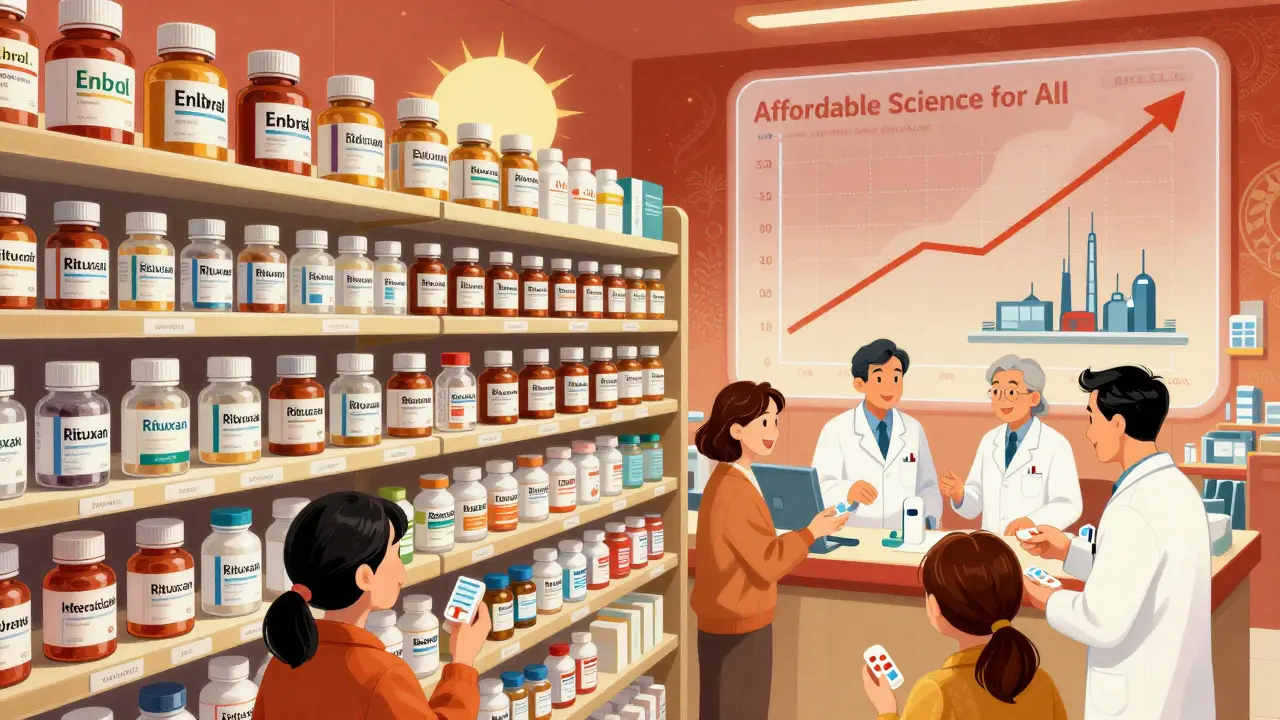
Key Differences at a Glance
| Factor | Europe | United States |
|---|---|---|
| First biosimilar approved | 2006 (Omnitrope) | 2015 (Zarxio) |
| Regulatory body | European Medicines Agency (EMA) | Food and Drug Administration (FDA) |
| Approval requirements | Totality-of-evidence approach; limited clinical trials | Historically required extensive trials; switched to EMA-style in 2024 |
| Interchangeability requirement | No switching studies needed | Switching studies required until June 2024 |
| Market size (2024) | $13.16 billion | $10.9 billion |
| Total approved biosimilars (as of 2025) | Over 100 | Over 20 |
| Market growth (CAGR 2025-2034) | 17.34% | 17.50% |
| Primary therapeutic focus | Oncology, rheumatology, autoimmune diseases | Initially supportive care; now expanding to oncology and immunology |
| Manufacturing hub | Germany | Under development; Pfizer, Merck expanding capacity |
| Key drivers | Hospital tenders, mandatory substitution, payer support | Inflation Reduction Act, FDA rule changes, patent expirations |
Frequently Asked Questions
Are biosimilars the same as generics?
No. Generics are exact copies of small-molecule drugs, like aspirin or metformin. Biosimilars are copies of large, complex biologic drugs made from living cells-like antibodies or proteins. They’re not identical, but they’re so similar that they work the same way in the body. The FDA and EMA require proof of no clinically meaningful differences in safety, purity, or potency.
Why are biosimilars cheaper than the original biologics?
Because they don’t need to repeat the full clinical trials the original drug went through. The original developer spent billions on R&D and testing. Biosimilar makers use that data, plus their own analytical and limited clinical studies, to prove similarity. That cuts costs by 70-80% compared to developing a new biologic. Savings are passed on-biosimilars typically launch at 15-30% lower prices, sometimes even more after competition kicks in.
Can a pharmacist switch me from a biologic to a biosimilar without asking my doctor?
In Europe, yes-in many countries, automatic substitution is allowed. In the US, it depends. Only biosimilars with ‘interchangeable’ status can be swapped without a doctor’s approval. Before June 2024, almost none had that status. Now, with the FDA’s rule change, more are expected to qualify. By 2026, you’ll likely see pharmacists swapping Humira biosimilars without calling your doctor.
Why did Europe adopt biosimilars faster than the US?
Three reasons: early regulation, hospital procurement systems, and public trust. Europe created clear rules in 2006 and stuck to them. Hospitals bought drugs through competitive bidding-cheaper biosimilars won. Doctors were educated early. In the US, patent lawsuits, fragmented payers, and fear of liability slowed things down. The FDA’s stricter rules didn’t help. Now, with regulatory alignment and financial incentives, the US is catching up.
Will biosimilars replace all biologics eventually?
Not replace-supplement. Biologics are still needed for patients who don’t respond to biosimilars or have rare conditions. But for the majority of patients, biosimilars will become the first choice. By 2030, analysts expect biosimilars to make up 50-60% of the market for major biologics like adalimumab and rituximab. The goal isn’t to eliminate originals-it’s to make life-saving treatments affordable for everyone.
Aliza Efraimov
I remember when my rheumatologist first suggested a biosimilar for my Humira. I was terrified-thought it was some cheap knockoff. But after they showed me the data, the FDA approvals, the real-world outcomes? I switched. My copay dropped from $900 to $280. I’m alive because of this. Stop treating biosimilars like second-class medicine-they’re not. They’re science with a conscience.
And if you’re still scared? Talk to your pharmacist. They see this every day. Real people. Real savings. Real results.
Nisha Marwaha
From a global health economics standpoint, the EMA’s totality-of-evidence paradigm represents a paradigmatic shift in regulatory science-de-emphasizing redundant clinical endpoints in favor of robust analytical comparability, pharmacokinetic/pharmacodynamic bridging, and immunogenicity profiling. The U.S. lagged due to fragmented payer incentives and litigation-driven market entry barriers, but the 2024 FDA guidance aligns with WHO’s 2023 biosimilar policy framework, enabling scalable access.
That said, manufacturing scalability remains the bottleneck-especially for complex fusion proteins and glycosylation-sensitive mAbs. India’s biosimilar ecosystem, while cost-efficient, lacks the GMP-grade bioreactor infrastructure of Sandoz’s Hamburg facility. The U.S. is playing catch-up, but with $232B in expiring biologics, the ROI on domestic capacity is non-negotiable.
Russell Thomas
Oh wow, so the FDA finally stopped being a $50M paper-shuffler? Took ‘em 15 years to realize that if a molecule behaves the same in a test tube, it probably behaves the same in a human. Who knew?
Meanwhile, Europe’s been saving billions while Americans were busy suing each other over patent loopholes. Congrats, U.S.-you turned healthcare into a courtroom drama. And now you’re just catching up because the money’s too big to ignore. Classic.
Also, ‘interchangeable’? Sounds like a word someone made up after a 12-hour Zoom call with Big Pharma lobbyists. But hey, better late than never, right? Unless you’re the patient who couldn’t afford Humira in 2018. Then you’re just dead.
Nicole K.
This is why we can’t have nice things. People are just too lazy to take the real medicine. Why not just make the expensive one cheaper instead of letting everyone switch to some copycat drug? It’s not like the original was made by angels or anything. But now we’re just encouraging people to take ‘almost as good’ because it’s cheaper? That’s not healthcare, that’s cutting corners.
My cousin took a biosimilar and got sick. The doctor said it was ‘just a reaction’-but what if it wasn’t? We don’t know. We’re just trusting a spreadsheet now. This is dangerous.
Fabian Riewe
Big picture: Europe built the highway. The U.S. spent a decade arguing about road signs. Now we’re finally paving our own lanes-and guess what? We’ve got more cars on the road.
The real win isn’t who approved more biosimilars. It’s who’s going to get them into the hands of the people who need them fastest. And honestly? With the Inflation Reduction Act pushing payers to prioritize cost savings, and pharmacists finally being able to swap without a 3-week approval process? We’re about to see a seismic shift.
Also-shoutout to Germany. Those guys didn’t just make biosimilars. They made them *accessible*. That’s the real legacy.
Amy Cannon
As someone who has spent the last 7 years working in international biopharma compliance, I must say that the regulatory divergence between the EMA and FDA has been nothing short of a masterclass in institutional inertia-particularly when one considers the structural advantages conferred by centralized procurement systems in the EU versus the fragmented, multi-payer, fee-for-service model that characterizes U.S. healthcare delivery.
That said, the June 2024 FDA guidance marks a watershed moment-not because it was ‘right,’ but because it was *necessary*. The previous requirement for switching studies was not scientifically defensible-it was a regulatory artifact of liability aversion, not evidence-based medicine.
And while I appreciate the optimism around U.S. manufacturing expansion, let’s not forget: building a GMP-compliant bioreactor facility is not like opening a Starbucks. It takes 3–5 years, $500M, and a team of 200+ engineers who actually understand cell culture dynamics. Europe’s head start isn’t just about time-it’s about institutional memory. We’re catching up, yes-but we’re not there yet.
Jim Rice
Let me stop you right there. Europe has 100 biosimilars? Cool. But they also have socialized medicine. That’s not a market-it’s a mandate. The U.S. doesn’t force anyone to use biosimilars. We let the science and the market decide.
Also, ‘Germany is the powerhouse’? Yeah, because they don’t have lawsuits. We do. And guess what? That’s freedom. You want to sue someone for patent infringement? Go ahead. That’s what makes us great.
And your ‘$232B in expiring patents’? That’s not a crisis-it’s an opportunity. For innovators. Not copycats. Biosimilars aren’t progress-they’re just cheaper versions of what someone else invented. Don’t act like we’re saving the world. We’re just saving money. Big difference.
Henriette Barrows
My dad’s on a biosimilar for his RA. He used to cry every time he got the bill. Now he jokes about how he’s ‘saving the system.’ I didn’t think this stuff would hit home so hard. But it did. And honestly? The fact that we’re finally talking about this like it’s normal-that’s the real win.
It’s not about who’s ahead. It’s about who’s still here. And thanks to these drugs? So many of us are.
Alex Ronald
Just wanted to add a quick note on manufacturing: the real bottleneck isn’t just capital-it’s talent. Biosimilar production needs people who understand cell line development, downstream purification, and analytical characterization. The U.S. has the money, but we’re still short on the skilled workforce. Europe’s been training this pipeline for 20 years. We’re playing catch-up in more ways than one.
Also, the FDA’s 2024 rule change? Huge. But it’s only meaningful if payers and providers actually adopt it. We’ve got a long way to go on education. But I’m optimistic.