
7 in 10 parents and caregivers accidentally measure children's medication doses incorrectly at home. This isn't just a minor mistake-it can lead to dangerous under-dosing or life-threatening overdoses. The good news? With the right tools and simple steps, you can prevent these errors every time.
Why Accurate Dosing Matters for Children
Children's bodies are smaller and more sensitive to medication than adults. A small error in measurement can cause serious harm. According to the American Academy of Pediatrics (AAP) is a professional organization that provides guidelines on pediatric healthcare, medication errors occur in 1.5-10% of pediatric hospital admissions, with liquid medications being a major cause. The CDC PROTECT initiative launched in 2010 to standardize pediatric dosing to milliliters only specifically targets this issue. Research shows that 7 in 10 people measure liquid medicine incorrectly, often using household spoons or dosing cups instead of proper tools.
The Right Tools for Accurate Dosing
Not all measuring tools are created equal. The CDC and AAP recommend using only tools marked in milliliters (mL), not teaspoons or tablespoons. Here's what you need:
| Tool | Accuracy Rate | Best For | Common Errors |
|---|---|---|---|
| Oral syringe a precise syringe for liquid medication | 94% | Doses under 5 mL | Improper handling |
| Dosing cup a cup with mL markings for larger doses | 76% | Doses over 5 mL | Spillage, inaccurate reading |
| Household spoon kitchen utensils like teaspoons | Variable (20-200% error) | Avoid entirely | Significant volume variation |
Oral syringes are the most accurate for small doses. For example, a 2.5 mL dose is much easier to measure precisely with a syringe than a cup. Dosing cups work better for larger volumes but can spill easily. Household spoons vary widely-what you think is a teaspoon might measure between 3.9 and 7.3 mL, leading to dangerous errors. Specialized tools like the NurtureShot color-coded syringe system that reduces errors by 61% are excellent options for parents.

Step-by-Step Guide to Measuring Medication
Follow these steps every time you give medication to your child:
- Check the prescription label for the dose in milliliters (mL). Never use teaspoon (tsp) or tablespoon (tbsp) measurements.
- Use the tool provided with the medication. Most pharmacies now include an oral syringe for liquid medicines.
- Hold the syringe vertically and look at the measurement at eye level. Read the meniscus (the curved surface of the liquid) at the correct line.
- For doses under 5 mL, always use a 1-5 mL oral syringe for precision.
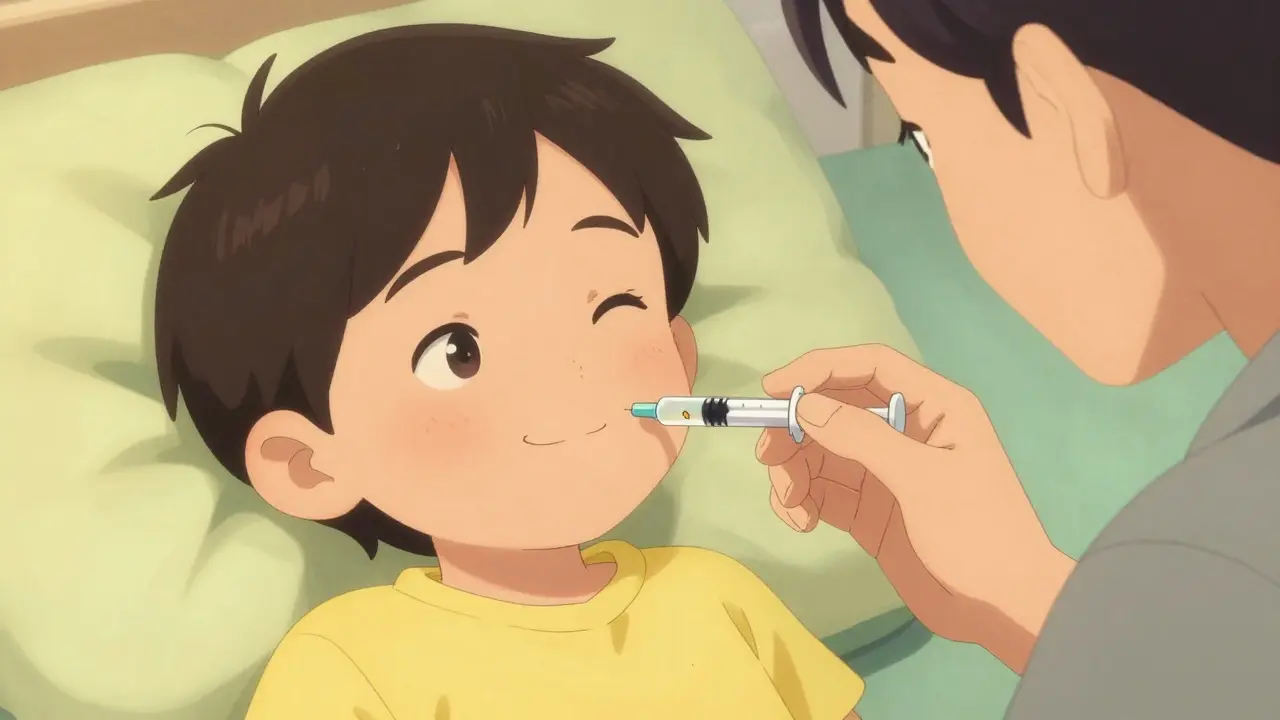
- Administer the dose gently into the side of the child's mouth (cheek pouch), not the front, to reduce spitting.
For example, if the dose is 2.5 mL, fill the syringe exactly to that mark. If the syringe has 0.1 mL increments, line up the top of the plunger with 2.5 mL. Never estimate or round up.
Weight-Based Dosing Explained
Many pediatric medications require dosing based on the child's weight. This is especially common for antibiotics and pain relievers. Here's how to calculate it:
- Convert weight from pounds to kilograms: weight in kg = weight in lb ÷ 2.2
- Check the prescription for mg/kg (milligrams per kilogram) dose.
- Multiply the child's weight in kg by the prescribed dose.
Example: A 22 lb child (10 kg) needs amoxicillin at 40 mg/kg/day in two doses. Total daily dose = 10 kg × 40 mg/kg = 400 mg. Each dose = 200 mg. If the concentration is 400 mg/5 mL, each dose is 2.5 mL.
Always double-check calculations. If unsure, ask your pharmacist or doctor. Many pharmacies provide weight-based dosing charts for common medications.
Common Mistakes to Avoid
Even experienced caregivers make these errors:
- Confusing mg and mL: "5 mg" is not the same as "5 mL". Always check the units on the label.
- Not shaking suspensions: Medications like amoxicillin suspension need shaking before use. Unshaken doses can be 30-50% weaker.
- Using kitchen spoons: A standard teaspoon holds 3.9-7.3 mL, not the exact 5 mL. This leads to inconsistent dosing.
- Measuring without eye-level reading: Tilting the syringe or cup can cause errors of up to 20%.
Dr. Matthew Grissinger of the Institute for Safe Medication Practices notes that "confusion between milligrams and milliliters accounts for 36% of all liquid medication errors in children." Always read the label carefully and ask for clarification if needed.
Frequently Asked Questions
What if my child spits out the medicine?
Administer the dose into the cheek pouch (side of the mouth) rather than the front. This reduces spitting. If your child spits up part of the dose, do not give more-wait until the next scheduled dose. Always check with your doctor before re-dosing.
How do I measure a dose between two marks on the syringe?
If the dose falls between marks, round to the nearest 0.1 mL. For example, 2.7 mL should be measured at the 2.7 mark. If your syringe only has 0.5 mL increments, ask your pharmacist for a more precise syringe. Never estimate-use a syringe with finer markings for small doses.
Can I use a kitchen teaspoon if I don't have a syringe?
Never use kitchen teaspoons or tablespoons. They vary widely in size (3.9-7.3 mL per teaspoon), leading to dangerous errors. Always use the tool provided with the medication-most pharmacies include an oral syringe at no cost.
Why is mL better than teaspoons for dosing?
Teaspoons and tablespoons vary by manufacturer and country, causing inconsistent dosing. The CDC PROTECT initiative mandates using only mL measurements to eliminate confusion. Using mL-only tools reduces dosing errors by 42% compared to mixed units.
What should I do if I accidentally give the wrong dose?
Contact your child's doctor or pharmacist immediately. Do not give another dose without their advice. Keep the medication container and packaging for reference. Most pharmacies have emergency protocols for dosing errors.
Lana Younis
Hey folks, gotta say this is super important. I've seen so many parents use kitchen spoons, especially in immigrant communities where they don't have access to proper syringes. The CDC's PROTECT initative is a step forward, but we need more outreach. Like, in my neighborhood, a lot of folks don't know that a 'teaspoon' isn't standardized. Maybe the pharma companies should include syringes with all meds. Also, the meniscus thing is crucial-read it at eye level. For doses under 5ml, syringe is best. But some pharmacies still give cups for small doses, which is risky. Maybe we need a national campaign to standardize this. Also, the weight-based dosing is tricky for parents; maybe apps could help calculate it. But yeah, the key is to avoid household spoons. I've seen a mom give 2 tsp of amoxicillin because the label said 10mL, but she thought tsp was 5mL. It's scary how easy it is to mess up. Like, the CDC says 7 in 10 people measure wrong. We need more education. Also, the NurtureShot syringe is cool, but not everyone has access. Maybe insurance should cover them. Oh, and don't forget to shake suspensions! Unshaken doses can be 30-50% weaker. So many things to watch for. Just gotta be careful.
one hamzah
So important! 🌟 I live in India and we often use kitchen spoons because syringes aren't always available. But this article explains why it's risky. The CDC PROTECT initative is a great step, but we need more education in rural areas. Maybe community health workers can help teach proper measuring. Also, weight-based dosing is tricky for parents-maybe apps could help. I've seen people confuse mg and mL all the time. 😊 Always check the units! Shaking suspensions is crucial too. Unshaken meds can be way off. Let's spread awareness! 🌍
Matthew Morales
Great post! 😊 I always use a syringe for my kid's meds. But sometimes the pharmacy gives a cup for small doses, which is risky. I've seen people measure wrong by not reading at eye level. Also, weight-based dosing can be confusing. Like, 22lb child is 10kg, so 40mg/kg/day is 400mg total. But if the concentration is 400mg/5mL, each dose is 2.5mL. Always double-check with pharmacist. Typo: "milliliters" as "millileters" but it's clear. This is so important for kids' safety. 😊
Diana Phe
This is all a ploy by Big Pharma to sell more syringes. The real problem is that the government is trying to control how we dose our kids. They don't want us using household spoons because they can't control the measurements. Also, the CDC is part of the conspiracy. They say 7 in 10 people measure wrong, but that's probably a lie. Maybe the real error rate is zero because people who use spoons are careful. The government is lying about this to push their agenda. Always question the CDC. They have a hidden agenda.
Carl Crista
the CDC is a tool of the government to control parents the real issue is that they want to make you use syringes so they can track you the household spoon is perfectly fine if you know what you're doing the 7 in 10 statistic is fake the real error rate is zero because people who use spoons are careful the government is lying about this to push their agenda
Andre Shaw
Let me tell you something-this whole 'oral syringe' thing is overhyped. Everyone's so worried about measuring errors, but the real problem is that doctors prescribe too much medicine in the first place. I've been giving my kid meds for years with spoons and never had an issue. The CDC is just trying to sell more syringes. Also, the weight-based dosing? That's a load of crap. Kids are resilient. You don't need to be so precise. What's next, a blood test for every dose? I think this is just fearmongering. The real danger is from overmedicating, not underdosing. The pharmaceutical industry is laughing all the way to the bank with this nonsense.
Brendan Ferguson
Hey everyone, this is really important. I've worked in pediatrics for years, and accurate dosing is critical. Using a syringe for small doses is the way to go. For example, if the dose is 2.5 mL, a syringe with 0.1 mL increments is perfect. But I've seen people use cups for small doses, which is risky. Also, reading the meniscus at eye level is crucial-tilting can cause errors. For weight-based dosing, converting pounds to kg is straightforward: divide by 2.2. Always double-check with your pharmacist. This isn't about being paranoid; it's about keeping kids safe. Let's all do better.
Katharine Meiler
The pharmacokinetic properties of pediatric medications necessitate precise dosing. The CDC PROTECT initiative is a necessary step, but we need more standardized protocols across healthcare systems. The variability in household spoon measurements is a critical issue-3.9 to 7.3 mL per teaspoon? That's unacceptable. We need mandatory syringe inclusion with all liquid medications. Also, the confusion between mg and mL is a leading cause of errors. Always verify units. This isn't optional; it's a matter of child safety. We must enforce stricter regulations.
Danielle Vila
They're lying about the 7 in 10 statistic. It's all a scheme to get us to buy syringes. Big Pharma and the government are in cahoots. They want to control how we dose our kids. The real issue is that they don't want us using household items. Also, the CDC is part of the deep state. They're trying to push this syringe agenda to make money. I've been using spoons for years and my kids are fine. This is all about profit, not safety. They're trying to make us dependent on their tools. Wake up!
Albert Lua
Always use mL-only tools. Period.
Rene Krikhaar
so important to get this right for kids i've seen parents struggle with dosing cups and household spoons the syringe is so much better for small doses always read at eye level and shake suspensions before use the weight-based dosing can be tricky but breaking it down helps always check with a pharmacist if unsure this is about keeping kids safe