
Fungal infections are not just an itchy nuisance. They can be life-threatening emergencies that require precise medical intervention. When a patient is critically ill with invasive candidiasis or aspergillosis, the choice of medication matters more than ever. You have two main heavy hitters in your arsenal: Azoles are a class of antifungal drugs that inhibit ergosterol synthesis in fungal cell membranes and Echinocandins are intravenous antifungals that disrupt fungal cell wall integrity by inhibiting beta-glucan synthase. Getting this choice wrong can lead to treatment failure, severe side effects, or even death due to dangerous drug interactions.
This guide cuts through the complexity. We will look at how these drugs work, when to use which one, and the critical safety checks you must perform before prescribing or taking them. Whether you are a clinician managing a septic patient or a patient trying to understand your prescription, knowing the difference between these classes is vital for survival and recovery.
How Azoles and Echinocandins Fight Fungi
To choose the right drug, you first need to understand what it actually does inside the body. These two classes attack fungi in completely different ways.
Azoles, such as fluconazole, itraconazole, voriconazole, and posaconazole, target the fungal cell membrane. Specifically, they block an enzyme called lanosterol 14-alpha-demethylase. This enzyme is responsible for creating ergosterol, a key component that keeps the fungal membrane stable. Without ergosterol, the membrane becomes leaky, and the fungus dies. Because humans also have cholesterol (similar to ergosterol), there is a risk of cross-reactivity, which is why liver monitoring is essential.
In contrast, Echinocandins, including caspofungin, micafungin, and anidulafungin, target the fungal cell wall. Humans do not have cell walls, only cell membranes. This makes echinocandins highly specific to fungi. They work by non-competitively inhibiting beta-(1,3)-D-glucan synthase, an enzyme needed to build the cell wall. Without a strong wall, the fungal cell bursts under osmotic pressure. This mechanism results in fewer side effects for humans because our cells lack this specific target entirely.
| Feature | Azoles | Echinocandins |
|---|---|---|
| Target | Cell Membrane (Ergosterol) | Cell Wall (Beta-Glucan) |
| Administration | Oral and Intravenous | Intravenous Only |
| Bioavailability (Oral) | High (e.g., Fluconazole 90%) | Poor (Not available orally) |
| Key Examples | Fluconazole, Voriconazole | Caspofungin, Micafungin |
When to Use Which Class: Clinical Guidelines
The Infectious Diseases Society of America (IDSA) provides clear guidelines on when to reach for azoles versus echinocandins. The decision often comes down to the severity of the illness and the type of fungus involved.
For invasive candidiasis in critically ill patients, especially those with sepsis or septic shock, echinocandins are the recommended first-line therapy. Why? Because they are safer for the kidneys. In critical care settings, protecting kidney function is paramount. Studies show echinocandins reduce the risk of acute kidney injury by 87% compared to azoles. If a patient is stable and not critically ill, fluconazole (an azole) is often preferred because it can be given orally and has excellent tissue penetration.
For invasive aspergillosis, voriconazole (an azole) remains the gold standard. It has shown superior response rates compared to older treatments like amphotericin B. However, if a patient cannot tolerate voriconazole due to side effects or drug interactions, echinocandins may be used as salvage therapy or in combination.
Consider the setting: Azoles are ideal for outpatient management or step-down therapy because pills are easier to manage than IV drips. Echinocandins require hospitalization or home infusion services, making them less practical for long-term chronic suppression unless necessary.
The Hidden Danger: Drug Interactions
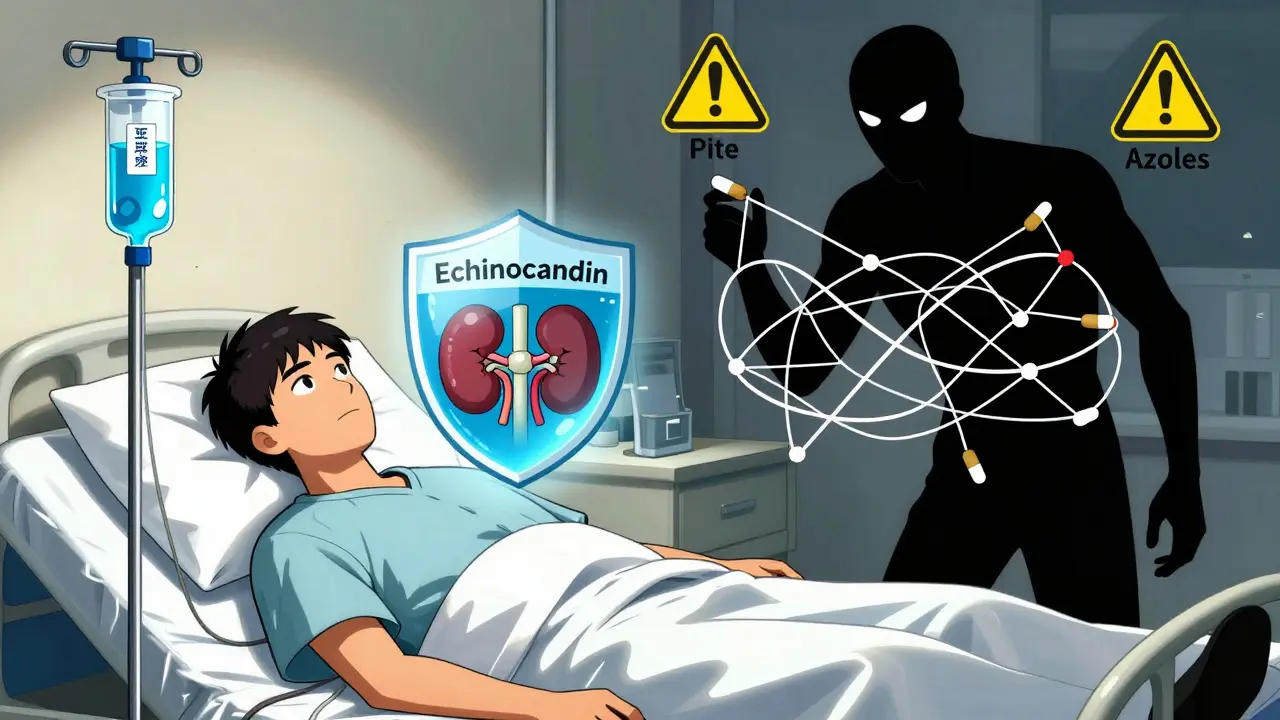
If there is one thing you must remember about azoles, it is this: they are interaction magnets. Azoles inhibit liver enzymes CYP3A4 and CYP2C9. These enzymes break down many other common medications. When you block them, levels of other drugs can skyrocket to toxic levels.
A 2022 analysis documented that azoles have over 597 severe drug-drug interactions. For example, combining voriconazole with phenytoin (a seizure medication) can double phenytoin levels within 48 hours, leading to toxicity. Similarly, combining posaconazole with certain macrolide antibiotics can dangerously prolong the QT interval, risking fatal heart arrhythmias.
Echinocandins are much safer in this regard. They have significantly fewer interactions-only about 178 severe ones documented. This is why they are preferred in complex ICU patients who are already on multiple medications. Before starting any azole, you must review the patient’s entire medication list. Check for statins, immunosuppressants, blood thinners, and anti-seizure meds. Adjust doses or switch classes if the risk is too high.
Safety Monitoring and Side Effects
Both classes require vigilance, but the types of risks differ.
Azoles: The biggest concern is hepatotoxicity (liver damage). The FDA mandates quarterly liver function tests for azole recipients. You must monitor ALT and AST levels. If they exceed five times the upper limit of normal, stop the drug immediately. Gastrointestinal issues are also common; nearly 70% of azole users report nausea or abdominal pain. Additionally, some azoles like ketoconazole have been removed from systemic use due to disproportionate liver risks.
Echinocandins: Liver issues are rare but possible. The primary side effect is infusion-related reactions, such as flushing or rash at the IV site. Kidney safety is their major advantage. Unlike amphotericin B or some azoles, echinocandins rarely harm the kidneys, making them ideal for patients with existing renal impairment.
Therapeutic drug monitoring (TDM) is crucial for voriconazole and posaconazole. Not everyone metabolizes these drugs the same way. About 37% of patients need dose adjustments to hit the target trough levels (1-5.5 μg/mL for voriconazole). Without TDM, you might underdose (leading to resistance) or overdose (leading to toxicity).
Cost and Access Considerations
Treatment decisions are not made in a vacuum. Cost plays a significant role, especially for long-term therapies.
Azoles are generally cheaper. A course of fluconazole might cost around $150, while a week of caspofungin can run over $1,250. This price gap influences formulary decisions. Hospitals often reserve echinocandins for the sickest patients where their safety profile justifies the expense. For stable patients, switching to oral fluconazole early in treatment saves money and allows for discharge.
However, consider the hidden costs of complications. If an azole causes liver failure or a dangerous drug interaction requiring ICU admission, the bill will far exceed the savings from the cheaper pill. Always weigh the upfront drug cost against the potential cost of adverse events.
Emerging Resistance and Future Options
Fungi are getting smarter. Azole resistance in Aspergillus fumigatus has jumped from 1.8% in 2012 to 8.4% in 2022. This is partly due to agricultural fungicides using similar chemicals. If current trends continue, experts warn that 30% of invasive fungal infections could become untreatable with existing drugs by 2035.
New options are emerging. Olorofim, a novel orotomide, received breakthrough therapy designation for resistant aspergillosis. Rezafungin, a long-acting echinocandin, offers once-weekly dosing, simplifying treatment. Keep an eye on these developments, as they may change standard protocols soon.
Can I take azoles if I am pregnant?
Azoles are classified as Pregnancy Category D, meaning there is positive evidence of human fetal risk. They should generally be avoided during pregnancy, especially in the first trimester. Echinocandins are Category C, implying risk cannot be ruled out but benefits may outweigh risks. Always consult an obstetrician and infectious disease specialist before treating fungal infections in pregnancy.
Why do I need liver tests when taking fluconazole?
Fluconazole and other azoles are metabolized by the liver and can cause hepatotoxicity. Regular monitoring of liver enzymes (ALT/AST) helps detect damage early. If levels rise significantly, the drug must be stopped to prevent permanent liver injury.
Are echinocandins effective against all fungal infections?
No. Echinocandins are primarily effective against Candida and Aspergillus species. They are not effective against Cryptococcus or Mucorales. Azoles have a broader spectrum, covering many yeasts and molds, which is why they are often chosen when the specific fungus is unknown.
What should I do if I experience visual disturbances on voriconazole?
Visual disturbances occur in about 38% of voriconazole users and are usually transient and harmless. However, inform your doctor immediately. While often benign, severe vision changes could indicate toxicity requiring dose adjustment or switching medications.
Is it safe to combine antifungals with corticosteroids?
Combining antifungals with corticosteroids can be risky. Corticosteroids suppress the immune system and can worsen fungal infections. For topical treatments, combinations like clotrimazole-betamethasone are discouraged for widespread use. Systemic combinations require careful oversight by a specialist.


Nivetha Narayanan
omg this is soo helpful!! i was so confused about why my doctor switched me from the pills to the iv drip last week. turns out it was for my kidneys! thanks for breaking it down simply 🙌
Frank Arlyss
I don't care about your charts. I just want to know if I can drink alcohol while on voriconazole because I have a party tonight and I'm not missing it for some fungus.
Tim Reynolds
The FDA is lying to you., They want you to buy the expensive echinocandins so pharma companies get rich., Azoles work fine., Just ignore the liver tests., It's all about control., Wake up.,
Victoria Mangiapane
Oh please, another boring medical lecture. You think we don't know this? I've been sick for years and I know more than you. The real issue is that doctors are lazy and just prescribe whatever is cheapest without thinking about us. It's tragic really. My life is ruined by these interactions and no one cares. I hate everything.
Lisa Russo
You guys are dumb. Echinocandins are not magic. They cost way too much and insurance won't cover them easily. Stop acting like money doesn't matter. Most people can't afford the IV stuff anyway. It's a scam.
Gareth Tyler
interesting point about the kidney safety. makes sense why they push echinocandins in ICU. do you think oral step-down is safe for everyone though or just specific cases?
Sharon O’Mahonh
let's talk about the synergy here folks. when we understand the mechanism of action we empower ourselves. the beta-glucan synthase inhibition is key. we must embrace the data but also trust our bodies. holistic health meets modern medicine. let's grow together in knowledge and compassion for our cellular structures.
Jonhnnie john13
The statistical significance of the 87% reduction in AKI is overstated. The sample size in those studies was likely biased towards severe cases where renal failure was already imminent. Correlation does not imply causation. The data is flawed.
Anthony Padilla
i totally agree with the part about drug interactions. its scary how many meds people take. i had a friend who got sick from mixing antifungals with his heart meds. we need better education in communities especially in india where polypharmacy is common but not always monitored well.
Elizabeth Fandry
One must consider the ontological implications of fungal cell wall disruption. It is quite pretentious to reduce such complex biological warfare to simple 'good vs bad' narratives. The visual disturbances mentioned are merely the mind expanding beyond the physical realm. 🧠✨ Truly, only the enlightened understand the true nature of ergosterol synthesis.
Madeline Petes
Wait so if i am pregnant i cant take azoles? That sounds super restrictive. Is there any other option? I am worried because i have a yeast infection right now and dont want to hurt the baby. Please help!
Ramanath Rao
This article is useless garbage. In India we use Amphotericin B for everything because it is cheap and effective. Your Western guidelines are irrelevant here. We do not have the luxury of checking liver enzymes every week. Patients die waiting for tests. Stop preaching to people who survive on pennies.