
CYP1A2 Medication Risk Calculator
How Your Habits Affect Your Medication
This tool estimates the relative impact of your grilled meat consumption and smoking habits on medications metabolized by CYP1A2. Note: Grilled meat is a minor factor for most people, while smoking is a major factor.
Step 1: Select Your Medication
Step 2: Your Smoking Habits
Step 3: Your Grilled Meat Consumption
Ever wondered if your weekend barbecue could mess with your meds? It sounds far-fetched - until you dig into the science. Charcoal-grilled meats don’t just taste smoky; they trigger real biochemical changes in your body that can affect how your medications work. The enzyme at the center of this is called CYP1A2. It’s responsible for breaking down about 10% of common drugs, including clozapine for schizophrenia, theophylline for asthma, and even caffeine. And yes, the char on your steak might be influencing it.
How Grilled Meat Changes Your Body’s Chemistry
When meat hits high heat over charcoal, two nasty compounds form: polycyclic aromatic hydrocarbons (PAHs) and heterocyclic amines (HCAs). These aren’t just carcinogens - they’re also potent activators of a cellular switch called the aryl hydrocarbon receptor (AhR). When AhR turns on, it tells your liver and intestines to produce more CYP1A2 enzyme. More enzyme means your body processes certain drugs faster. That’s not always good.Take clozapine, for example. It’s a powerful antipsychotic with a very narrow safety window. Too little, and symptoms return. Too much, and you risk seizures or heart problems. If your CYP1A2 levels spike after eating grilled meat, your body might clear clozapine too quickly, making it less effective. On the flip side, if you suddenly stop eating grilled meat after months of it, your enzyme levels drop, and drug levels could creep up dangerously.
The Two Studies That Started the Debate
In 1999, researchers at the University of Michigan led by Dr. Robert Fontana did something unusual: they took biopsies from people’s intestines and livers. Ten healthy adults ate 250 grams of charcoal-grilled meat every day for seven days. The results? Liver CYP1A2 activity jumped by 47%. Intestinal CYP1A1 - another enzyme in the same family - rose by 53%. This wasn’t a guess. They measured the actual proteins being made. The evidence was direct, physical, and convincing.Then, in 2005, a team in Denmark led by Dr. Kim Brøsen tried to replicate it - but they didn’t take biopsies. Instead, they used caffeine as a probe. People drank coffee, and the researchers measured how fast their bodies broke it down. That’s a standard way to estimate CYP1A2 activity. After five days of the same grilled meat diet, caffeine metabolism changed by just 4.2%. Not statistically significant. No real change.
So which study is right? Both. And neither. Fontana measured enzyme production. Brøsen measured actual drug processing. One showed the machinery was being built. The other showed the factory wasn’t running faster. The difference? Time, method, and biology. Fontana’s group had longer exposure, both men and women, and looked at tissue. Brøsen’s group had only men, a shorter window, and relied on a single drug (caffeine) as a proxy. Neither tested real patients on real medications - just healthy volunteers.
Why Smoking Matters More Than Steak
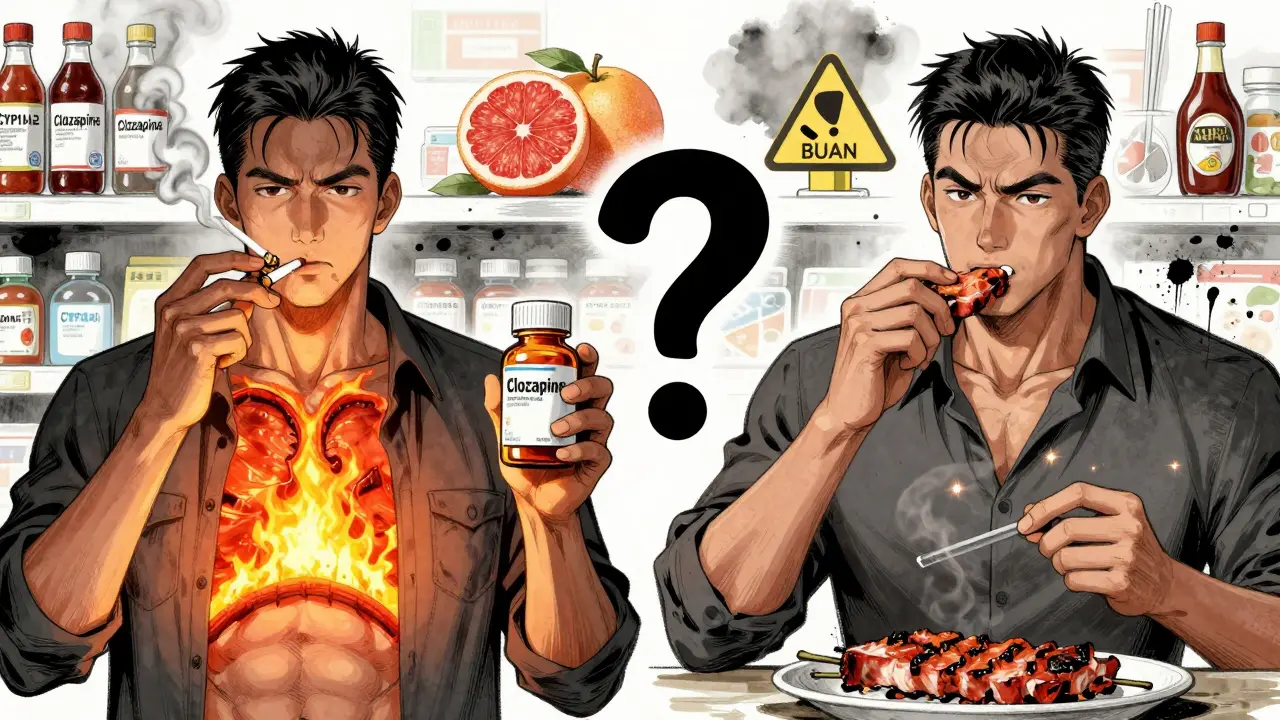
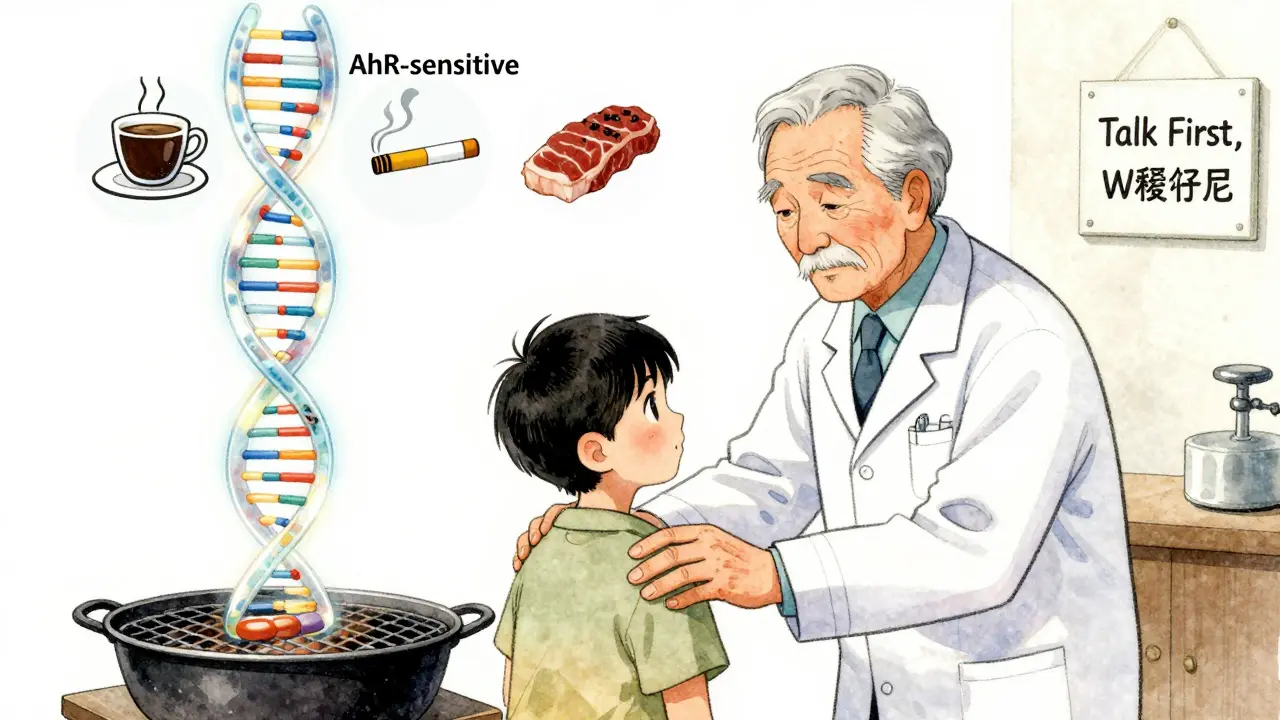
Here’s the kicker: cigarette smoke is a far stronger inducer of CYP1A2 than grilled meat. Smokers can have 200% to 400% higher enzyme activity than non-smokers. That’s not a small bump - that’s a full-blown overhaul of your drug metabolism. If you’re on theophylline and you quit smoking, your dose might need to be cut in half. But if you eat a burger off the grill once a week? The effect is barely noticeable in most people.And here’s what no one talks about: genetics. Some people have versions of the AhR gene that make them extra sensitive to PAHs. Others barely respond at all. That’s why one person might have a problem after eating grilled meat, while their friend eats the same meal and feels nothing. It’s not about the food - it’s about your DNA.
What Do Doctors and Pharmacies Actually Say?
Look at the official guidelines. The FDA and EMA don’t mention grilled meat in any drug label warnings. The Clinical Pharmacogenetics Implementation Consortium (CPIC), which sets global standards for genetic drug interactions, doesn’t list it as a concern. Mayo Clinic and Cleveland Clinic patient guides don’t warn about it. In fact, a 2021 survey found that only 7% of community pharmacists ever ask patients about grilled meat when dispensing CYP1A2 drugs. Meanwhile, 92% ask about grapefruit juice - which is a proven, strong inhibitor.On Reddit’s r/pharmacy, pharmacists consistently say: “Don’t stress.” A patient on clozapine once posted asking if backyard BBQs were dangerous. The top response: “No documented cases in 20 years of clinical practice.” Only three possible case reports in the last decade even hinted at a link - and none proved causation.
Should You Stop Grilling Your Meat?
If you’re on a drug like clozapine, theophylline, or tacrine, and you’re eating grilled meat every day - maybe think about it. But if you have it once a week? Probably not worth changing your habits. The real risks are still smoking, heavy alcohol use, or taking other drugs that interact with CYP1A2. Grilled meat is a footnote, not a headline.Here’s what you should actually do:
- If you’re on a CYP1A2 substrate drug and you’re a regular grilled meat eater, don’t suddenly stop. That could cause drug levels to rise.
- If you’re a smoker and you quit, tell your doctor. Your dose may need adjusting.
- If you start eating a lot more grilled meat than usual, keep an eye out for changes in how your medication works - less effect, or more side effects.
- Don’t panic. There’s no evidence that occasional grilled meat causes harm with medications.
What’s Next for This Research?
The science has stalled. No new clinical trials on grilled meat and CYP1A2 have been registered since 2005. Funding has moved on. The 2023 European Society of Clinical Pharmacology position paper called the evidence “insufficient to warrant clinical recommendations.” Experts agree: it’s academically interesting, but not clinically urgent.One exception? Genetic research. Scientists are now looking at whether certain DNA variants make some people more likely to respond to PAHs. In the future, we might see personalized advice: “Your gene variant makes you sensitive - limit charred meat.” But that’s still years away.
For now, the bottom line is simple: your weekly barbecue isn’t going to ruin your medication. But if you’re on a narrow-therapeutic-index drug and you’re changing your diet dramatically - talk to your doctor. Don’t guess. Don’t assume. Just ask.
Can eating charcoal-grilled meat affect how my medication works?
Yes, theoretically. Charcoal-grilled meats contain compounds that can increase the activity of the CYP1A2 enzyme, which breaks down certain drugs like clozapine, theophylline, and caffeine. But in most people, the effect is small and temporary. Unless you’re eating large amounts daily and are on a drug with a narrow safety window, it’s unlikely to cause problems.
Should I stop eating grilled meat if I take clozapine or theophylline?
No, you don’t need to stop. There are no documented cases of clozapine toxicity or theophylline failure directly caused by grilled meat in clinical practice. The bigger concern is smoking - which increases CYP1A2 activity far more than food. Just avoid sudden, extreme changes in your diet. If you normally eat grilled meat daily and suddenly stop, your drug levels might rise. Talk to your doctor before making big changes.
Does caffeine metabolism change after eating grilled meat?
Studies show mixed results. One study found no significant change in how fast people broke down caffeine after eating grilled meat for five days. Another found a clear increase in CYP1A2 enzyme levels. The difference? One measured enzyme production in tissue, the other measured caffeine clearance in urine. For most people, caffeine metabolism won’t noticeably change from occasional grilled meat.
Is grilled meat more dangerous than smoking for CYP1A2 interactions?
Absolutely not. Smoking increases CYP1A2 activity by 200-400%. Grilled meat, at most, increases it by 50% in sensitive individuals - and often much less. If you’re on a CYP1A2-metabolized drug, quitting smoking is far more important than avoiding barbecue. The FDA and other agencies only list smoking as a strong inducer, not grilled meat.
Why don’t drug labels warn about grilled meat?
Because the evidence isn’t strong enough. Regulatory agencies like the FDA and EMA only add warnings when there’s clear, consistent proof of harm. Only two human studies exist on this topic, and they conflict. No real-world cases of drug failure or toxicity have been linked to grilled meat. In contrast, grapefruit juice has dozens of documented interactions - so it’s warned about. Grilled meat doesn’t meet that bar.

Ben Kono
So let me get this right you’re telling me my Sunday ribs are gonna mess with my asthma meds and no one’s even written a warning on the label
Rinky Tandon
Let me break this down for you in 10 seconds - PAHs activate AhR → CYP1A2 upregulation → altered pharmacokinetics of substrates → clinical relevance is negligible without genetic predisposition or chronic exposure. The Danish study used caffeine as a probe - flawed proxy. The Michigan biopsy data is gold standard. End of discussion.
Cecelia Alta
Okay but like why is everyone acting like this is some big secret when every single smoker I know has had their theophylline dose changed after they quit and no one ever says oh wait did you stop eating steak too
Like come on we’re all just pretending this is about food when it’s really about how lazy medicine is at connecting lifestyle to pharmacology
And don’t even get me started on how we panic about grapefruit juice but ignore the fact that your neighbor smokes three packs a day and is on clozapine and no one checks his levels
It’s not the BBQ it’s the systemic failure to treat patients as whole people
Also I’ve been eating charred burgers weekly for 12 years on clozapine and I’m fine so either this is a myth or I’m just genetically lucky
Either way I’m not giving up my grill
And if your doctor says to stop eating meat because of your meds they’re probably just trying to make you feel better without actually knowing anything
Also why is this even a thing
Who funded this research
Are we being sold fear
Also I’m not a scientist but I read a lot of Reddit
Alice Elanora Shepherd
It’s worth noting that CYP1A2 induction from dietary PAHs is transient, dose-dependent, and highly variable across individuals - especially given the polymorphisms in the AhR receptor gene. For the vast majority of patients, occasional grilled meat poses no meaningful risk. What matters far more is consistency: if you’re a regular consumer, don’t suddenly stop - and if you’re a smoker, prioritize quitting over dietary changes. The evidence simply doesn’t support alarmism, but it does support awareness.
Also, if you’re on clozapine, your prescriber should already be monitoring your levels routinely - regardless of diet. That’s the real safety net.
Cassie Widders
I eat grilled chicken every weekend and take theophylline. Never had an issue. Probably fine.
Audu ikhlas
Why are we even talking about this like its some deep mystery when the real problem is westerners eating charred meat like its a sport while in Nigeria we cook our meat over open fire and still live to 90
Maybe its not the meat its the fact you all eat too much processed junk and then wonder why your meds dont work
Also I read this article and my brain hurt
Craig Wright
The notion that charcoal-grilled meat significantly alters CYP1A2 activity in a clinically meaningful way is scientifically tenuous at best. The 1999 study used a highly artificial protocol - 250g of charcoal-grilled meat daily for seven days - a regimen no sane human would follow. Meanwhile, the 2005 caffeine probe study, which measured actual metabolic outcomes, found no significant effect. To elevate this to the level of clinical concern is to misunderstand the difference between biochemical curiosity and therapeutic relevance. The FDA doesn’t warn about it because there is no evidence - not because they’re asleep at the wheel.
Moreover, to compare this to smoking - a potent, chronic, systemic inducer - is misleading. The magnitude of effect differs by an order of magnitude. This is not a drug interaction. It is a footnote.
Sonal Guha
Studies conflict so the answer is maybe
Also genetics matter
Also smoking matters more
Also no one cares
Also your doctor won't ask
Also you probably still eat the steak
Rebekah Cobbson
If you're on clozapine or theophylline and you're worried about your diet, start by talking to your pharmacist or doctor - not Reddit. But honestly, if you're eating grilled meat once a week and you're stable on your meds, you're probably fine. The bigger issue is consistency. Don't quit smoking and then start eating charcoal every day and expect your body to handle it. Small changes are fine. Big, sudden ones? That's when you need to check in. You got this.
Konika Choudhury
India eats grilled meat every day and no one here has a problem with clozapine because we don't overthink everything like Americans do
Also we use tandoor not charcoal and it's different anyway
Stop being so paranoid