
HIV & Statin Interaction Checker
How This Tool Works
Select your HIV treatment regimen and current statin to see if they're compatible. Based on your choices, you'll receive safe options and important safety guidelines.
Important: Never stop or change your medications without consulting your healthcare provider.
Important Safety Information
Never stop or change medications without consulting your doctor. Always work with your healthcare provider to determine the best statin for your specific situation.
Monitor for muscle symptoms: Unexplained muscle pain, weakness, or dark urine could indicate serious side effects.
Check drug interactions: Use the University of Liverpool HIV Drug Interactions Checker before starting any new medication.
When you’re living with HIV and also need to manage high cholesterol, the last thing you want is for your medications to fight each other. That’s exactly what can happen when certain HIV drugs are mixed with statins - the cholesterol-lowering pills many people take to protect their hearts. The risk isn’t theoretical. It’s real, serious, and sometimes life-threatening. But here’s the good news: you don’t have to choose between heart health and viral control. With the right choices, you can safely take both.
Why This Mix Can Be Dangerous
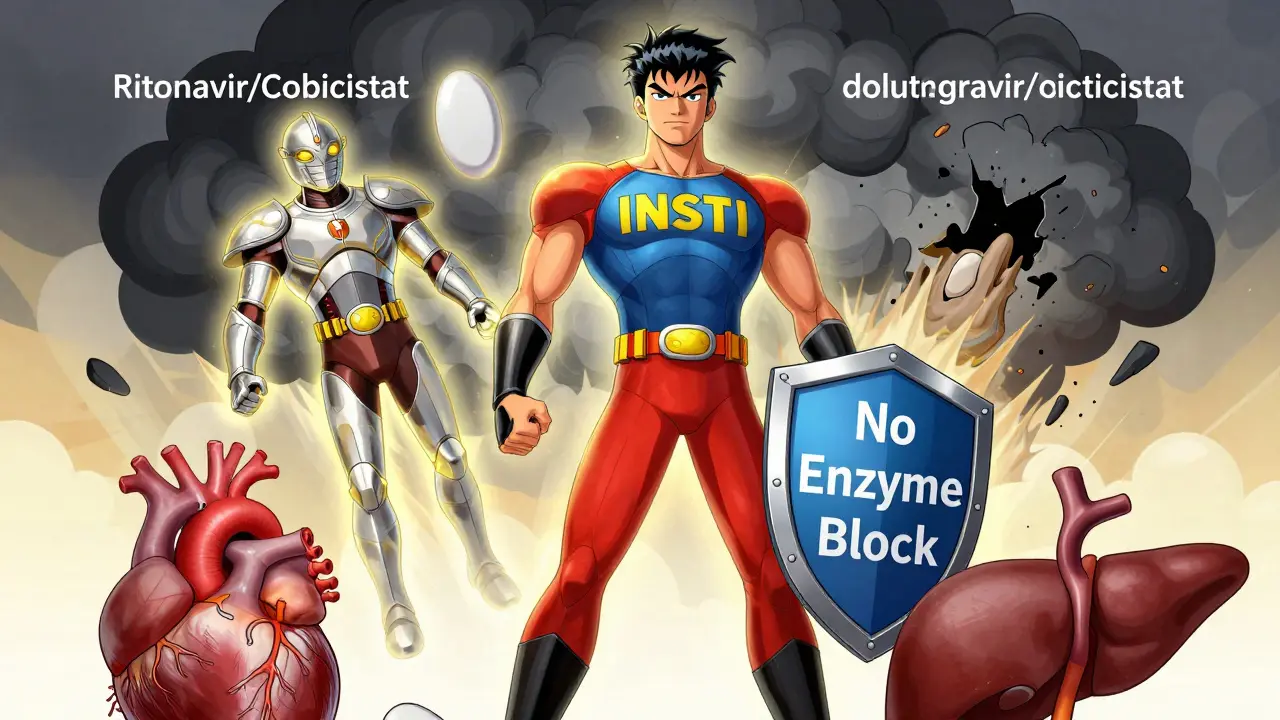
Most statins are broken down in your liver by an enzyme called CYP3A4. Many HIV medications, especially those boosted with cobicistat or ritonavir, block that same enzyme. When that happens, your body can’t clear the statin properly. The result? Statin levels in your blood can spike by 200% to 300%. That’s not a small bump - it’s a red flag for muscle damage. The worst-case scenario is rhabdomyolysis, a condition where muscle tissue breaks down and floods your kidneys with toxic proteins. This can lead to kidney failure. In extreme cases, it’s fatal. That’s why the FDA and major HIV guidelines are crystal clear: simvastatin and lovastatin are absolutely off-limits if you’re taking any boosted HIV regimen. There’s no safe dose. No exceptions.Which Statins Are Safe?
Not all statins are created equal when it comes to HIV drug interactions. Some are metabolized through different liver pathways, making them much safer to use alongside antiretrovirals.- Pitavastatin - This is often the top choice. It’s barely touched by CYP3A4 and has minimal interaction risk, even with cobicistat or ritonavir. It’s also effective at lowering LDL cholesterol and has a low rate of muscle-related side effects.
- Pravastatin - Another safe option. It doesn’t rely on CYP3A4 at all. You can usually take it at standard doses without adjustment, even with boosted HIV meds.
- Rosuvastatin - Safe, but with limits. It can increase in concentration by up to 3 times when taken with ritonavir or atazanavir. The FDA recommends capping the dose at 10 mg per day in these cases. Never go higher unless your doctor closely monitors you.
- Atorvastatin - Works well, but needs caution. With darunavir/cobicistat, your doctor might start you on 10 mg and only increase to 20 mg if needed. The US product label for Symtuza (which contains darunavir/cobicistat) says 20 mg is the max. Some international guidelines allow up to 40 mg, but only under strict supervision.
- Fluvastatin - A less common but viable alternative. It’s processed by CYP2C9, not CYP3A4. However, ritonavir can still raise its levels by about 2-fold, so start low and watch for muscle soreness.
What About New HIV Drugs?
The HIV treatment landscape has changed dramatically. Today, most people start on integrase strand transfer inhibitors (INSTIs) like dolutegravir or bictegravir. These drugs don’t interfere much with liver enzymes. That’s a game-changer. If you’re on a regimen like Biktarvy (bictegravir/emtricitabine/tenofovir alafenamide) or Triumeq (dolutegravir/abacavir/lamivudine), you can usually take most statins at standard doses. No need to cut back on atorvastatin or rosuvastatin. Your doctor may still check your cholesterol levels and muscle enzymes, but the interaction risk is low. This is why many clinicians now prefer INSTIs for patients who need statins. It simplifies care and reduces long-term risks.
What to Avoid - Beyond the Big Two
You’ve heard about simvastatin and lovastatin. But other drugs can make things worse too.- Gemfibrozil - A fibrate used for high triglycerides. It increases statin toxicity by blocking how your body clears them. Avoid it completely if you’re on a statin. Use fenofibrate or omega-3s instead.
- Certain blood pressure meds - Calcium channel blockers like felodipine or verapamil are metabolized by CYP3A4. Taking them with a statin and a boosted HIV drug can triple your risk of muscle damage. Ask your doctor about alternatives like amlodipine or lisinopril.
- Over-the-counter supplements - Red yeast rice contains a natural form of lovastatin. Even though it’s sold as a “natural” remedy, it’s just as dangerous as the prescription version when mixed with HIV meds.
Monitoring Is Non-Negotiable
Even if you’re on a safe combo, you can’t just take your pills and forget about it. Muscle damage doesn’t always hurt at first. You might feel fine - until it’s too late. Your doctor should check:- Creatine kinase (CK) - A blood marker for muscle breakdown. A level 5 times above normal is a warning sign.
- Liver enzymes - Statins can affect the liver. Routine tests help catch issues early.
- Physical symptoms - Unexplained muscle pain, weakness, or dark urine? Call your doctor immediately. Don’t wait.
Who’s at Higher Risk?
Not everyone reacts the same way. Some people are more vulnerable.- People over 65 - Aging liver and kidneys clear drugs slower. Risk of side effects goes up.
- People with kidney disease - Both HIV and statins can affect kidney function. Combining them needs extra care.
- Women - Some studies suggest women may be more prone to statin-related muscle symptoms, though data in HIV populations is still limited.
- People taking multiple meds - The more drugs you take, the higher the chance of hidden interactions.
What Should You Do?
If you’re on HIV meds and your doctor suggests a statin, here’s your action plan:- Ask: “Is my HIV regimen boosted with cobicistat or ritonavir?” If yes, you need a statin that’s safe with those.
- Ask: “Which statin are you recommending, and why?” Make sure they’re not suggesting simvastatin or lovastatin.
- Ask: “What’s the starting dose, and how will we monitor for side effects?” Don’t accept vague answers.
- Use the University of Liverpool HIV Drug Interactions Checker - it’s free, updated monthly, and trusted worldwide. Bring the results to your appointment.
- Keep a list of every medication you take - including supplements, vitamins, and OTC painkillers. Bring it to every visit.
Bottom Line
You don’t have to live with high cholesterol because you have HIV. Safe statin choices exist. The key is matching the right statin to your specific HIV regimen - not guessing, not assuming, not relying on old advice. Pitavastatin and pravastatin are your safest bets with boosted HIV drugs. Atorvastatin and rosuvastatin can work too - but only at lower doses. INSTIs like dolutegravir and bictegravir open up more options. The biggest risk isn’t the statin. It’s not taking one when you need it. Heart disease is the leading cause of death among people with HIV. Skipping a statin because you’re afraid of interactions could be far more dangerous than the right one, taken correctly. Stay informed. Stay proactive. And never hesitate to ask your doctor to double-check your meds with a trusted drug interaction tool.Can I take simvastatin if I have HIV?
No. Simvastatin is absolutely contraindicated with all HIV protease inhibitors and cobicistat-containing regimens. Even low doses can raise statin levels up to 20 times normal, leading to severe muscle damage or rhabdomyolysis. There is no safe scenario for using simvastatin with these HIV drugs.
Is atorvastatin safe with HIV meds?
It can be, but only with strict limits. With darunavir/cobicistat, the maximum recommended dose is 20 mg per day. With other boosted regimens like lopinavir/ritonavir, 20-40 mg may be used under close monitoring. If you’re on an unboosted INSTI like dolutegravir or bictegravir, standard doses (up to 80 mg) are generally safe.
What’s the safest statin for someone on HIV treatment?
Pitavastatin is often the safest choice because it’s metabolized through a different liver pathway and has minimal interaction with HIV drugs. Pravastatin is another excellent option. Both can usually be taken at standard doses without adjustment, even with boosted HIV regimens.
Can I take rosuvastatin with ritonavir?
Yes, but only up to 10 mg per day. Ritonavir can increase rosuvastatin levels by up to 3 times, raising the risk of muscle side effects. Never exceed 10 mg if you’re on ritonavir or atazanavir/ritonavir. Higher doses require specialist supervision.
How do I know if my statin is causing muscle damage?
Watch for unexplained muscle pain, weakness, or tenderness - especially in your shoulders, thighs, or back. Dark, cola-colored urine is a red flag. If you notice these symptoms, stop the statin and contact your doctor immediately. Blood tests for creatine kinase (CK) will confirm muscle breakdown.
Should I avoid all statins if I have HIV?
No. Heart disease is the top cause of death among people with HIV. Avoiding statins because of fear of interactions is dangerous. The right statin, at the right dose, with the right HIV regimen, is not only safe - it’s life-saving. Work with your doctor to find your best option.
Can I use over-the-counter cholesterol supplements?
Avoid red yeast rice. It contains a natural form of lovastatin and carries the same risks as the prescription version when taken with HIV meds. Other supplements like plant sterols or fiber-based products are generally safe, but always check with your doctor before starting anything new.
Do I need to check for interactions every time I get a new prescription?
Yes. New medications - even antibiotics, antifungals, or over-the-counter pain relievers - can interact with your HIV drugs and statin. Always run any new prescription through the University of Liverpool HIV Drug Interactions Checker before filling it. It takes two minutes and can prevent a serious reaction.


Phil Maxwell
Been on Biktarvy for 3 years and just started pitavastatin last month. No issues at all. My doc used the Liverpool checker and said I'm golden. Honestly, I was terrified at first, but this post saved my sanity. Just take the right combo and you're fine.
Also, red yeast rice? Nah. I tried that 'natural' stuff once. Felt like I got hit by a truck the next day. Never again.
Amelia Williams
Y'all need to stop acting like statins are the enemy. Heart disease is the #1 killer in HIV+ folks and we're all too scared to take what we need. I'm 58, on dolutegravir, and taking 20mg atorvastatin. CK levels? Perfect. Cholesterol? Down 40%.
Don't let fear keep you from living. Talk to your doc, use the Liverpool tool, and get your heart right. You deserve to be healthy, not just alive.
Also, if your doctor suggests simvastatin, fire them. Seriously. That's not medical advice, that's negligence.
Viola Li
Wow. Another 'trust your doctor' post. When did we stop thinking for ourselves? What if your doctor is wrong? What if they're just following pharma bro guidelines? I’ve seen people on pitavastatin get rhabdo because the 'safe' dose wasn’t safe for THEIR liver.
And why is everyone so quick to trust a website? Who runs it? Who funds it? Maybe it’s just another marketing tool.
I’d rather take my chances with diet and exercise than risk my muscles for a pill that’s been pushed since 2012.
venkatesh karumanchi
From India, here. We don’t have pitavastatin easily here, but pravastatin is cheap and works. My HIV doc in Mumbai said the same thing - avoid boosted regimens if you can. INSTIs are the future.
Also, I told my uncle to stop red yeast rice. He thought it was 'Ayurvedic' so it must be safe. Bro, it’s literally lovastatin in disguise. He ended up in the hospital.
Don’t be that guy. Check your meds. Always.
Vatsal Patel
Oh look, another corporate-approved medical pamphlet dressed up as Reddit wisdom. 'Use the Liverpool tool!' Like that’s some sacred oracle. Meanwhile, real people are dying from statins because the 'safe' doses were calculated on 22-year-old white men in clinical trials.
And let’s not forget - HIV isn’t a lifestyle disease. It’s a systemic condition. Your liver doesn’t care if your statin is 'CYP3A4-safe' if your kidneys are already struggling.
Stop selling hope. Start admitting we don’t have enough data for real-world complexity.
Also, why is everyone so obsessed with cholesterol? Maybe your body’s just trying to heal. Just a thought.
Kat Peterson
OMG I JUST REALIZED I’VE BEEN TAKING ROSUVASTATIN WITH DARUNAVIR/Cobicistat 😱😱😱
THAT’S 20MG?? I’M ON 20MG?? I’M GONNA DIE 😭😭😭
My doc said it was fine, but now I’m googling rhabdomyolysis and my legs feel weird and I think I’m turning into a statue??
HELP. IS IT TOO LATE? I’M CRYING IN THE PHARMACY RIGHT NOW. 🤍🩷
Himanshu Singh
Hey Kat - breathe. You’re not turning into a statue. 20mg rosuvastatin with darunavir/cobicistat is actually the max recommended dose. You’re within limits.
But yeah, you’re right to panic - that’s how you stay alive. Don’t stop the med, but call your doctor tomorrow. Get a CK test. You’re being responsible, not paranoid.
Also, if you’re feeling muscle pain, drink water, rest, and don’t do squats for a week. Seriously. Your body’s just asking for a break.
You got this. 🙌💛
Izzy Hadala
While the information presented is largely accurate and aligns with current clinical guidelines, it is imperative to emphasize that pharmacokinetic interactions are population-based estimates. Individual variability in CYP enzyme expression, renal clearance, and mitochondrial function may significantly alter risk profiles. Furthermore, the utility of the University of Liverpool tool, while commendable, is predicated on the fidelity of the input regimen and may not account for polypharmacy beyond antiretrovirals and statins.
As such, therapeutic decision-making must be individualized, incorporating genotypic data where available, and should not be reduced to algorithmic compliance. A multidisciplinary approach involving infectious disease specialists, clinical pharmacists, and cardiologists remains the gold standard.
Additionally, the assertion that heart disease is the leading cause of mortality in HIV-positive populations requires qualification: this is true in high-income settings with effective viral suppression. In resource-limited contexts, opportunistic infections and non-adherence remain dominant threats.
Therefore, while the advice is generally sound, its universal applicability warrants caution.