
When a pharmacist hands you a pill bottle with a different name than what your doctor wrote on the prescription, it’s natural to pause. Generic medications work the same way as brand-name drugs-they contain the exact same active ingredient, in the same dose, and work the same way in your body. But many patients still worry: Is this really as good? Will it make me feel different? Will it even work at all?
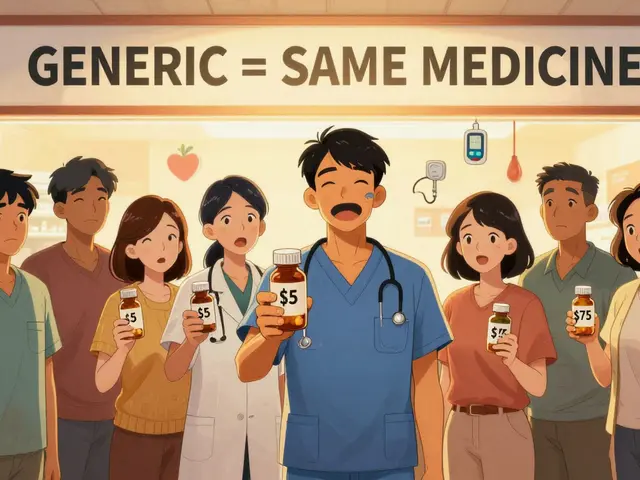
The truth is, 90% of all prescriptions filled in the U.S. are for generic drugs. They save patients and the healthcare system over $370 billion every year. And yet, nearly one in three patients still hesitate to take them. Why? It’s not because the science is weak. It’s because the conversation never happened.
Why Patients Doubt Generics-And What the Data Shows
Research from the PLOS ONE study in December 2024 found that 49.4% of patients believe doctors should prescribe more generics. But only 37.6% of Americans actually prefer using them. That gap tells us something important: people aren’t against generics because they’re expensive-they’re against them because they don’t understand them.
One of the biggest myths? That generics cause more side effects. A national survey published in the Journal of General Internal Medicine showed that 30.2% of patients believe brand-name drugs are more effective, and 53.7% think they’re just better quality. But here’s what the FDA confirms: for a generic to be approved, it must deliver the same amount of active ingredient into the bloodstream within the same time frame as the brand. The acceptable range? 80% to 125%-meaning the body absorbs it just as reliably.
And the data doesn’t lie. A 2023 study in Frontiers in Drug Safety and Regulation found that 66% of patients agreed generics are not inferior in quality. Another 68.9% said they were just as effective. But those numbers only tell part of the story. The real issue? Who told them that.
The Power of a Simple Conversation
Here’s the most powerful finding from years of research: It’s not what patients know-it’s who told them.
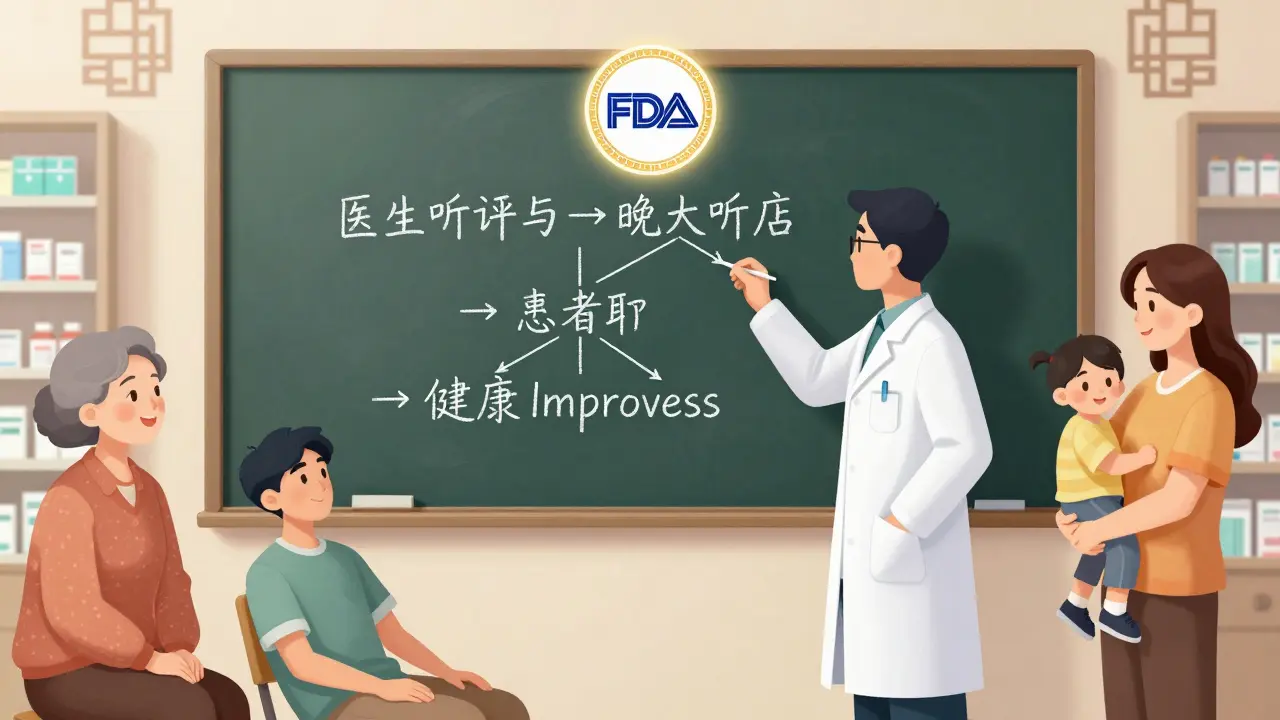
When a pharmacist spends just two to three minutes explaining why a generic is safe and equivalent, patient comfort with substitution jumps from 63% to 85%. That’s not magic. That’s communication.
Patients who received no explanation were twice as likely to refuse the generic. Those who heard a clear, calm explanation from their provider were far more likely to take it-and stick with it.
Dr. Sarah Ibrahim from the FDA put it plainly: “Taking time to talk with patients about switching from brand-name to generic drugs can increase their confidence.” It’s not about convincing. It’s about clarifying.
What should that conversation sound like?
- “This generic has the same active ingredient as your old pill-same strength, same way of working.”
- “The FDA requires it to meet the same strict standards for safety and effectiveness.”
- “Many people switch and don’t notice any difference. If you do feel something unusual, let us know.”
It’s not about jargon. It’s about trust. And trust isn’t built with pamphlets or websites. It’s built in real time, with real words.
Who’s Most at Risk? And Why
Not everyone feels the same way about generics. Research shows certain groups are more likely to hesitate:
- Patients with low health literacy: 50.3% believe generics are less safe or effective.
- People on Medicaid: 39.4% express concern, compared to 21.7% with private insurance.
- Non-Caucasian patients: Only 78.3% feel confident, versus 89.1% of Caucasian patients.
- Those with lower education or income: Doubts rise sharply when financial stress is high.
This isn’t about ignorance. It’s about access to clear, consistent information. A patient who’s been told “this is cheaper” without being told “this is just as good” will assume the worst. That’s human nature.
One study found that patients over 60 were more likely to accept generics-71.4% saw them as safe. Why? Because they’ve been through the system longer. They’ve seen how medications work. They’ve learned to trust the process.
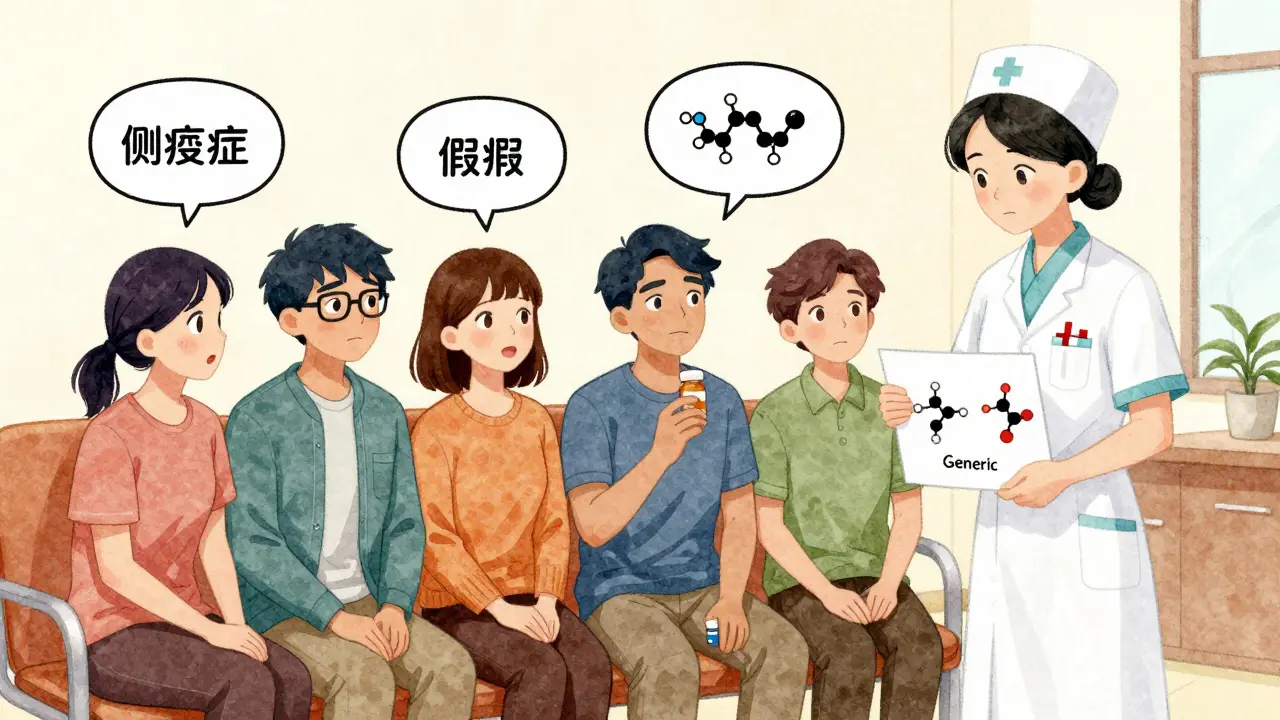
But younger patients? They’re more likely to be influenced by online stories. A Reddit thread from January 2024 had 142 comments. 68% said generics worked fine. But 32% shared stories like: “My generic Sertraline made me feel jittery-brand never did.”
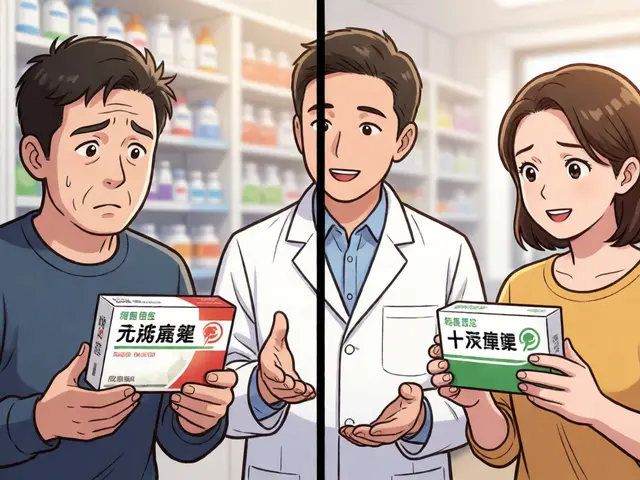
That’s not proof generics are flawed. It’s proof that people need context. Sometimes, differences in inactive ingredients (like fillers or dyes) can cause minor side effects. But those aren’t the drug failing. They’re the body reacting to something new. And that’s something a provider can explain.
What Works in Real Life
Pharmacies that train staff in simple communication see better outcomes. CVS Health has a 4.2/5 rating on Trustpilot for generic counseling. Walmart Pharmacy? Only 3.1/5. Why? The difference isn’t the drugs. It’s the time spent talking.
Best practices from research:
- Always ask: “Have you taken this medication before?”
- Use plain language: Say “same medicine” instead of “bioequivalent.”
- Offer reassurance: “If you feel different, call us. We’ll help you figure it out.”
- Don’t assume: Just because a patient is quiet doesn’t mean they’re okay.
- Use the Newest Vital Sign tool: A quick 3-question test to check health literacy before explaining.
One hospital in Ohio started a program where pharmacists spent exactly 90 seconds with every patient switching to a generic. Within six months, refill rates for generics went up by 22%. No incentives. No discounts. Just better talk.
What Doesn’t Work
Handing out a brochure doesn’t cut it. A 2023 study found only 62% of patients found pharmacy pamphlets “somewhat helpful.” Why? They’re too dense. Too technical. Too silent.
Same goes for relying on websites. The FDA has an excellent page answering 50 common questions about generics. But if a patient doesn’t know it exists-or doesn’t feel confident enough to look it up-it’s useless.
And never say: “It’s the same thing.” That’s not enough. It sounds dismissive. Instead, say: “It’s the same active ingredient, made to the same strict standards. The only difference is the price-and the name on the label.”
The Bigger Picture
Generic drugs aren’t just cheaper. They’re essential. In 2022, 92.7% of all Medicare Part D prescriptions were generic. Without them, millions couldn’t afford their treatment. But if patients stop taking them because they’re scared, the savings vanish-and so does the health benefit.
States are starting to catch on. Eighteen states now let pharmacists substitute generics without asking the doctor first. But that only works if patients are prepared. Otherwise, they walk out with the brand-or don’t fill the prescription at all.
The goal isn’t to push generics. It’s to empower people to choose them-confidently, knowingly, and without fear.
What’s Next?
Machine learning models are now predicting patient acceptance of generics with 87.3% accuracy. The top predictors? Provider communication, age, and education level. That means we can target help where it’s needed most.
But technology won’t fix this. People will. Every pharmacist, every nurse, every doctor who takes two minutes to explain-really explain-what a generic is, makes a difference.
It’s not about changing minds. It’s about opening them.
Are generic drugs really as effective as brand-name drugs?
Yes. The FDA requires generic drugs to have the exact same active ingredient, strength, dosage form, and route of administration as the brand-name version. They must also prove they deliver the same amount of medicine into the bloodstream at the same rate. This is called bioequivalence. Studies show no difference in effectiveness for conditions like high blood pressure, diabetes, depression, or asthma.
Why do some people feel different on a generic version?
The active ingredient is the same, but inactive ingredients-like fillers, dyes, or coatings-can vary. These don’t affect how the drug works, but they can sometimes cause minor side effects, like stomach upset or a different pill size that feels odd. If you notice a change, talk to your pharmacist. It doesn’t mean the generic is unsafe-it just means your body might need a little time to adjust, or you may need to try a different manufacturer’s version.
Can pharmacists substitute a generic without asking me?
In 18 U.S. states, pharmacists can legally substitute a generic for a brand-name drug without contacting your doctor first. But they’re still required to inform you. If you don’t want a substitution, you can say no. Always ask: “Is this a generic?” and “Can you tell me how it’s the same or different?”
Is it safe to switch from a brand-name drug to a generic?
Yes. The FDA approves all generics before they hit the market. Millions of people switch every year without issue. The biggest risk isn’t the drug-it’s not being told about the switch. If you’re concerned, ask your provider to write “Dispense as Written” on the prescription. That ensures you get exactly what they ordered.
Why do some doctors still prescribe brand-name drugs?
Sometimes, it’s because they’re not aware of the generic option, or they’ve had a rare case where a patient reacted differently. Other times, it’s for complex drugs-like inhalers or injectables-where equivalence is harder to prove. But for most common medications, generics are just as safe and effective. Ask your doctor: “Is there a generic version available?”

Kunal Kaushik
I’ve been taking generics for years, and honestly? Never had an issue. 🌿 My blood pressure med? Generic. My anxiety pill? Generic. Even my kid’s antibiotics-generic. The only time I noticed a difference was when the pill looked different. Felt weird at first, but same results. Pharmacist just said, "Same stuff, different wrapper." That’s all I needed. 😌
Caleb Sutton
Generics are a scam. Big Pharma and the FDA are in bed together. You think they really test these things? They just run a quick scan and say "yep, close enough." What about the fillers? The dyes? The cheap Chinese manufacturing? My cousin took a generic SSRI and ended up in the ER. They covered it up. Don’t be fooled.
Jamillah Rodriguez
I get why people are skeptical. I used to be one of them. Then I switched to generic levothyroxine and started feeling like a zombie. Not the drug-probably the filler. Switched back, felt normal. Now I only take brand. Not because I’m rich, but because I’m tired of being a guinea pig. 🤷♀️
Susheel Sharma
The real issue isn’t bioequivalence-it’s epistemic asymmetry. Patients are not merely uninformed; they are systematically disempowered by a healthcare architecture that prioritizes cost-efficiency over epistemic trust. The FDA’s 80–125% range is statistically permissible, but phenomenologically unsettling. When a patient’s somatic experience diverges from institutional assurances, the dissonance is not irrational-it is rational resistance to a system that commodifies bodily integrity.
Janice Williams
I find it appalling that anyone would suggest generics are "just as good." The fact that 30% of people believe brand-name drugs are more effective? That’s not ignorance-that’s instinct. And instinct is often right. Why would a pharmaceutical company spend billions on branding if the product was truly identical? There’s something being hidden here. And no, I don’t trust the FDA.
Roshan Gudhe
You know what’s beautiful? That a 90-second conversation can shift someone’s entire belief system. It’s not about science-it’s about dignity. When someone takes the time to say, "I see you’re nervous," and then explains without jargon? That’s healing. Not the pill. The human moment. We’ve turned healthcare into a transaction. But medicine? Medicine is a relationship. And relationships need words. Not pamphlets. Not apps. Words.
Rachel Kipps
i read this and thought abt my grandma shes 78 and takes 6 generics and never had a problem. she says "if it works and costs less why not?" she dont care about the name on the bottle. she cares about not being in pain. maybe we overthink this too much?
Katherine Urbahn
I must insist: the notion that "generics are just as effective" is dangerously oversimplified. The bioequivalence standard is not a guarantee of therapeutic equivalence. There are documented cases-peer-reviewed, FDA-recognized-of clinically significant differences in absorption profiles, particularly with narrow-therapeutic-index drugs like warfarin and levothyroxine. To dismiss patient concerns as "misinformation" is not only unscientific-it is ethically indefensible.
Joy Johnston
I’m a pharmacist in Ohio. We started doing the 90-second talk with every switch. Within 3 months, our refill rates jumped. Not because we offered discounts. Not because we pushed. We just said: "This is the same medicine. The only difference is the price. If you feel weird, call us. We’ll help." People just needed to hear it from someone they trusted. Simple. Human. Works every time.
Shelby Price
I used to hate generics until I tried one for my antidepressant. Felt kinda off for a week-more tired, weird dreams. Called my pharmacist. She said, "That’s the filler. Different company. Try this one." Switched brands, felt fine. No big deal. But if she hadn’t said anything? I would’ve thought it was the drug failing. And quit. So yeah. Talk matters.
Jesse Naidoo
You say pharmacists should talk more? What about the 10 people waiting in line? What about the 200 scripts you have to fill before lunch? You want me to spend 3 minutes with every patient? Then who’s gonna do the other 50? This isn’t a therapy session-it’s a pharmacy. You can’t fix systemic underfunding with a pep talk.
Keith Harris
Let’s be real. The only reason generics exist is because Big Pharma wants to kill competition. They let a generic company make the same pill for $0.02 and then sue anyone who tries to make a better one. Meanwhile, they patent new "versions" of old drugs every 6 months. Generics aren’t saving you money-they’re letting the system keep its grip. And don’t even get me started on the colorants. Ever wonder why your generic pill is neon green? That’s not medicine. That’s branding.