
When you pick up a prescription, you might see two names on the label: one you recognize, like Viagra, and another that looks like a random string of letters and numbers, like sildenafil. The second one is the generic version. It works the same way. It’s the same medicine. But it costs a fraction of the price. Why? And how does that help you - and your insurance company - save so much money?
Same Medicine, Different Price Tag
Generic drugs aren’t knockoffs. They’re not cheaper because they’re lower quality. The U.S. Food and Drug Administration (FDA) requires that generics contain the exact same active ingredient, strength, dosage form, and route of administration as the brand-name drug. They must work the same way in your body. In fact, the FDA says 90% of all prescriptions filled in the U.S. are for generics - and they’re just as safe and effective. The big difference? Cost. A 30-day supply of the brand-name drug Alimta used to cost around $3,800. The generic version? About $500. That’s an 87% drop. Another example: Latuda, used for depression and bipolar disorder, dropped from $1,400 to under $60 per month after generics entered the market. These aren’t rare cases. They’re the norm.Why Do Generics Cost So Much Less?
Brand-name drug companies spend years and billions of dollars developing a new medicine. They run clinical trials, prove it works, apply for patents, and market it heavily. All that adds up. Once the patent expires - usually after 10 to 12 years - other companies can make the same drug without repeating those expensive steps. Generic manufacturers don’t need to do new clinical trials. They just have to prove their version is bioequivalent - meaning it gets into your bloodstream the same way and works the same way. That cuts development costs by 80% or more. No marketing campaigns. No sales reps. No patent protection. That’s why a generic drug can cost 80% to 85% less than the brand name.Competition Drives Prices Even Lower
The real magic happens when more than one company starts making the same generic. The first generic maker might charge a little more. But as soon as two or three more jump in, prices plunge. The FDA found that with just three generic competitors, prices drop to about 15%-20% of the brand-name price. With five or more, they can fall even lower. Take metformin, a common diabetes drug. There are dozens of generic makers. You can buy a 90-day supply for under $10 at many pharmacies. Compare that to a brand-name drug like Januvia, which still costs over $500. The difference isn’t about quality. It’s about competition.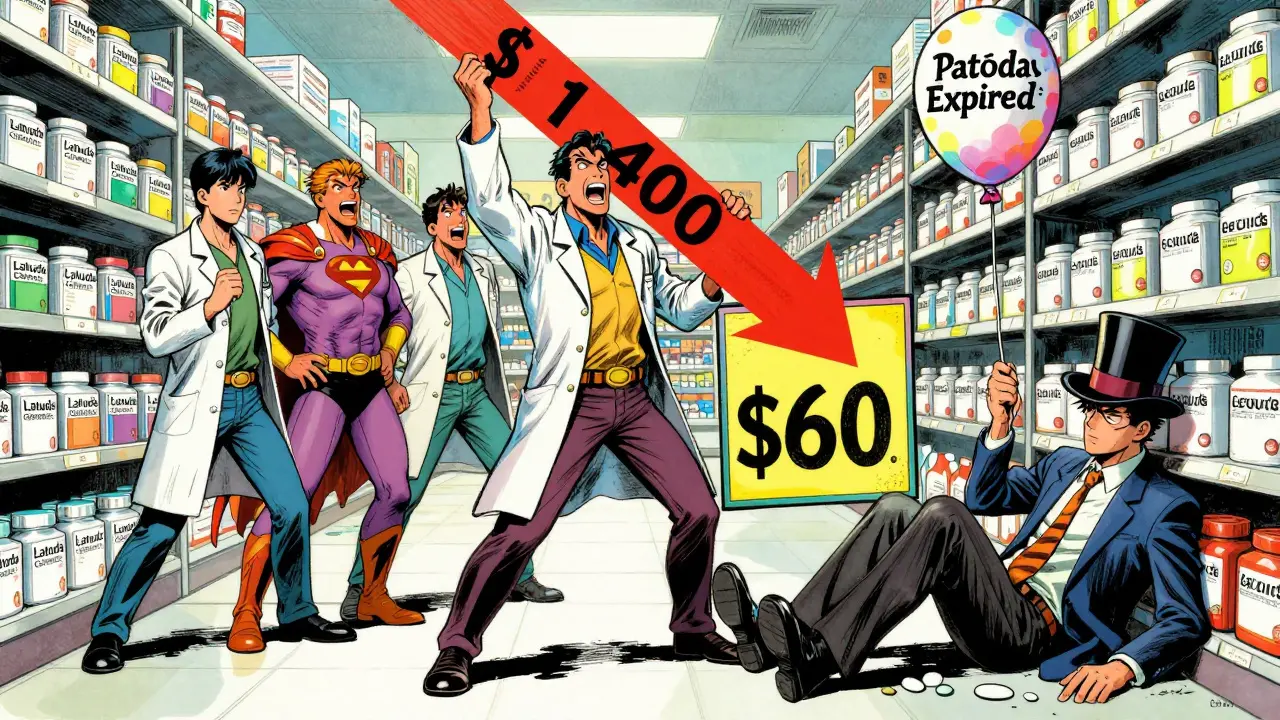
How This Saves Patients and Insurers
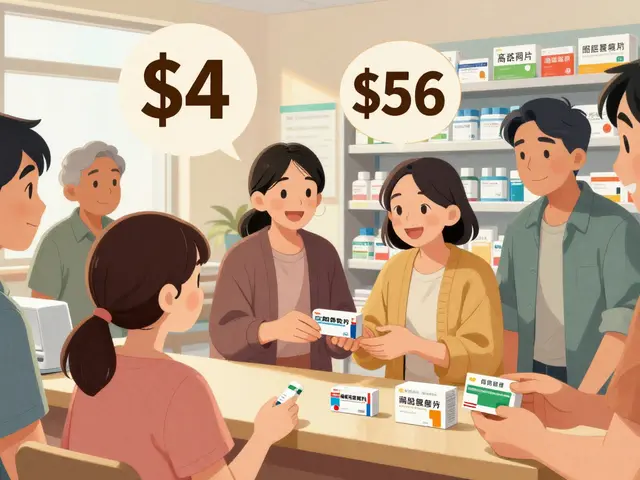
In 2022 alone, generic and biosimilar drugs saved the U.S. healthcare system $408 billion. That’s money that didn’t go to drug companies - it went back into patients’ pockets and insurers’ budgets. For patients, the average copay for a generic is $6.16. For a brand-name drug? $56.12. That’s nearly nine times more. And 93% of generic prescriptions cost under $20. Only 59% of brand-name prescriptions do. If you’re on a high-deductible plan, paying cash for a generic can be even cheaper than using insurance. A 2023 Reddit survey found 78% of people with high-deductible plans saved more by paying out-of-pocket for generics than using their insurance. Insurers benefit too. Lower drug costs mean lower premiums over time. Medicare and Medicaid saved billions because generics keep overall spending down. Without generics, healthcare costs would be unaffordable for millions.Not All Generics Are Created Equal
Here’s the catch: not every generic is cheap. Some are surprisingly expensive - even more than others in the same category. A 2022 study in JAMA Network Open found 45 high-cost generics that were 15 times more expensive than other, equally effective alternatives. Why? Because of something called “spread pricing.” Pharmacy benefit managers (PBMs), who negotiate drug prices for insurers, sometimes profit from the difference between what they pay pharmacies and what they charge insurers. If they push a slightly more expensive generic onto a formulary, they pocket the difference. That’s why you might see a generic that costs $40 when another version of the same drug costs $8. It’s not about the medicine. It’s about the business deal behind the scenes.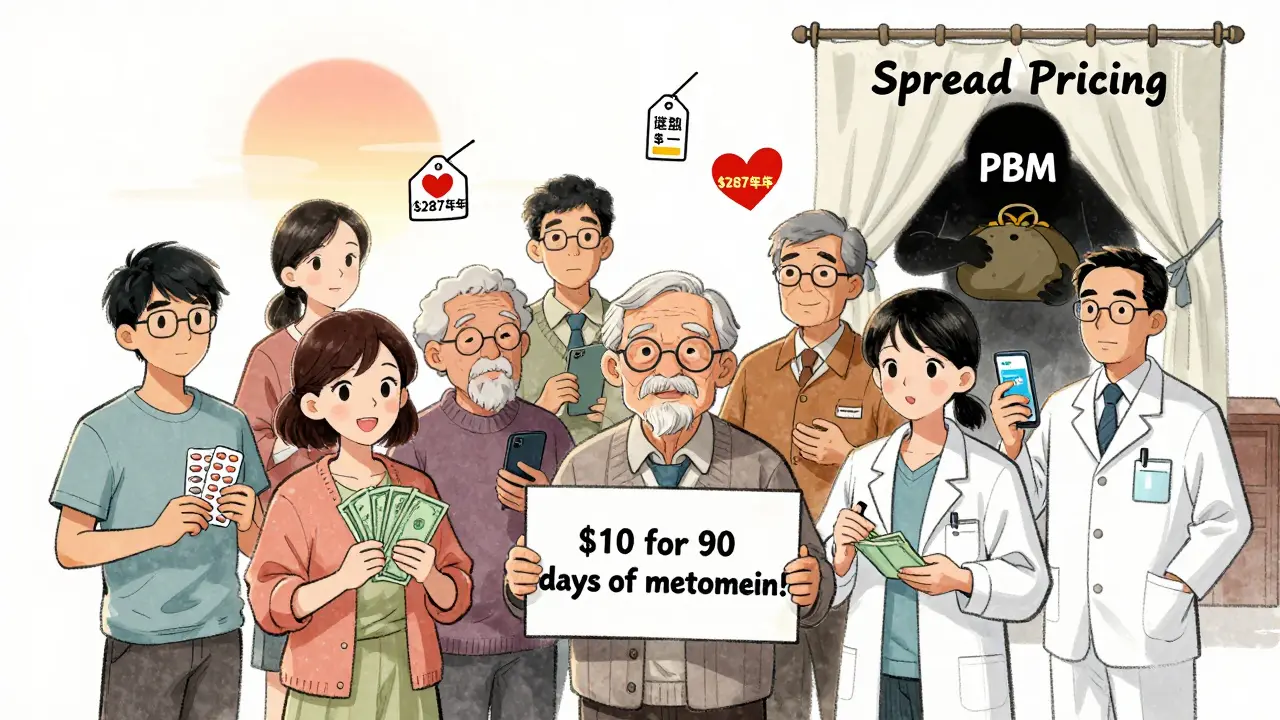
How to Get the Best Deal on Generics
You don’t have to guess which generic is the cheapest. There are tools to help.- Ask your doctor to write “dispense as written” on your prescription - that lets your pharmacist choose the lowest-cost generic.
- Use free apps like GoodRx or SingleCare. They show you prices at nearby pharmacies. For depression meds, users see an average 67% discount. For blood pressure drugs, it’s 58%.
- Try mail-order pharmacies for maintenance meds like cholesterol or diabetes drugs. Many offer 90-day supplies for less than a 30-day retail price.
- Compare cash prices vs. insurance. Sometimes paying cash is cheaper, especially if you have a high deductible.
What’s Next for Generic Drugs?
The future looks promising. The FDA approved over 700 new generic drugs in 2022. More are coming as blockbuster drugs like Humira and Enbrel lose patent protection. Biosimilars - generic versions of complex biologic drugs - are expected to save another $150 billion by 2027. But challenges remain. Some generic drugs are at risk of shortages, which can spike prices. And regulators are still investigating “pay-for-delay” deals, where brand-name companies pay generic makers to delay entering the market. These practices hurt patients and inflate costs. Still, the bottom line hasn’t changed: generics are the most powerful tool we have to make medicines affordable. They’re not a compromise. They’re the smart choice.Real Savings, Real Impact
If you’re taking a daily pill for high blood pressure, diabetes, or depression, chances are you’re on a generic. And if you’re paying full price for it, you’re leaving money on the table. You don’t need to be a healthcare expert to save hundreds a year. Just ask. Compare. Choose. It’s that simple.Generic drugs don’t just cut costs. They make treatment possible for people who otherwise couldn’t afford it. That’s not just economics. It’s healthcare justice.
Are generic drugs as safe and effective as brand-name drugs?
Yes. The FDA requires generic drugs to have the same active ingredient, strength, dosage form, and route of administration as the brand-name version. They must also meet the same strict standards for quality, purity, and stability. Studies show generics work the same way in the body and produce the same clinical outcomes. Over 90% of prescriptions in the U.S. are for generics because they’re proven to be just as safe and effective.
Why is my generic drug more expensive than another version of the same drug?
Some generic drugs cost more due to practices like “spread pricing,” where pharmacy benefit managers (PBMs) profit from the difference between what they pay pharmacies and what they charge insurers. This can lead to higher-priced generics being placed on formularies even when cheaper, equally effective alternatives exist. Always compare prices using tools like GoodRx - the lowest-cost generic may not be the one your insurance automatically covers.
Can I save money by paying cash instead of using insurance for generics?
Yes, especially if you have a high-deductible health plan. Many cash prices for generics are lower than your insurance copay. For example, a 30-day supply of metformin might cost $4 at a pharmacy if you pay cash, but your insurance copay could be $10 or more. Use apps like GoodRx to compare cash prices versus your insurance rate before filling your prescription.
Do all pharmacies charge the same for generics?
No. Prices can vary widely between pharmacies - even within the same city. A generic drug might cost $8 at one CVS, $12 at a local pharmacy, and $3 at a warehouse club like Costco or Walmart. Always check prices before you fill your prescription. Mail-order pharmacies and discount programs often offer the lowest rates for maintenance medications.
Are there any downsides to using generic drugs?
The main downsides aren’t about safety or effectiveness - those are identical to brand-name drugs. The real issues are availability and pricing complexity. Some generics are in short supply, which can temporarily raise prices. Others are priced higher than they should be due to PBM practices. And not all generics are available through every insurance plan. Always check your options and ask your pharmacist for the lowest-cost alternative.
Mandy Kowitz
So let me get this straight - we’re celebrating drug companies being forced to stop gouging people after their patents expire? Wow. What a miracle. Next you’ll tell me the sun rises because someone remembered to turn on the lamp.
Cassie Tynan
Generics aren’t just cheaper - they’re the ultimate middle finger to corporate greed. You want to know why healthcare feels broken? It’s because we let profit dictate who gets to live. Generics? They’re justice in pill form.
Stephen Craig
Metformin at $4. Cash. No insurance needed.
Justin Lowans
The systemic efficiency of generic drug adoption is one of the most underappreciated triumphs of modern pharmacoeconomics. The reduction in per-capita pharmaceutical expenditure, coupled with improved adherence rates due to affordability, represents a virtuous cycle that benefits public health outcomes at every socioeconomic level. It’s not merely cost-cutting - it’s health equity engineered through regulatory foresight.
Roshan Aryal
USA thinks it’s so smart with generics but in India we’ve been making them for decades cheaper than your coffee. You pay $500 for a drug we make for $2.50 and ship globally. Your ‘innovation’ is just patent trolling with a white coat. Your system isn’t broken - it’s designed to bleed you dry.
Doreen Pachificus
I’ve noticed my blood pressure med changed from a white oval to a blue triangle and my pharmacist said it’s the same thing. But I still feel weird about it. Is that just me?
Catherine HARDY
Did you know that some generics are made in the same factories as the brand-name versions? The only difference is the label. The FDA doesn’t inspect every batch. They just trust the paperwork. And now they’re saying it’s ‘just as safe’? I’m not buying it. Not anymore.
Rory Corrigan
Generics are the only thing keeping me alive. I take 5 meds. 4 are generics. The fifth? Still brand-name. Insurance says ‘no coverage.’ So I skip it. I’m not brave. I’m just poor. 😔
Ethan Purser
You think this is about saving money? No. It’s about control. The same people who own the brand-name drugs own the PBMs. They let the generics in - just enough to look good - but they jack up the price on the ones they control. It’s not capitalism. It’s a rigged game where the house always wins. You’re not saving money. You’re being manipulated into thinking you are.
Jason Stafford
They say generics are the same. But have you ever read the inactive ingredients? Fillers. Binders. Dyes. Some of those are linked to inflammation, thyroid disruption, even neurological issues. The FDA doesn’t require them to test those the same way. You think it’s safe? You’re just lucky so far.
Charlotte N
I used GoodRx for my antidepressant and saved $180... but then my insurance denied it next month because they switched to a different generic... why do they do this... I’m so tired...
Connor Hale
Generics are the quiet revolution. No parades. No headlines. Just millions of people breathing easier because they can afford to keep taking their medicine. We don’t need heroes. We need systems that don’t punish illness.
Jack Wernet
As someone who has worked in global health policy, I can attest that the expansion of generic access has been one of the most significant advances in reducing mortality from chronic disease in low- and middle-income countries. The principles outlined here are not merely economic - they are moral imperatives.
Michael Rudge
You people act like generics are some kind of heroic victory. Meanwhile, the same companies that made billions off the brand-name drug now own the generic version through subsidiaries. You didn’t beat the system. You just got handed the same cake, but with less frosting - and you’re thanking them for the crumbs.